
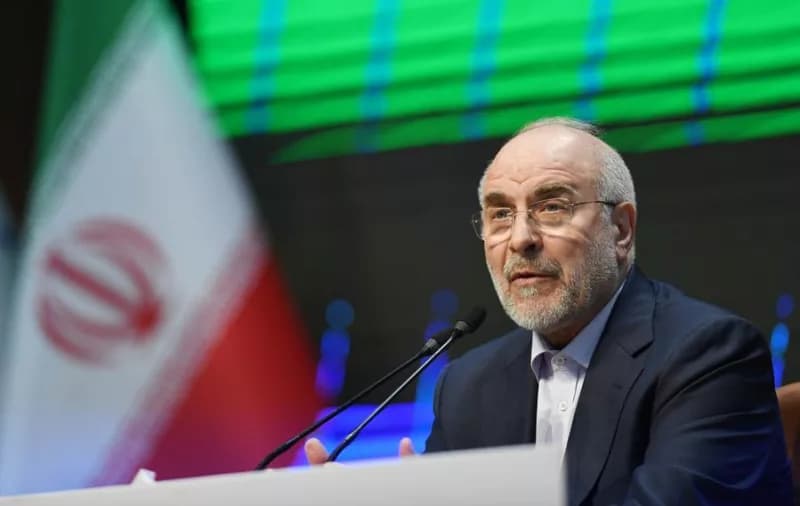
Iran's chief negotiator in talks with the US has said that Americans have "said NO TO WAR", after President Trump's Republican Party suffered defeat in midterm
Mohammed Bagher Ghalibaf said Iran "endorsed" the message sent by American voters./XINHUA

"We endorse this message," parliament speaker Mohammed Bagher Ghalibaf wrote on X.
"If the US [government] betrays their public will to serve international paymasters and blackmailers, it will learn our NO comes with a Nightmare," he warned.
Trump acknowledged on Tuesday that the poor results for Republican congressional candidates were partly due to the war and the related surge in petrol prices. But he insisted that he did not regret launching a joint attack with Israel on Iran in February.
In an interview with Fox News, Trump said of the midterm results: "I think a part of it was Iran".
He went on to say: "People agree with what I'm doing on Iran but they really probably weren't willing to do the short-term consequences of paying more for gasoline - I understand that."
Speaking separately to the BBC's US news partner, CBS News, Trump said the conflict would end "when I say it ends".
In recent weeks, the president has warned that the US and Israel could return to all-out war after the midterms if a deal to end the conflict cannot be reached with Iran.
Also on Wednesday, Iran's Islamic Revolutionary Guard Corps (IRGC) said four oil tankers caught fire after hitting naval sea mines in the Strait of Hormuz.
The IRGC said two of the vessels were still burning, and two additional tankers had been intercepted, according to the semi-official Tasnim news agency. It said they were trying to travel through a prohibited southern route in the Strait of Hormuz.
The BBC has not independently verified the IRGC's claims.
The UK Maritime Trade Operations (UKMTO) centre said a tanker was struck by two unknown projectiles about 14 nautical miles (26km) north-east of Limah, in Oman's Musandam peninsula, on Tuesday evening. No casualties were reported, it added.
On Monday, an Indian crew member of a dhow - a wooden sailing boat - was killed in an attack north-east of Limah. Thirteen other crew members were rescued by Omani authorities.
The IRCG also reported on Wednesday that its forces had shot down another US MQ-9 drone over the Strait of Hormuz.
It made a similar claim on Monday night, when US officials said the US military had carried out limited strikes on Iran's Qeshm Island in response to the IRGC firing on a US aircraft.
In an interview with the Financial Times ahead of the midterms, Trump suggested he was happy with the state of the conflict, and that he did not consider them to be "really in a war".
When asked about what the newspaper described as "strong hints" by Israeli Prime Minister Benjamin Netanyahu that there would be an attack on Iran this week, Trump said they were "locked and loaded if we need to go, but there may be no need for it".
Indirect talks to end the conflict have been stalled for months.
President Masoud Pezeshkian maintained on Tuesday that his government had been trying to resolve the crisis "through dialogue".
"No-one will benefit from this war" if it were to resume, he warned.
He also emphasised that Iran's Supreme Leader, Mojtaba Khamenei, had granted the government powers to negotiate "issues that he had previously considered off-limits".
Iranian foreign ministry spokesperson Esmaeil Baqai said on Monday that the basis of the current indirect negotiations mediated by Qatar remained a seven-step proposal that Iran submitted in September. But he added that the proposal had been "condensed, making it possible to implement it within two days".
The Strait of Hormuz, through which a fifth of global oil and gas shipments usually pass, was effectively closed after the start of the Iran war due to Iranian missile and drone attacks on commercial vessels and the US naval blockade.
The US and Iran reached a preliminary agreement to end the war and reopen the strait in June, but it collapsed within weeks after Iranian attacks on shipping resumed and the US reinstated its blockade.
Iran insisted it would not give up some measure of control over the waterway and began targeting vessels using a southern route through Omani waters that avoids its preferred route through Iranian waters.
To keep exports flowing from Gulf Arab states, the US military has been providing protection for tankers shuttling oil through the Strait of Hormuz.

Comments
No comments yet. Be the first to share your thoughts.