
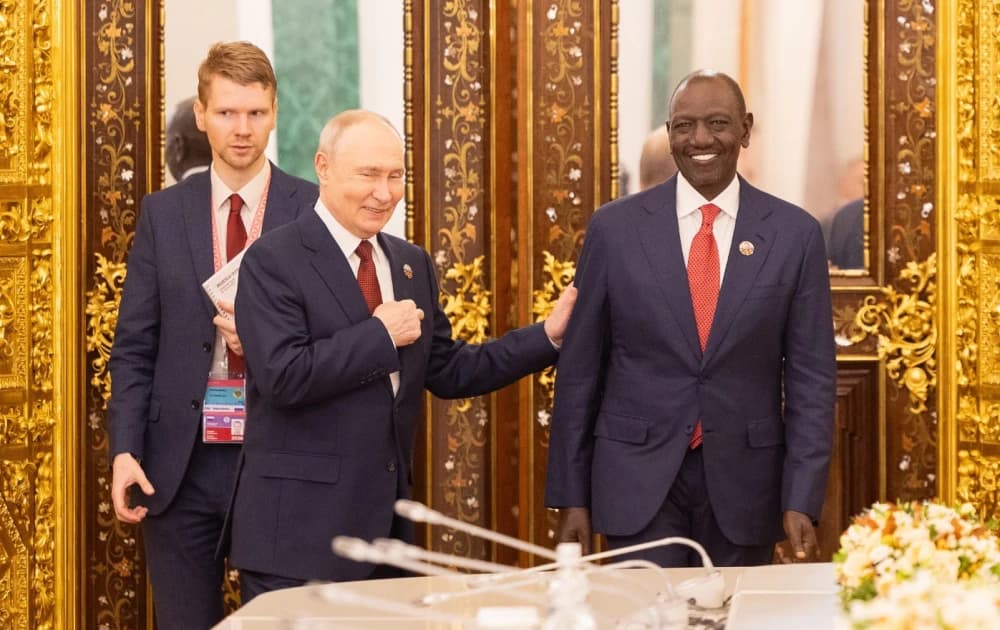
Russia's President Vladimir Putin with Kenya's President William Ruto at the Russia-Africa summit in Moscow held from October 28 to 29, 2026.
Footage showing African heads of state - including Kenya’s President William Ruto - lining up alongside other foreign dignitaries to receive traditional Russian ice cream gifted by President Vladimir Putin has ignited widespread criticism across Kenya and the broader African continent.
The video captures an unconventional moment set against the backdrop of high-stakes geopolitical engagement.
While attending events tied to the showcase summit in Moscow - such as tours and high-level forums aimed at strengthening ties between Russia and 48 African nations - an ice cream station was set up as a hospitality gesture from the Kremlin.
In the footage, several prominent African leaders can be seen waiting in line near the stand, creating a striking visual of heads of state queueing for treats handed out under the watchful eye of their host.
While the scene was likely intended to project warmth, camaraderie, and soft-power hospitality, it had the opposite effect on digital platforms.
Kenyans and citizens from other African countries took to social media to express disappointment and sharp criticism, arguing that the optics were deeply unbecoming of continental leaders.
Key themes driving the online backlash include the dignity of office, as critics argued that seeing presidents and heads of state lining up in such a manner demeans the high offices they hold, projecting an image of subservience rather than sovereign equality.
Additionally, many online commentators questioned priorities versus optics, contrasting the lighthearted queuing for snacks with serious socioeconomic and political challenges back home.
Furthermore, coming during a summit where Moscow heavily pushed its narrative as an alternative, non-colonial partner to the West, detractors viewed the scene through the lens of geopolitical posturing as symbolic of unequal power dynamics in international relations.
The summit itself was framed by Moscow as a major push for deeper economic, agricultural, and technological cooperation, with Putin emphasizing trade, grain supplies, and educational exchanges.
One X user wrote: "At a time when citizens across the continent are grappling with serious socioeconomic challenges, watching leaders line up for snacks at a foreign summit hits the wrong note. Priorities matter—especially on the global stage."
Another said: "Moscow framed the Russia-Africa summit around non-colonial partnership and equal ties. Yet, this ice cream stand subtly reinforces unequal power dynamics in international relations. Symbols speak louder than speeches."
Yet another unimpressed commenter wrote: "The optics here are just painful. Seeing our heads of state lined up like school kids for ice cream while high-stakes economic deals are on the table projects subservience, not sovereign equality. Dignity of office matters on the global stage."
African heads of state and high-level delegations gathered in Moscow from October 28 to 29, 2026, for the Third Russia–Africa Summit and Economic and Humanitarian Forum.
Hosted by Russian President Vladimir Putin, the summit brought together delegates from nearly 50 African nations - including over 20 heads of state - to strengthen bilateral ties across political, economic, and security domains.
The primary objectives of the visit focused on expanding trade, investment, food security, and technical cooperation between Russia and African nations.
Participating countries sought to negotiate broader market access for agricultural exports - such as tea, coffee, and horticulture - while securing critical imports of Russian grain and fertilizers.


Comments
No comments yet. Be the first to share your thoughts.