
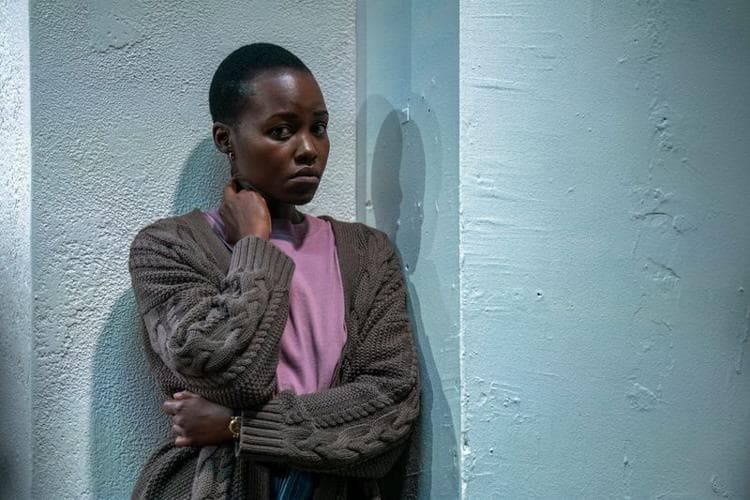
Lupita Nyong’o has never been an actor who simply occupies a stage. She changes its temperature.
In Pre-Existing Condition, Marin Ireland’s tightly constructed drama about the psychological wreckage of domestic abuse, the Oscar-winning Kenyan-Mexican actor brings a particular combination of elegance, vulnerability and controlled volatility to a woman identified only as A. The result is a performance that is as unsettling as it is magnetic and a reminder that stories about violence against women need not reduce their protagonists to victims.
At Greenwich House Theater, Nyong’o anchors a 75-minute production that moves through the aftermath of an abusive relationship with the disorientation of memory itself. A has been assaulted by her former partner. Seven months later, she is confronting the legal, emotional and social consequences of an incident she never reported to police and that occurred across state lines.
The bureaucracy is daunting. The shame is worse.
“You have to be ready for a fight,” A is told early in the play. It is less a line of dialogue than a diagnosis of the exhausting machinery survivors are expected to navigate.
Ireland, who drew from her own experience of domestic violence, refuses the conventional architecture of a victim narrative. There is no clean progression from trauma to recovery. Instead, A ricochets between anger, denial, sexual agency, embarrassment, resentment and moments of unexpected hope.
Nyong’o understands that contradiction instinctively. Her A is youthful, regal and at times almost defiantly self-assured — a woman who appears to be encountering the brutality of another person before she has fully understood its capacity to rearrange her own identity.
When she returns to dating, Nyong’o plays the encounters with an almost hypersexual confidence, making A’s attempts at reclaiming desire feel simultaneously liberating and desperate.
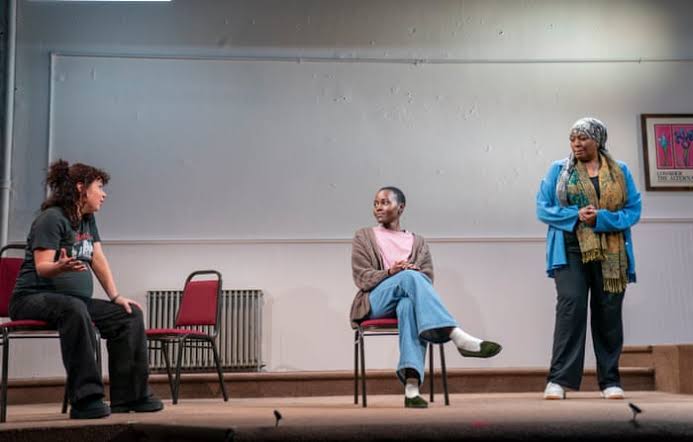
That complexity is where the production finds its power.
Three actors — Greg Keller, Dael Orlandersmith and Sarah Steele — move through an assortment of friends, relatives, counselors and social workers. Their rapid transformations create a social landscape in which even kindness can wound. Someone wants A to heal. Someone else wants her to move on. Someone means well and says precisely the wrong thing.
It is a familiar ecosystem for anyone who has watched institutions and communities struggle to respond to intimate violence.
Director Maria Dizzia wisely avoids theatrical excess. Isabella Byrd’s lighting allows scenes to bleed into one another, while Cate McCrea’s restrained set and Enver Chakartash’s understated costumes keep the focus firmly on the actors. The effect is deliberately destabilizing: people enter and exit almost like fragments of A’s consciousness.
And then there is the title.
Pre-Existing Condition points to a particularly ugly chapter in America’s healthcare history, when domestic violence could be classified by insurers as a pre-existing condition — effectively turning violence suffered by women into another reason to deny them coverage.
That detail expands the play beyond the personal. Ireland’s story becomes an indictment of systems that can transform private trauma into legal, financial and institutional vulnerability.
Yet this is not an evening built entirely from despair.
Its greatest achievement may be the tenderness threaded through the anger. Ireland and Dizzia, both actors themselves, understand performance as a communal act. The rotating casting — across generations, races, bodies and artistic identities — reinforces one of the play’s most compelling ideas: domestic violence is not confined to one kind of woman.
Nyong’o’s casting makes that argument particularly resonant.
Her presence carries the cultural weight of a performer who has moved between Nairobi, Mexico and Hollywood, becoming one of the most recognizable African-born actors on the global stage. Here, however, celebrity is deliberately stripped down. There is no red carpet, no superhero mythology, no cinematic distance. There is simply a woman trying to make sense of what happened to her.
That is what makes Nyong’o’s performance so striking.
Two years ago, the role was played by Edie Falco. Nyong’o could scarcely be more different in age, appearance, temperament, race or screen mythology. Yet both can inhabit the same character because Ireland’s writing understands something essential about trauma: its manifestations may be radically different, but its architecture is painfully familiar.
For Nyong’o, the role is another intriguing chapter in an already expansive career, one that has moved from 12 Years a Slave and Black Panther to theatre, animation and increasingly ambitious forms of storytelling.
But Pre-Existing Condition is not interested in celebrity as spectacle.
It asks what happens after the headlines, after the courtroom possibilities, after the friends have offered advice and after everyone else has gone home. What remains is a woman trying to become herself again. And Nyong’o makes that struggle impossible to look away from.
Pre-Existing Condition is playing at Greenwich House Theater in New York through Jan. 8, 2027, with a rotating cast of actors taking on the role of A.



Comments
No comments yet. Be the first to share your thoughts.