
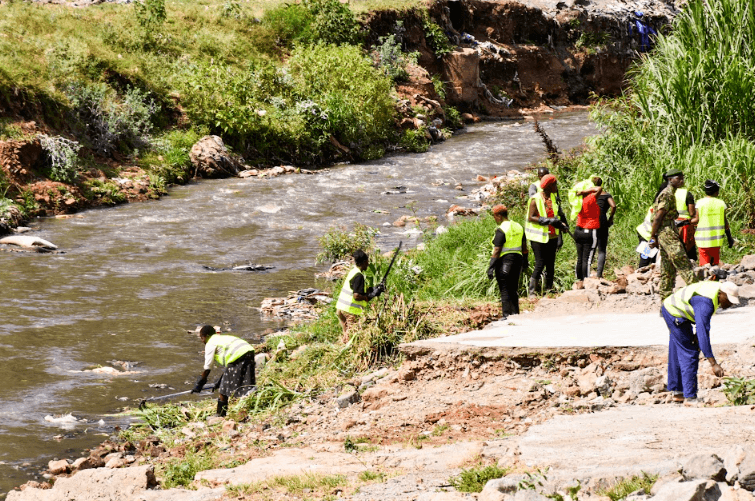
Experts at the recent Trust Summit in Nairobi said that Africa must bridge the gap between policy and implementation, strengthen public trust in science, and make environmental responsibility a shared commitment among governments, businesses, and citizens.
During a session on climate and ecological fragility, environmentalists and policymakers rooted for stronger institutional accountability, public participation, environmental education and private-sector investment to enhance climate action.
Mr. Laban Musinguzi from Uganda’s Office of the Prime Minister, SDG Secretariat, challenged governments to examine how they incentivise businesses to participate in climate action while creating an enabling environment for investment in the sector.
Musinguzi wants governments to voluntarily develop frameworks that “encourage private-sector participation and translate climate ambitions into practical, investable opportunities.”
Rose Mwabeza, Director of the Regional Office for Africa at the United Nations Environment Programme (UNEP), said environmental protection must extend beyond government policy to include individual responsibility, education and community action.
“We have not to only focus on the Government but also on the education sector. We must take responsibility for ourselves, do we recycle?” Mwabeza posed, noting that citizens have a role in demanding better environmental governance, particularly in waste management and disposal.
“As responsible citizens, it starts with us to create an environment where Governments will be forced to create order in waste disposal,” she said.
Ms. Mwabeza also cautioned that establishing recycling facilities would not, on its own, resolve the waste crisis without changes in public behaviour, effective systems and responsible leadership.
“Even if there were 100 recycling spots, there will still be garbage,” she said, challenging policymakers and investors to look beyond the environmental damage caused by poor waste management and recognise the economic opportunities in recycling and waste recovery.
“Improper waste disposal is not just a problem, but a business opportunity waiting for the right mindset and leadership,” she said.
Her remarks pointed to the potential for circular-economy businesses to create value from waste while supporting cleaner communities, provided governments establish effective systems and citizens participate in responsible disposal practices.
Mwabeza also identified declining confidence in scientific evidence as a significant obstacle to collective climate action.
“One of the challenges we have is trust in science, people are questioning whether climate change is real,” she said.
She added that UNEP’s work was grounded in trust and its commitment to people and the planet, with communities playing a central role in delivering environmental outcomes.
“UNEP’s work is based on trust. Our work is about people and planet; our trust is in the community,” she said.
Nagnouma Kone, Manager for Africa Strategy and Partnerships and Head of the Kenya Office at the Global Green Growth Institute, challenged governments to move beyond policy development and focus on implementation.
“We need to start operationalizing the beautiful policies we have. We love making them but we do not implement,” Kone said.
Her remarks show a gap between ambitious environmental commitments and action on the ground, calling attention to the need for implementation capacity, accountability and sustained political commitment.
Dr Philip Osano, Chief Operations Officer at the World Agroforestry Centre (ICRAF), pointed to another challenge: ensuring that scientific excellence translates into practical, inclusive solutions for communities affected by environmental degradation and climate change.
“There is a tension in the scientific community that science is excellent that leads to exclusion in the field,” Osano said.
His intervention raised questions about how scientific knowledge is developed, communicated and applied, particularly where communities need to be included in decisions affecting their livelihoods and environments.
Sebastian Groth, Ambassador of the Federal Republic of Germany to Kenya, emphasised the importance of scrutiny and public awareness in environmental governance.
“Sometimes what looks good on the surface is not very good if you investigate it,” Groth said, pointing to the need to look beyond appearances when assessing environmental initiatives and their outcomes.
He also linked improper waste disposal to social norms and education, reinforcing the argument that sustainable environmental practices require changes in behaviour alongside effective regulation and infrastructure.
For Africa, the challenge is not simply to develop more environmental policies or expand climate commitments, but to ensure that these translate into measurable improvements in waste management, environmental protection and community resilience.
Building trust will require governments to demonstrate results, businesses to invest in sustainable solutions, scientists to communicate evidence effectively and citizens to participate in protecting their environment.
The bottom-line is: effective climate action depends not only on what governments promise, but also on what institutions deliver, what businesses invest in and what citizens are willing to do collectively to protect the planet.



Comments
No comments yet. Be the first to share your thoughts.