
The Judicial Service Commission (JSC) has projected a Sh20.35 billion funding gap in its proposed Sh30.41 billion budget for the 2027/28 financial year and the medium-term period covering 2027/28 to 2029/30.
The Commission said it requires Sh50.76 billion to implement its identified priorities during the period, leaving a funding shortfall of Sh20.35 billion.
The proposed budget prioritizes case clearance and reduction of case backlogs, expansion of access to justice, preparations for the 2027 General Election, automation of judicial services, improvement of court infrastructure, and human resource management and development.
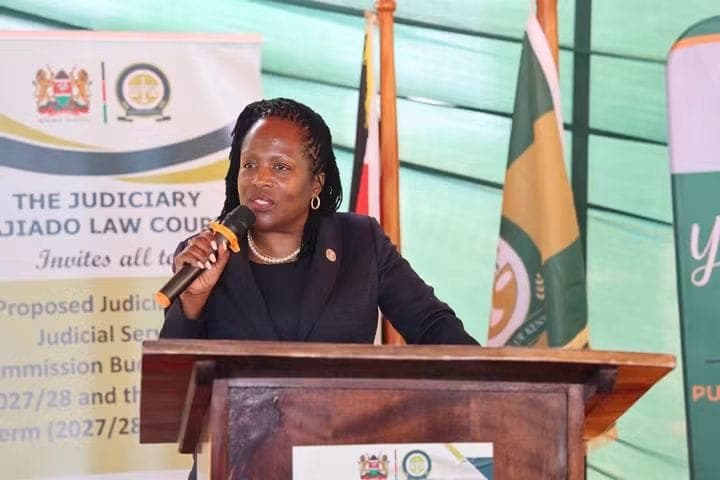
Speaking during a public participation exercise at Kajiado Law Courts, Chief Registrar of the Judiciary Winfridah B. Mokaya said the engagement provided an opportunity for the Judiciary and the Commission to account to the public, consult stakeholders, and receive feedback on the proposed budget.
Mokaya said public participation was a constitutional obligation and an important avenue for aligning the judiciary’s priorities with the justice needs and experiences of Kenyans.
She thanked members of the public and stakeholders for participating, noting that their involvement demonstrates the constitutional principle that judicial authority is derived from the people and exercised on their behalf.
“Justice is costly, and the JSC needs finances to make it accessible. The finances are paid from taxes, so it is important for members of the public to know what the judiciary has been able to do with the money,” said Mokaya.
She added that inadequate resources could make access to justice more difficult and undermine the rule of law.
Kajiado Chief Magistrate Peter Gesora said the judiciary remained committed to ensuring residents have access to justice, noting that plans were underway to improve access to courts in Namanga.
Gesora said a report on the proposed establishment of court services in Namanga would be tabled by early November.
Presiding Judge at Kajiado Law Courts, Lady Justice Christine Meoli, said efforts were also being made to ease case backlogs in Ngong by establishing a High Court.
Judiciary Director of Finance Beatrice Kamau identified several areas requiring increased funding, including 2027 General Election preparedness and dispute resolution, operationalization of new courts and establishment of sub-registries, specialised courts, court circuits, service weeks, mobile courts, scene and prison visits, special benches, mediation, court automation, and infrastructure.
Other areas include recruitment of judges, judicial officers, and other judiciary staff.
Kamau said the Commission faced inadequate funding, insufficient infrastructure to support survivor-centered and child-friendly justice, emerging challenges associated with artificial intelligence and social media, and threats to judicial independence and the safety of judicial officers.
She also cited inadequate staff and infrastructure within the Commission as well as delayed or non-compliance with court orders, which she said undermines judicial authority and public confidence.
According to the Judiciary’s non-financial performance review for the 2025/26 financial year, 561,580 cases were filed between July 2025 and June 2026, while 576,162 cases were resolved, translating to a case clearance rate of 103 per cent.
During the period, the Court of Appeal, through the Rapid Results Initiative (RRI), resolved 111 cases.
The High Courts also conducted prison decongestion initiatives in six prisons, handling 1,247 criminal matters and resulting in the release of 113 prisoners.
The Magistrates’ Courts conducted an RRI targeting uncontested succession cases, reviewing 7,068 cases, of which 1,688, representing 24.9 per cent, resulted in the issuance of Certificates of Confirmation of Grants.
The Judiciary further reported that 4,100 cases were resolved by the high courts and 283 by Tribunals as part of efforts to reduce case backlogs.
Through the Mahakama Popote initiative, judicial officers were virtually assigned matters across court stations, enabling courts with available capacity to support stations facing higher caseloads without requiring officers to relocate or litigants to travel.
The initiative saw 31,187 matters referred, with 22,516, representing 72.2 per cent, resolved.
The Judiciary also used court circuits, which are sessions designed to expedite the resolution of disputes and bring justice closer to the people. During the period, 272 circuits resolved 8,288 cases.
Court-Annexed Mediation (CAM) has also been expanded to all 47 counties, with 42 new registries established across 128 court stations.
Under General CAM, 11,630 matters were referred, 10,788 were handled, and 5,491, representing 59.9 per cent, settled. At the appellate level, 36 matters were referred, 25 finalized, and nine fully settled through settlement agreements.
The Judiciary also continued to strengthen Alternative Justice Systems (AJS), with three new County Action Plans launched in Garissa, Mombasa, and Embu, bringing the number of AJS registries to 13.
A total of 2,967 matters were referred to AJS, of which 2,334, representing 79 per cent, were handled, with 2,003 settled.
The Commission has recommended adequate and sustainable funding, enhanced budgetary allocations, and strategic partnerships to address resource gaps, strengthen digital governance, and enhance public confidence and accountability.
The measures are also expected to improve transparency, communication, and inter-agency collaboration within the justice sector.
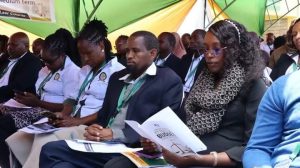
The public participation forum brought together representatives from the Office of the Director of Public Prosecutions, prisons, police, probation, children’s courts, Court-Annexed Mediation, the Alternative Justice Systems Secretariat, and members of the public.
Also in attendance was Law Society of Kenya South Eastern Branch representative Mutua J. Makau, among other court users and stakeholders.
By Joyline Arodi

Comments
No comments yet. Be the first to share your thoughts.