
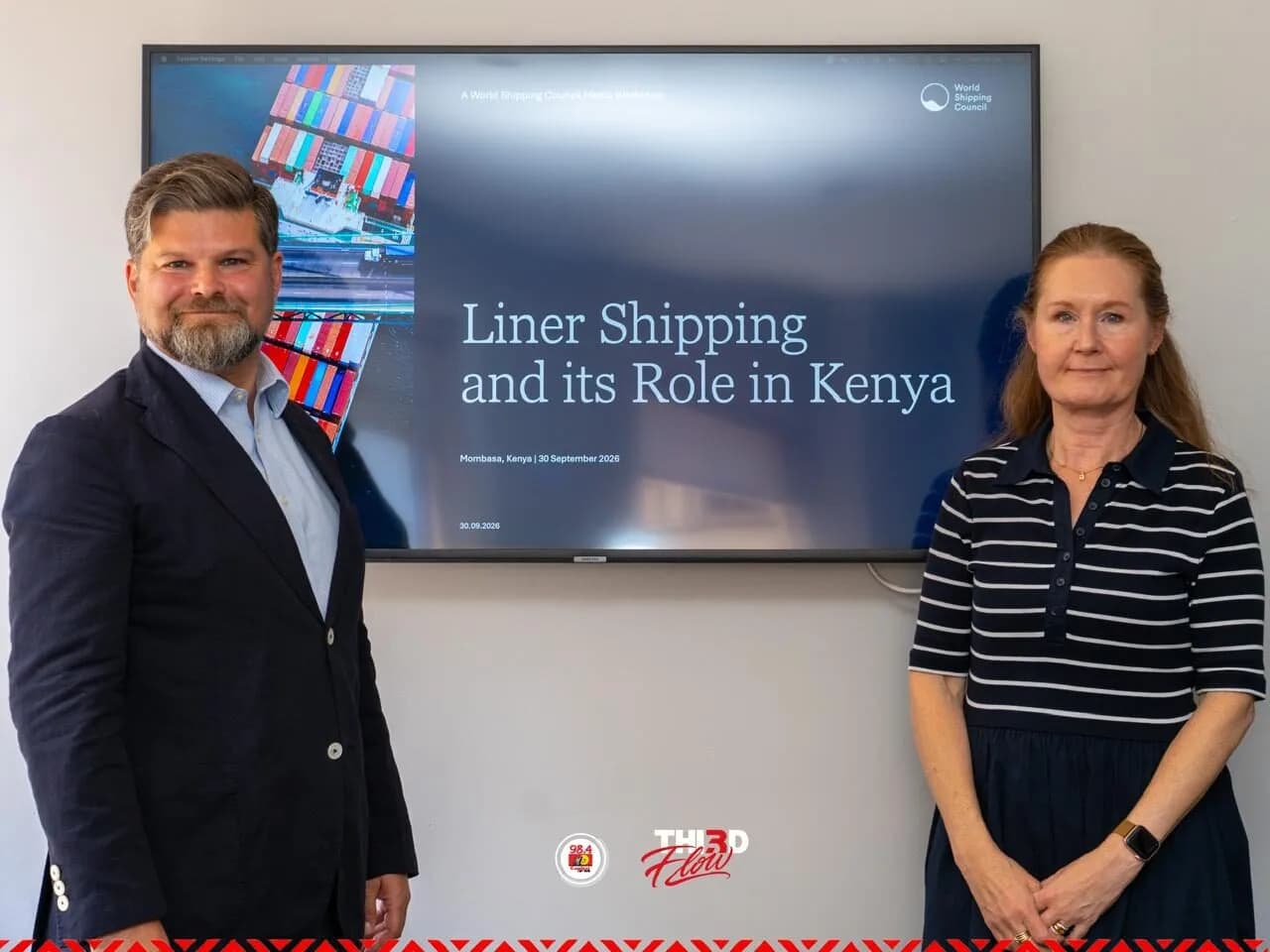
NAIROBI, Kenya, Oct 1 – Kenya could expand the economic role of its ports by positioning Mombasa not only as a regional transshipment center but also as a hub for renewable maritime fuels, the World Shipping Council (WSC) says.
The global liner shipping body says Kenya’s renewable energy potential, strategic location and growing pool of skilled young workers give it an opportunity to attract more maritime-related investment as shipping lines shift towards lower-carbon fuels.
Damian Viccars, WSC Government Affairs for Europe and Africa, said Kenya could benefit from growing efforts by shipping companies to diversify supply chains and reduce dependence on traditional trading routes.
“The role of decarbonization and working to protect the climate is also creating opportunities. And there, Kenya is amazingly well positioned with the primary energy numbers as high as 93 and 98% renewable,” Viccars said.
The WSC said new vessels are increasingly being designed to operate on alternative fuels, creating potential demand for countries capable of producing and supplying renewable energy-derived marine fuels.
Viccars said Kenya could seek to replicate elements of Singapore’s maritime model, where transshipment and marine bunkering have supported the development of a wider maritime services ecosystem.
“That means that they are then attracting talent and creating more high value jobs in maritime technology and different things like that,” he said.
Anna Larsson, Vice President for Communications at World Shipping Council said Kenya’s geographical position, renewable energy resources and young workforce could help it capture more value from changing global trade patterns, with opportunities extending beyond cargo handling.
“Kenya is ideally placed to actually pick up on many of these,” Larsson said, referring to opportunities arising from supply-chain diversification and the changing global trade environment.
“We see a lot of possibilities.”
Kenya’s ports already serve as an important gateway for East and Central Africa.
WSC data shows Mombasa and Lamu are linked by about 40 carriers to more than 80 destinations.
Mombasa handled 45.45 million tonnes of cargo in 2025, up 10.9 percent, while container traffic rose 5.5 percent to 2.11 million TEUs.
Regional transit cargo increased 19.5 percent to 15.88 million tonnes, serving markets including Uganda, the Democratic Republic of Congo, Rwanda and Tanzania.



Comments
No comments yet. Be the first to share your thoughts.