
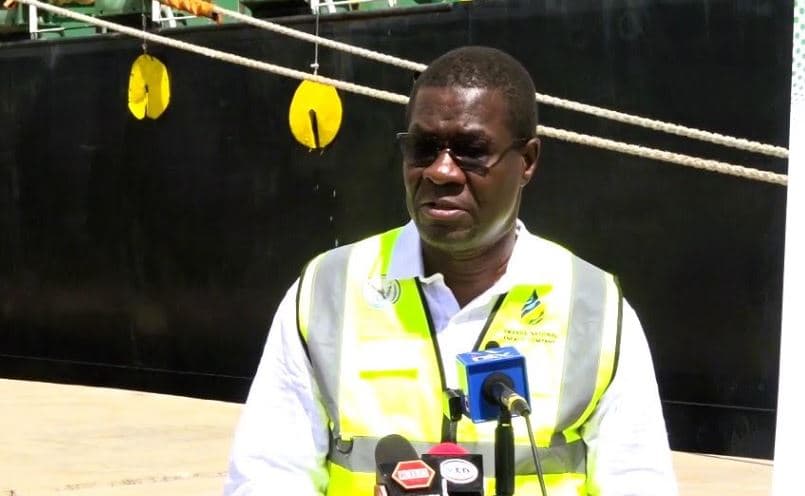
The Port of Mombasa is cementing its position as East Africa’s gateway after receiving Rwanda’s maiden shipment of petroleum products at the Kipevu Oil Terminal 2 (KOT2).
The 40,000-metric-tonne consignment arrived at KOT2 aboard the MT Sea Wolf. The reception ceremony was officiated by Cabinet Secretary (CS) for Energy and Petroleum James Opiyo Wandayi and Rwanda’s Minister of State in the Ministry of Infrastructure, Armand Zingiro.
At the Sh40 billion ultra-modern oil terminal, three vessels were simultaneously discharging petroleum products for Kenya, Rwanda, and Uganda.
Kenya and Rwanda signed a government-to-government framework on June 29, 2026, allowing Rwanda to import bulk refined petroleum products through the Port of Mombasa and the Northern Corridor. Previously, Rwanda sourced most of its petroleum products through the Central Corridor, which starts at the Port of Dar es Salaam in Tanzania.
Under the agreement, Rwanda will independently source its bulk petroleum products while utilizing Kenya’s petroleum infrastructure for transportation and storage.
The agreement marks a significant milestone in regional cooperation and energy security by establishing a structured and reliable framework for the supply, transportation, storage, and evacuation of petroleum products through Kenya’s petroleum infrastructure.
Under the partnership, Rwanda will benefit from improved access to Kenya’s petroleum logistics system, including import coordination, strategic storage, and pipeline infrastructure, enhancing the efficiency, reliability, and resilience of the country’s petroleum supply chain.
CS Wandayi termed the Rwanda shipment historic and a testament to East African Community integration, affirming that Kenya is ready to serve as Rwanda’s gateway to global energy markets and the preferred route for its petroleum imports through the Northern Corridor.
“This framework is projected to grow the volume of petroleum products moving through our Northern Corridor to Rwanda tenfold over the coming years. That is a vote of confidence, not just in a pipeline or a port, but in Kenya as a nation,” said CS Wandayi.
He added, “It cements our position as the logistics and energy transit hub of the EAC, and it is a tangible expression of the deeper economic integration we are building with our neighbours in line with the objectives of the EAC and the African Continental Free Trade Area.”
The CS lauded the Kenya Ports Authority (KPA) for efficiently discharging the cargo and ensuring it moves reliably from the vessel to shore for onward transportation through the Kenya Pipeline Corporation (KPC) pipeline and storage network.
“Together, the two institutions give Rwanda a seamless path from the port of Mombasa to its market in Rwanda and beyond. Our obligation to Rwanda is simple and firm. Kenya will provide a transit environment that guarantees the security of supply of bulk refined petroleum products over the long term,” promised the CS.
State agencies were directed to provide Rwanda-bound cargo with the operational flexibility required as volumes increase.
“It means continued government support for investment in the national infrastructure that underpins this route. This is a long-term partnership, not a one-off gesture,” stated CS Wandayi.
He noted that a secure and predictable supply of petroleum products to Rwanda supports trade, industry, and livelihoods across the EAC.
“We can no longer afford to operate in silos as member states of the EAC. It behoves all of us to work closely together, in unison, for us to be able to reap the full benefits of this integration.”
The East African Oil Refinery being built in Lamu, the CS said, will further cement Kenya’s position as an energy hub by providing refined products for the region. He further assured the Rwanda National Energy Company that Kenya will ensure the Northern Corridor delivers profitability and security of petroleum products.
Rwanda’s Minister of Infrastructure, Armand Zingiro, said Rwanda had borne the brunt of instability in the Middle East, which had affected fuel supplies, prompting a deliberate effort to diversify import routes and collaborate with regional partners.
“This framework with Kenya is the practical expression of that strategy and strengthens our energy security. This framework also supports our national effort to build strategic fuel reserves. Rwanda’s own storage capacity is being expanded, and the extended storage terms Kenya has offered us here at Kipevu give us further flexibility while that capacity comes on stream,” he said.
He reaffirmed Rwanda’s commitment to the partnership with Kenya and to the wider vision of regional integration that binds the two countries under the EAC.
“We look forward to many more vessels following in the wake of MT Sea Wolf and to an enduring relationship built on shared prosperity between Rwanda and Kenya.”
KPA CEO Capt. William Ruto underscored the significance of the agreement, noting that it signals the beginning of the port’s role in facilitating the importation of Rwanda’s refined petroleum products through the Northern Transport Corridor.
He assured Rwanda of KPA’s commitment to efficient service delivery in handling Rwanda-bound petroleum products, noting that the authority has invested heavily in infrastructure to support port operations and guarantee faster vessel turnaround times.
“Our new Kipevu Oil Terminal can handle three tankers with a 170,000-deadweight-tonne capacity simultaneously, ensuring that oil tankers can discharge efficiently and in record time, minimizing cases of delays and demurrage charges,” he said.
KPC PLC Acting Managing Director Pius Mwendwa said the corporation had invested ahead of demand, noting that KPC’s network spans 1,342 kilometers of pipeline and can transport approximately 14 billion liters of petroleum products annually.
“We have 1.138 billion liters of storage capacity and a marine loading facility at the Kisumu Oil Jetty that offers a cost-effective water route towards Rwanda,” he stated.
He noted that for more than a decade, most of Rwanda’s fuel had been transported through the Central Corridor, while Kenya’s Northern Corridor had captured barely 10 per cent of that market.
Rwanda-bound volumes through Kenya are now expected to grow from approximately 60,000 cubic metres annually to 600,000 cubic metres, representing a tenfold increase. He assured Rwanda that ongoing investments in storage, loading facilities, and pipeline capacity will ensure the additional volumes are absorbed without compromising supplies to Kenya or the wider region.
By Sadik Hassan


Comments
No comments yet. Be the first to share your thoughts.