
NCBA cuts Kenya’s 2026 economic growth forecast to 4.8 per cent amid global shocks

Global geopolitical tensions, volatile commodity prices and domestic fiscal pressures threaten growth, with the lender projecting a recovery in 2027.
Kenya’s economic growth is expected to slow to 4.8 per cent this year, down from an earlier projection of 5.1 per cent, as global geopolitical tensions, volatile commodity prices and domestic economic pressures weigh on the country’s outlook.
According to NCBA Group’s latest forecast, a combination of external shocks and fiscal constraints could undermine the country’s ability to sustain its recent economic momentum.
However, the lender expects the economy to recover in 2027, with growth projected at between 4.0 and 5.0 per cent, supported by investment, structural reforms and stronger productive capacity.
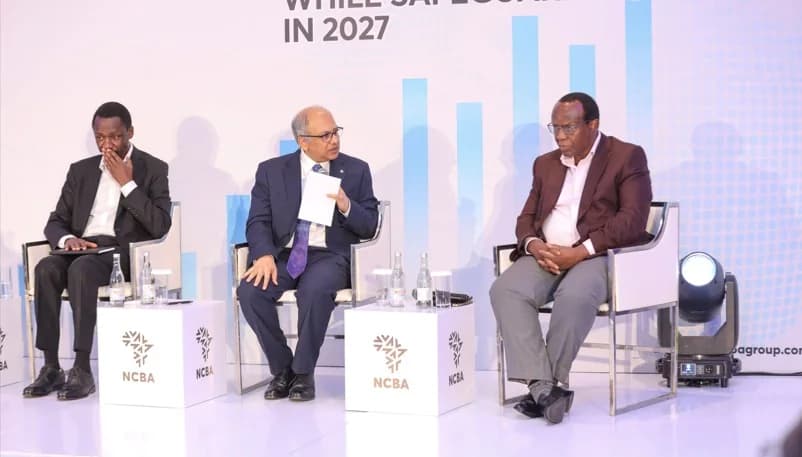
The revised outlook was unveiled on Tuesday during the NCBA Economic Forum 2026 in Nairobi.
The forum brought together Treasury Cabinet Secretary John Mbadi, World Bank Division Director for Kenya, Rwanda, Somalia and Uganda Dr Qimiao Fan, and President William Ruto’s economic adviser David Ndii, among other policymakers and business leaders.
NCBA Group Managing Director John Gachora said the economy had demonstrated resilience but warned that its capacity to withstand repeated shocks was becoming increasingly constrained.
Latest Stories
- Second body recovered from rubble as Eastleigh building rescue efforts continue
- Trump faces major test as Americans vote in crucial US midterm elections
- The livestock are gone, but a mother’s fight to feed her children in Marsabit continues
- Party factor, deep pockets and ethnic re-alignment: The high-stakes battle for Nairobi’s top job
“The year 2026 has been characterised by a convergence of shocks, including the crisis in the Middle East, the ongoing Russia-Ukraine conflict, a sudden tightening of monetary policy in several key economies and volatility in sovereign bond markets,” Gachora said.
“While our economy has remained resilient, our capacity to absorb successive shocks is not limitless. Our task is therefore twofold: to safeguard the gains made so far while accelerating growth.”
The bank attributed the subdued outlook to heightened uncertainty arising from global political tensions, commodity price fluctuations, changing weather patterns and the upcoming General Election.
Speaking at the forum, Mbadi projected stronger economic performance in 2027, forecasting growth of 5.1 per cent as the government seeks to maintain macroeconomic stability and accelerate investment.
“We project economic growth of 5.1 per cent in 2027, with inflation remaining within target and the shilling maintaining stability. Safeguarding these gains will require sustained fiscal discipline, improved revenue mobilisation and better management of public expenditure,” Mbadi said.
“We are also undertaking reforms to improve access to credit, including transparent, risk-based credit pricing anchored on KESONIA, modernised payment systems and the transformation of the Credit Guarantee Scheme to unlock more lending to SMEs.”
The Treasury Cabinet Secretary said Kenya’s economy had grown by an average of five per cent between 2022 and 2025, with inflation remaining within the target range at 7.3 per cent in October. The shilling, meanwhile, traded at an average of Sh129.9 against the dollar.
However, he warned that rising expenditure pressures, particularly domestic debt interest payments and pension obligations, continued to strain government resources, making fiscal discipline and efficient public spending critical.
Mbadi also urged banks to pass on interest rate cuts to borrowers and increase lending to businesses, farmers and micro, small and medium enterprises (MSMEs).
He noted that although the Central Bank Rate had fallen from 13 per cent in mid-2024 to 8.75 per cent, average lending rates remained relatively high at 14.4 per cent.
Meanwhile, Ndii pointed to improving performance in agriculture and manufacturing, citing increased production of milk, sugar and coffee, as well as rising vehicle registrations.
He said Kenya was tracking an investment pipeline worth approximately $45.7 billion (Sh5.9 trillion) across infrastructure, manufacturing, agriculture and ICT. The government is also pursuing a proposed National Infrastructure Fund expected to mobilise $10 billion (Sh1.3 trillion).



Comments
No comments yet. Be the first to share your thoughts.