
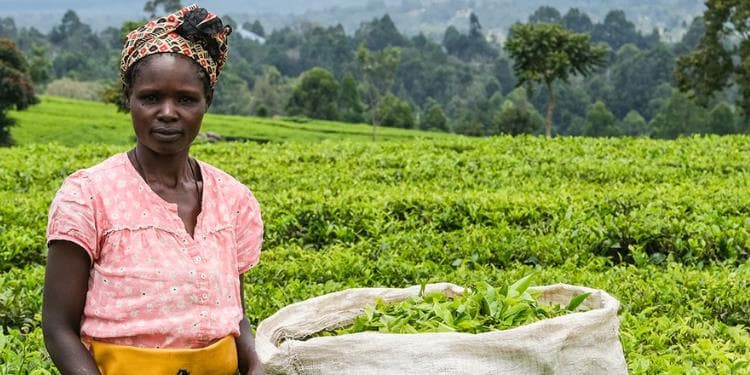
Kenya’s tea industry has recorded higher farmer payments and export earnings following a series of government reforms introduced over the past four years.
Tea export earnings increased from KSh136.5 billion in 2021 to KSh181.6 billion in 2024 and KSh186.9 billion in 2025, according to the Tea Board of Kenya (TBK).
Average green-leaf payments to farmers also rose from about KSh35 per kilo in 2021 to KSh64 in 2024 before settling at KSh56 in 2025.
The government is targeting payments of at least KSh100 per kilo by next year through improved tea quality, lower production costs, greater value addition and stronger selling channels.
Fertilizer Subsidies Support Farmers
Since 2022, more than 650,000 smallholder tea farmers have received about 290,000 tonnes of subsidized fertilizer as part of efforts to cut production costs.
The government has also spent KSh850 million modernising machinery and equipment in 17 smallholder tea factories.
Tea production increased from 537 million kilogrammes in 2021 to 598 million kilogrammes in 2024 before falling to 550 million kilogrammes in 2025.
For farmers, however, higher green-leaf prices have not removed concerns over production costs, factory debts and the level of annual bonuses.
Kennedy Kemboi, who farms seven acres in Baraton, Nandi County, said the current green-leaf price has helped him pay workers and retain some income.
“The price of green leaf per kilo has now risen to Sh26. I am able to pay the farm workers and remain with some money to meet my needs,” he said.
Kemboi said his factory is servicing a KSh1.2 billion loan, which affects the amount farmers receive from their annual bonus.
“If the declared bonus is Sh20 per kilo, we end up receiving Sh12,” he said, calling for government assistance in clearing the debt.
In Nyamache, Kisii County, farmer Teresa Moraa said tea earnings remained insufficient for many households.
“We rely mostly on our tea for income but we are unhappy. We are unable to pay school fees for our children. Our factory directors should raise the pay to at least Sh50 per kilo,” she said.
Government Increases Factory Investment
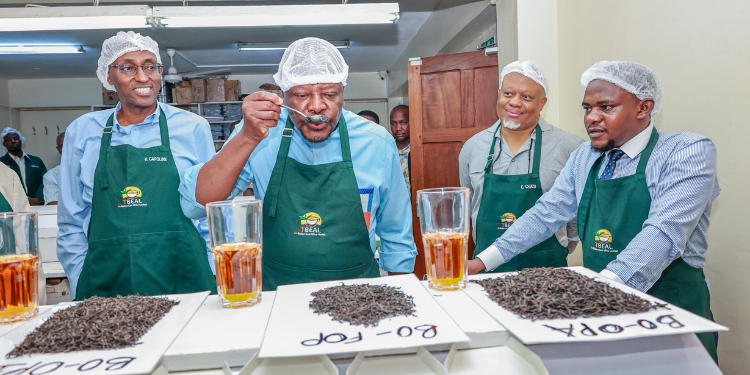
The factory modernization program is part of wider efforts to improve efficiency and the quality of Kenyan tea.
Kericho received the largest share of the KSh850 million allocation at KSh248.6 million, followed by Nyeri at KSh131.6 million and Bomet at KSh104.8 million.
Other counties that benefited included Nandi, Murang’a, Nakuru, Trans Nzoia, Nyamira, Tharaka Nithi and Kirinyaga.
The government has also introduced measures to increase the value retained from tea before it reaches international consumers.
These include removing VAT on tea purchased from factories for value addition and zero-rating packaging materials used for value-added tea.
The government also provided Ketepa with a KSh100 million grant to establish a common-user facility for tea value addition.
Kenya Expands Tea Markets
Kenya is also seeking to reduce reliance on a limited number of export destinations by promoting Kenyan tea in traditional, emerging and new markets.
These include Pakistan, Egypt, the United Arab Emirates, the United Kingdom, China, Saudi Arabia, Germany and Malaysia, among others.
Agriculture Cabinet Secretary Mutahi Kagwe said Kenya would continue strengthening existing markets while pursuing new destinations with growth potential.
“Tea is the backbone of many rural economies in Kenya. Hundreds of thousands of households depend directly or indirectly on tea for their livelihoods,” Kagwe said.
He said the government was also prioritizing quality, safety and traceability, climate resilience and reforms to the tea auction and trading system.
Industry Seeks More Value From Tea
TBK Chief Executive Willy Mutai said the government wants farmer payments to reach at least KSh100 per kilo by next year.
He said better quality, lower production costs, increased value addition and more competitive selling channels would be central to achieving the target.
The government has also gazetted new Tea Registration and Licensing Regulations and Tea Levy Regulations in 2026 to strengthen regulation of the industry.
Industry players, however, say Kenya needs to move further beyond bulk tea exports.
Robert Koech, chairman of the East Africa Tea Trade Association, said greater value was increasingly being created through brands, blends, extracts, ready-to-drink products and traceability systems.
Thushara De Silva, who chaired the organising committee of the Seventh African Tea Convention in Nairobi, said much of Africa’s tea is exported in bulk before being blended, packaged, branded and marketed elsewhere.
He called for more investment in branding, packaging, product development and distribution so that a larger share of the value created from African tea remains in Africa.
The government’s next phase of reforms will therefore focus on improving farmer returns, expanding value addition, strengthening factory governance and opening up more markets for Kenyan tea.
Follow our and X Account for real-time news updates.



Comments
No comments yet. Be the first to share your thoughts.