

Germany remains one of the most accessible and affordable routes to a serious European degree for ambitious students across Africa.
With public universities charging little or no tuition, a growing number of English-taught programmes, and a post-study work system designed to keep talent, the country continues to attract tens to hundreds of thousands of international students each year.
More than 400,000 international students were enrolled in the winter semester 2024/25, according to Daad.de, a German Academic Exchange Service. There is no enrolment cap. The 2023 Skilled Workers Immigration Act made the intention explicit: Germany wants capable graduates to stay. An 18-month job-seeker residence permit after graduation, the right to work any job while searching, and a clear route to the EU Blue Card and permanent residence are all written into law.
For students in Kenya, Ghana, Nigeria, Uganda, Tanzania, Rwanda, South Africa, Zimbabwe and elsewhere on the continent, the attraction is not difficult to understand.
The challenge is knowing where to begin.
The answer is to treat the journey as a sequence rather than a single application.
As Zoe Craydel, a senior counsellor specialising in Germany, puts it:
“The sequence is what trips people up: offer first, then the blocked account and insurance, then the visa. Do it in order and the whole thing takes a few calm months.”
Craydel helps African students find universities and courses they’re built for.
Here is how Craydel structures it for African students going to Germany — it’s their end-to-end model + Germany’s specific rules:
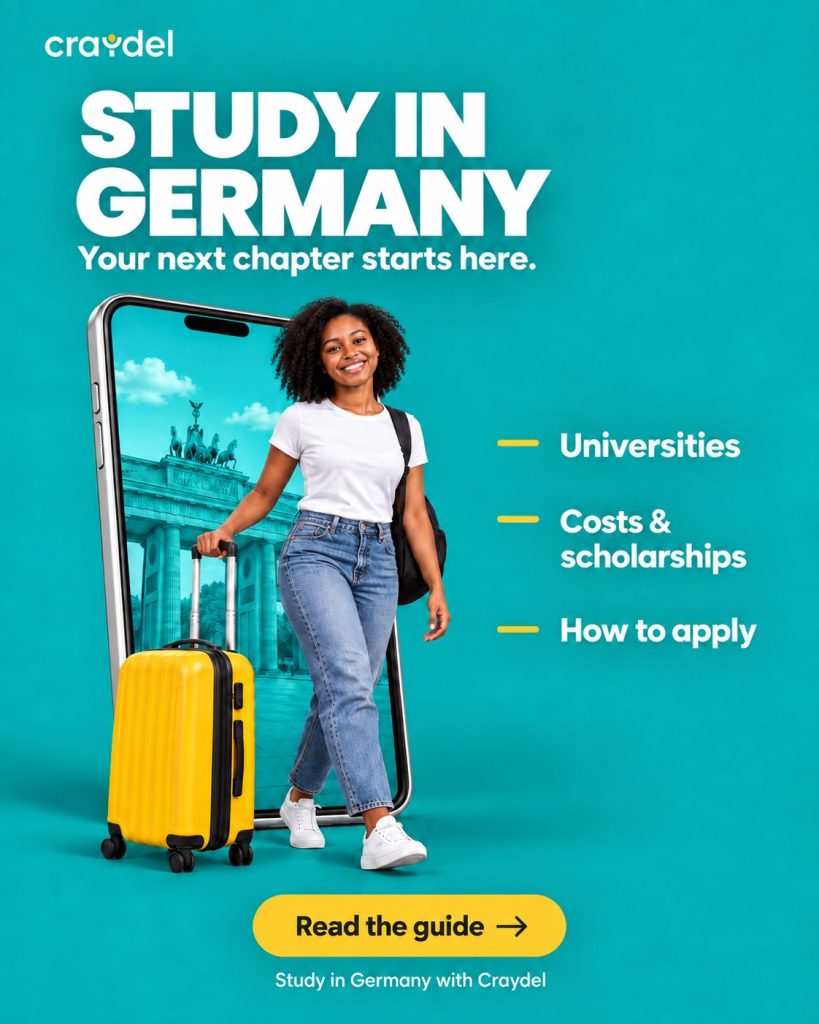
Craydel is Africa’s AI-powered study abroad platform — you discover, compare and apply free, as the platform is funded by university commissions. A modest career-match assessment tool is also available if you don’t know what to study.
Their Germany flow:
1. Discovery & Matching
On craydel.com you input KCSE / Diploma / Degree grades. Their AI filters partner universities in Germany — Constructor University, BSBI Berlin, SRH, UE, Lancaster Leipzig etc. This covers Craydel’s WunderGig competition universities too.
2. Counsellor checks your Hochschulzugangsberechtigung (HZB)
Germany needs a higher education entrance qualification. For Kenyans:
KCSE C+ is usually direct entry, below C+ = often goes to Studienkolleg (1-year prep) OR do 1 year of university in Kenya first
Higher Diploma / Bachelors = direct access for Bachelors / Masters
Craydel does the Anabin / uni-assist evaluation for you.
3. Choose program + language route
English-taught: IELTS 6.0-6.5, TOEFL 80+, many private universities accept Duolingo/MOI
German-taught (mostly public no-tuition): TestDaF 4, DSH-2, Goethe C1 — takes 8-12 months to learn
Craydel shows you the full cost upfront: tuition + living + visa — no surprises later
4. Documents & Application
Documents typically include legalised transcripts, language test, a motivation letter, CV and references. Craydel submits and tracks.
5. Funding proof
You need proof of €11,208 per year — deposited in a blocked account. In 2026 the required amount is now €11,904 at most embassies. You get your Zulassungsbescheid (admission letter) and use it for the visa.
6. Visa at German Embassy Nairobi
National student visa if you have admission, or study-application visa if still applying. Required: admission letter, blocked account, health insurance, passport. Apply at least 3 months early.
Enrollment in Germany
After arrival: pay semester fee (~€300-400, includes transport ticket), do Anmeldung within 14 days, get TK/AOK health insurance — mandatory before enrollment, get Immatrikulationsbescheinigung.
Anmeldung is the mandatory legal process of registering your residential address with local authorities in Germany.
Immatrikulationsbescheinigung is an official certificate of enrollment issued by a German university or higher education institution. It proves that you are actively registered as a student for a specific semester.
Why the numbers still favour Germany
Public universities remain free of tuition in almost every state. Engineering, computing and applied sciences programmes feed directly into employers such as Siemens, Bosch, BMW and SAP. Starting salaries for mechanical and electrical engineers commonly sit between €45,000 and €55,000; IT specialists often range higher. Living costs in Leipzig or Bremen hover around €900–1,100 a month, helped by student canteens and the transport ticket included in the semester contribution.
English-taught options remove the immediate language barrier. Those who later add German open still more doors, including faster routes to settlement.
Germany Study Abroad agent in Kenya: Craydel contacts
Craydel’s main headquarters is located at The Pavilion, 1st Floor, Lower Kabete Road in Nairobi, with phone contacts +254 799000444 (and email info@craydel.com), and within Kenya, they are also available in Mombasa and Eldoret, while internationally Craydel operates offices across multiple countries including Nigeria, Uganda, Zimbabwe, Rwanda, and Burundi.
At a glance
* Study in Germany: Choose a recognised programme and university that fit your academic profile.
* Intakes: October is the main winter intake; some programmes also admit students in April for the summer semester.
* English: English-taught programmes are available, but language requirements vary by institution.
* Academic eligibility: Your qualification must provide the required German higher-education entrance route. KCSE, A-Level, ACSEE, UACE and ZIMSEC qualifications may lead to different pathways depending on the applicant and programme.
* Funds: For 2026, the standard blocked-account figure for student visa financial proof is €11,904, or €992 per month.
* Visa: Non-EU students normally need the appropriate national student visa before travelling for long-term study.
* After graduation: Eligible international graduates can generally receive up to 18 months to search for qualified employment in Germany.
* Timing: From the first shortlist to a visa decision, allow several months and begin well before the intended intake.
* Germany study abroad agency: Craydel Africa
Germany is not a shortcut.
It is something more useful: a route.
Success as you apply.
Read Also: New Tobacco Law to regulate Electronic Cigarettes to Undergo Public Scrutiny


Comments
No comments yet. Be the first to share your thoughts.