
We are living in an era where Climate Change is a reality. This phenomenon has been brought about mainly from pollution from industries and motor transport, cutting down trees which act as carbon sinks, among others.
Consequently, the world is moving from fossil energy to power transport and machines to more environment friendly sources of energy. Thus the world is now moving to electric transport such as electric motorcycles, trains, vehicles and tuktuks.
The origin of electric tuktuks is an evolution that bridges 19th-century human-powered transit with modern, eco-friendly engineering. While traditional internal combustion tuktuks got their name from the signature “tuktuk” noise of their loud, single-cylinder engines, their modern electric counterparts have emerged over the last few decades as a solution to urban air and noise pollution.
Electric tuktuks in Kenya offer significantly lower operating and maintenance costs than fuel-powered ones, though they require a higher initial purchase price and depend on charging or battery-swapping infrastructure.
Tuktuks running on petrol or diesel costs roughly Sh4.4 to Sh. 5.3 per kilometer, depending on pump prices. Research has shown operators often spend Sh1,500 to Sh2,000 daily on fuel. Electric tuktuks are battery-powered three-wheelers transforming urban public transport in Kenya by replacing noisy, polluting petrol and diesel models with quiet, eco-friendly rides.
Drivers of electric tuktuks on the other hand save significantly on fuel and maintenance, as charging or swapping batteries is cheaper than buying petrol.
They produce no tailpipe exhaust, helping cities cut down on carbon and noise pollution. Electric powertrains vibrate less and offer a more comfortable experience for both passengers and drivers.
Electric tuktuks are rapidly transforming urban and coastal transport in Kenya by offering quiet, zero-emission, and cost-effective rides.
Exact official numbers for electric tuktuks alone in Kenya are not explicitly broken out in national registry data, but the broader market is growing rapidly within a total national electric vehicle (EV) count exceeding 35,000units.
Kenya’s electric three-wheeler (tuktuk) market is estimated at 5,000 to 8,000 units annually, growing at over 25 per year. This is according to data from the National Transport and Safety Authority (NTSA).
The country has seen rapid Electric Vehicle (EV) adoption, climbing from roughly 1,200 vehicles in 2023 to more than 35,000 electric vehicles (largely driven by two- and three-wheelers whose adoption is heavily concentrated in coastal and urban tourist zones like Mombasa (which hosts nearly 15,000 total tuk-tuks transitioning toward electric), Dianna, Nairobi, Malindi, and Kisumu.
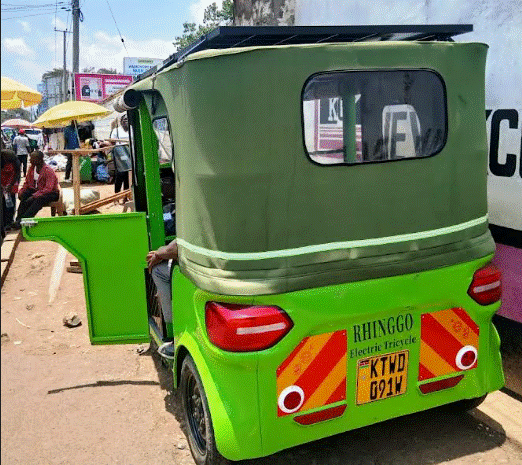
On the busy streets of Kisumu, a new kind of tuk-tuk green in colour is catching the eyes and ears of residents. It passes without the familiar roar of an engine or a cloud of exhaust smoke.
Electric tuktuks are expanding rapidly in Kisumu, offering a cleaner, quieter and cheaper alternative to traditional petrol-powered three-wheelers via providers like RhingGo e-mobility.
Commercial electric tuktuks were officially launched in Kenya in February 2024 when automotive company Car and General unveiled the Piaggio Apé Electrik models.
By April and August 2026, major brands like Rhinggo officially launched electric three-wheelers in Kisumu, introducing passenger, cargo and even electric ambulance models to western Kenya.
Kisumu has quickly become a key hub for electric mobility in western Kenya, with several dealers establishing physical showrooms, operations and battery-swapping infrastructure in the lakeside city.
An electric tuktuk operates on a simple, efficient battery-powered electric drivetrain that replaces the internal combustion engine, fuel tank and exhaust system of a traditional petrol model.
Its core components include a lithium-ion battery pack, which stores electrical energy and is mounted under the passenger seat to keep the centre of gravity low; an electric motor, which uses magnetic fields powered by the battery to spin and turn the wheels, providing instant rotation for quick and smooth acceleration even when carrying heavy loads.
Rhinggo e-tuktuks are priced at around Sh380,000, with financing options such as Lipa Polepole deposits starting at around Sh38,000 and daily payments. The vehicles can travel about 120 kilometers on a full charge.
Charging a battery costs roughly Sh700 to 800 per day, compared to Sh1,500–2,000 spent daily on petrol for conventional models, while maintenance costs are cut by over 50 per cent since there is no engine oil, spark plugs or fuel filters.
In Kisumu, operators use two models. Under battery swapping, drivers pull into a designated station like the Rhinggo Kisumu Hub on Obote Road next to KCB Kisumu West or the e-Safiri Charging Station on Oginga Odinga Road, where a depleted battery is swapped for a fully charged one in under two minutes for a small fee.
Under plug-in charging, some models are plugged directly into a standard 240V wall outlet at home or a depot overnight, taking four to six hours to reach full charge.
Peter Omollo, who has driven both petrol and electric tuktuks, says the difference is felt immediately when you sit behind the handlebars.
According to Omollo, the old tuktuk uses a petrol engine, needs fuel, engine oil, spark plugs and frequent servicing, is noisy, vibrates a lot and emits smoke.
The electric one, he explains, uses a battery and motor, has no engine oil or exhaust pipe, starts instantly, does not vibrate and moves almost silently.
“It does not vibrate like the older models. It is efficient and comfortable, especially for town service,” Omollo says.
Omollo adds that, in terms of daily operation, the old model forces drivers to spend Sh1, 500–2,000 on fuel per day, plus engine servicing, while the electric one uses about Sh700–800 on charging or swapping and needs less maintenance.
David Ochonga, an electric tuktuk driver, said he chose the vehicle after learning that its solar panel could help charge the battery.
“I was told that the solar panel at the top of the tuktuk can charge it,” Ochonga says.
However, he said he still prefers charging the vehicle normally because the battery is expensive and can easily be damaged or stolen.
Ochonga notes that the fare remains the same as that charged by petrol-powered tuktuks, allowing passengers to enjoy the new technology without paying more. He added that the vehicles contribute to a cleaner environment because they produce neither smoke nor engine noise.
For passengers, the ride itself stands out. Jane Akinyi, a regular customer, said the electric tuktuk provides a smoother and more comfortable ride.
“As a regular customer, I can say this is better. The ride is smooth, it is not shaking and the driver is not in a hurry to buy fuel. It is very comfortable,” she says. Brian Nyongesa, another customer, says he previously avoided tuk-tuks because of the noise and fumes but now prefers the electric version.
“I used to avoid tuktuks because of the noise and smoke, but now I use the electric tuktuk because it is quiet and clean,” Nyongesa said.
While the comfort is clear, operators say the real shift is in sustainability and daily savings. With no tailpipe emissions, the e-tuktuks help reduce air pollution around busy areas such as Kisumu Main Bus Park and Oginga Odinga Street.
Their near-silent operation also reduces noise pollution, which is a major concern for traders and residents in the central business district.
However, drivers admit there are still hurdles to full adoption. Most charging and swapping stations are still concentrated in central Kisumu, making it difficult to operate in the outskirts.
The lithium-ion batteries also degrade slowly over time, and replacement is expensive unless a driver is on a battery-as-a-service subscription where the provider owns the battery. For those using home charging, the four- to six-hour wait can affect work hours if not planned overnight.
Despite these challenges, the numbers are convincing many young drivers to make the switch. With fuel prices remaining unpredictable, saving up to Sh. 1,000 daily on energy costs means more money remains at home at the end of the day.
The availability of flexible financing has also opened the sector to more youth who previously could not afford second-hand petrol tuktuks.
For drivers like Ochonga and Omollo, it is not just a new vehicle; it is a new way of doing business no queues at the petrol station, no oil-stained hands.
And for passengers like Akinyi and Nyongesa, the journey is no longer noisy and bumpy, but sitting back and enjoying the ride.
As more of these silent three-wheelers glide through Kisumu, the city’s streets are telling a new story — one of clean energy, one trip at a time.
by Mabel Keya- Shikuku / Adhiambo Yvonne and Amanda Ijai Wamalwa



Comments
No comments yet. Be the first to share your thoughts.