
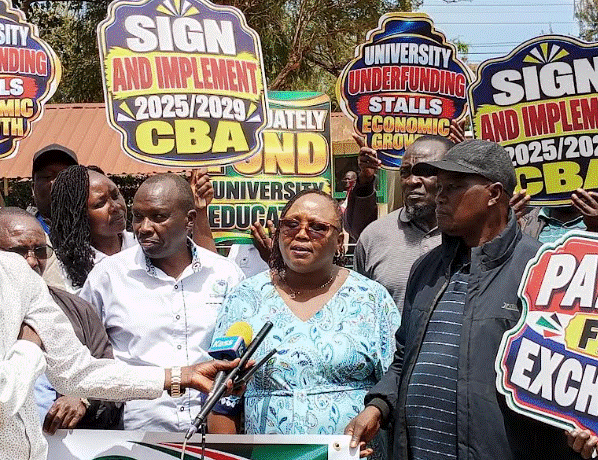
Lecturers at the University of Eldoret and Moi University have joined a nationwide strike by public university academic staff, demanding the implementation of the 2025-2029 Collective Bargaining Agreement (CBA) and payment of their salaries through the Exchequer.
The two Universities Academic Staff Union (UASU) chapters said they would remain on strike until the government addresses their concerns, including the conclusion and implementation of the 2025-2029 CBA, which they said had remained unresolved despite previous agreements.
At the University of Eldoret, UASU branch secretary Robinson Kibet said the union had rejected proposals requiring universities to rely on students’ fees to pay lecturers’ salaries, arguing that academic staff in public universities are government employees whose salaries should be funded through the Exchequer.
Kibet said the return-to-work formula agreed previously was expected to have been finalized in February 2025, but had not been implemented.
“We want to be treated like other public servants. If it is taxes, we are public servants, and if it is providing public service, we are university staff,” he said.
He said lecturers were sympathetic to students who were affected by the strike, but maintained that their grievances had to be addressed before they could return to the classroom.
UASU officials at the University of Eldoret also raised concerns over what they termed local disparities in allowances and other employment benefits.
Dr. Nyaberi Mogaka, who delivered a message from the union’s national leadership, said the University of Eldoret staff had not had some local issues negotiated since 2013.
He cited commuter allowance as one of the outstanding matters, saying some staff at the university received Sh8,000 while comparable allowances in other institutions were significantly higher.
The union also called for the government to fully fund public university education and ensure that lecturers’ salaries are paid from the national Exchequer.
At the University of Eldoret, UASU treasurer Catherine Elima said lecturers would not return to class until the 2025-2029 CBA was signed and implemented.
She said lecturers were concerned that increased dependence on student fees could eventually transfer the burden of financing university education to students and their parents.
Meanwhile, at Moi University, UASU chapter officials said they had also downed their tools in solidarity with academic staff in public universities across the country.
Moi University UASU chapter chair Prof. David Koskei said the 2025-2029 CBA had been agreed upon following reconciliation between the union and the government, with negotiations expected to have been completed within 30 days.
He said the union had submitted its proposals but accused the government of failing to conclude the negotiations.
“We are asking that salaries for lecturers and university workers, like any other government workers, must come from the Exchequer,” Koskei said.
He called for urgent intervention to prevent prolonged disruption of learning, saying lecturers would return to class if the government addressed the matter and reached an agreement with the union.
Moi University UASU officials also raised concerns over the proposed salary increment, with chapter treasurer and national trustee Jane Michael saying the union had been presented with a three per cent proposal for basic salaries.
Jane argued that the proposal did not adequately address inflation or provide for annual increments, and called for a more comprehensive offer.
She said the union had rejected what it considered inadequate terms and would remain on strike until the government made a proposal acceptable to its members.
The Moi University chapter also raised a separate local matter concerning the implementation of the 2017-2021 CBA, saying outstanding financial obligations to staff remained unresolved.
The lecturers said the local matter was distinct from the current national dispute over the 2025-2029 CBA but called for the government to address both issues.
At both institutions, the lecturers maintained that the dispute was not intended to target students, but was aimed at securing what they described as fair and sustainable terms of employment.
The union officials called on the government to resume negotiations and address the outstanding issues, saying a negotiated agreement and its actual implementation would pave the way for lecturers to resume teaching.
The strike has consequently disrupted learning in public universities, even as academic staff maintain pressure on the government to resolve the CBA dispute.
by Ekuwam Sylvester

Comments
No comments yet. Be the first to share your thoughts.