
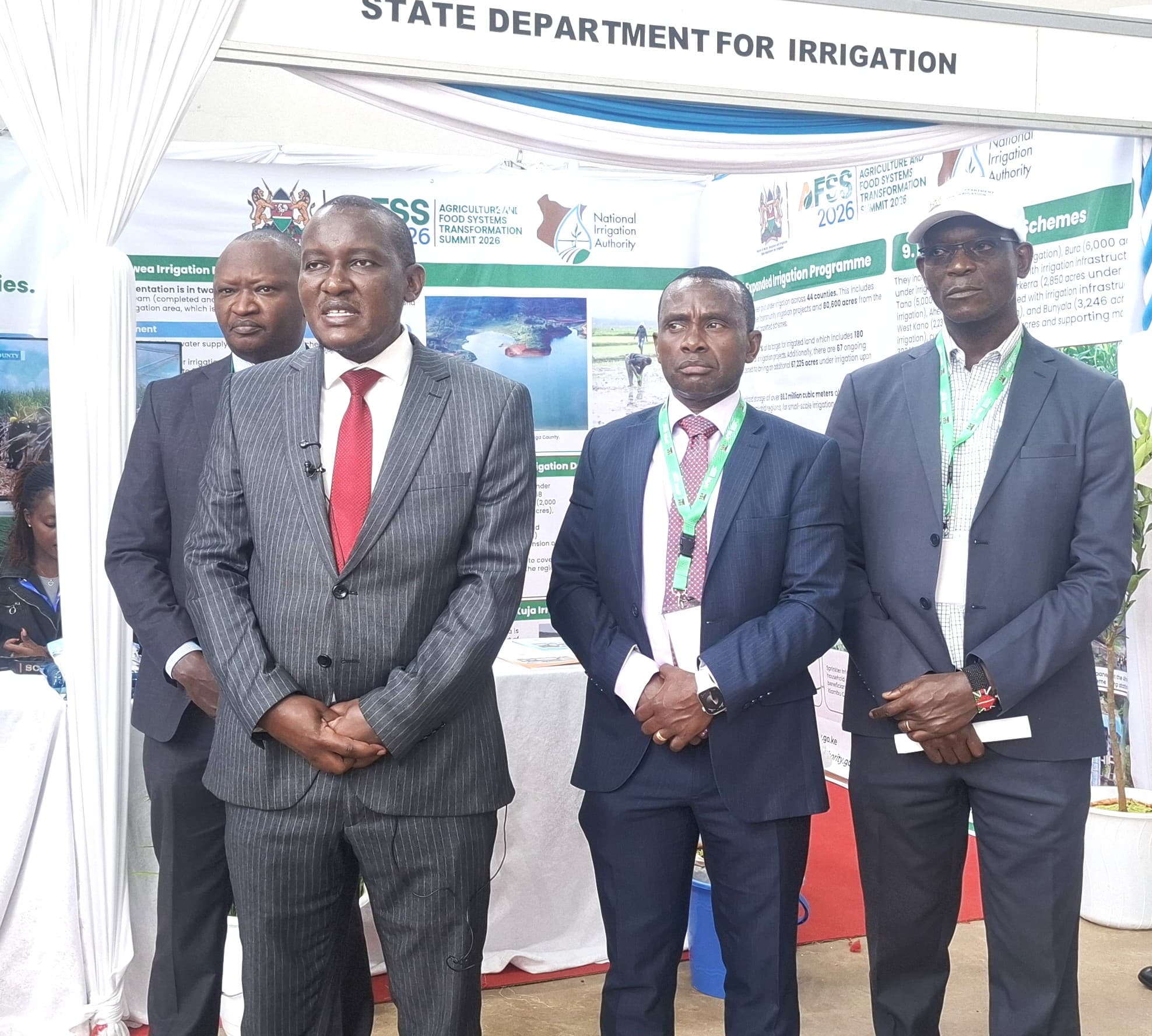
Kenya plans to bring an additional 1.5 million acres of farmland under irrigation as part of efforts to reduce reliance on rain-fed agriculture, improve food security and strengthen resilience to increasing climate variability.
Principal Secretary for Irrigation Ephantus Kimotho said irrigation, water harvesting and affordable farm technology were key to ensuring farmers have predictable access to water and achieve consistent production throughout the year.
Speaking to KNA on the sidelines of the Agriculture Summit at the Jamhuri Park ASK Showground, Kimotho said the Government had developed a plan targeting both large-scale commercial farms and smallholder farmers.
He said only about 500,000 of the 8.9 million registered farmers currently benefit from irrigation, leaving millions dependent on increasingly unreliable rainfall.
Kimotho noted that irrigation had enabled farmers to achieve more consistent production and predictable yields, urging more farmers to adopt irrigation technologies.
“We want more farmers to come on board and start using irrigation as a way to address food deficiency and achieve food security,” Kimotho said.
Under the plan, 500,000 acres will be developed through large-scale commercial irrigation projects, including Galana-Kulalu, Gura, Isiolo and Lake Baringo.
The Government is also targeting smallholder farmers through community and public irrigation schemes while expanding water harvesting in arid and semi-arid areas.
Kimotho said Kenya had added 114,000 acres to the area under irrigation over the past four years, contributing to an increase in agricultural production from 190,000 metric tonnes to 350,000 metric tonnes.
He added that the Government was investing in large dams to secure water supplies for irrigation, with 18 major dams planned or under development.
“These investments are aimed at ensuring water harvesting so that we can drive the irrigation sector,” he said.

The State Department is also promoting solar-powered irrigation through a programme designed to help individual farmers acquire solar pumps at subsidised prices and through affordable payment arrangements.
Meanwhile, Agriculture Sector Network (ASNET) representative Dr. Bimal Kantaria said irrigation should be accompanied by increased adoption of affordable technologies and mechanisation to reduce production costs and improve yields.
Kantaria said many farmers still relied on manual labour despite the availability of relatively inexpensive technologies such as drip irrigation, pivots and small handheld machinery.
He said locally manufactured drip irrigation pipes had helped reduce the cost of irrigation, while handheld machines costing between Sh50,000 and Sh100,000 could offer affordable mechanisation options for small-scale farmers.
Kantaria proposed that cooperatives and self-help groups acquire tractors and operate them as businesses at ward level, allowing farmers to hire machinery instead of purchasing their own.
“Every farmer cannot afford a tractor. We understand that,” he said, adding that banks were increasingly offering financing for farm machinery.
He said Kenya could also consider limited Government seed capital to support community-based mechanisation, with the private sector providing the bulk of financing.
Kantaria cited India, which purchases about one million tractors annually, compared with about 700 purchased by Kenya last year, as an indication of the scale of mechanisation required to transform agriculture.
“Mechanisation is the way forward for this country to reduce the cost of production and increase yields,” he said.
The Agriculture Summit, which runs for three days, is focusing on agricultural transformation, climate resilience and technology.
By Wangari Ndirangu



Comments
No comments yet. Be the first to share your thoughts.