
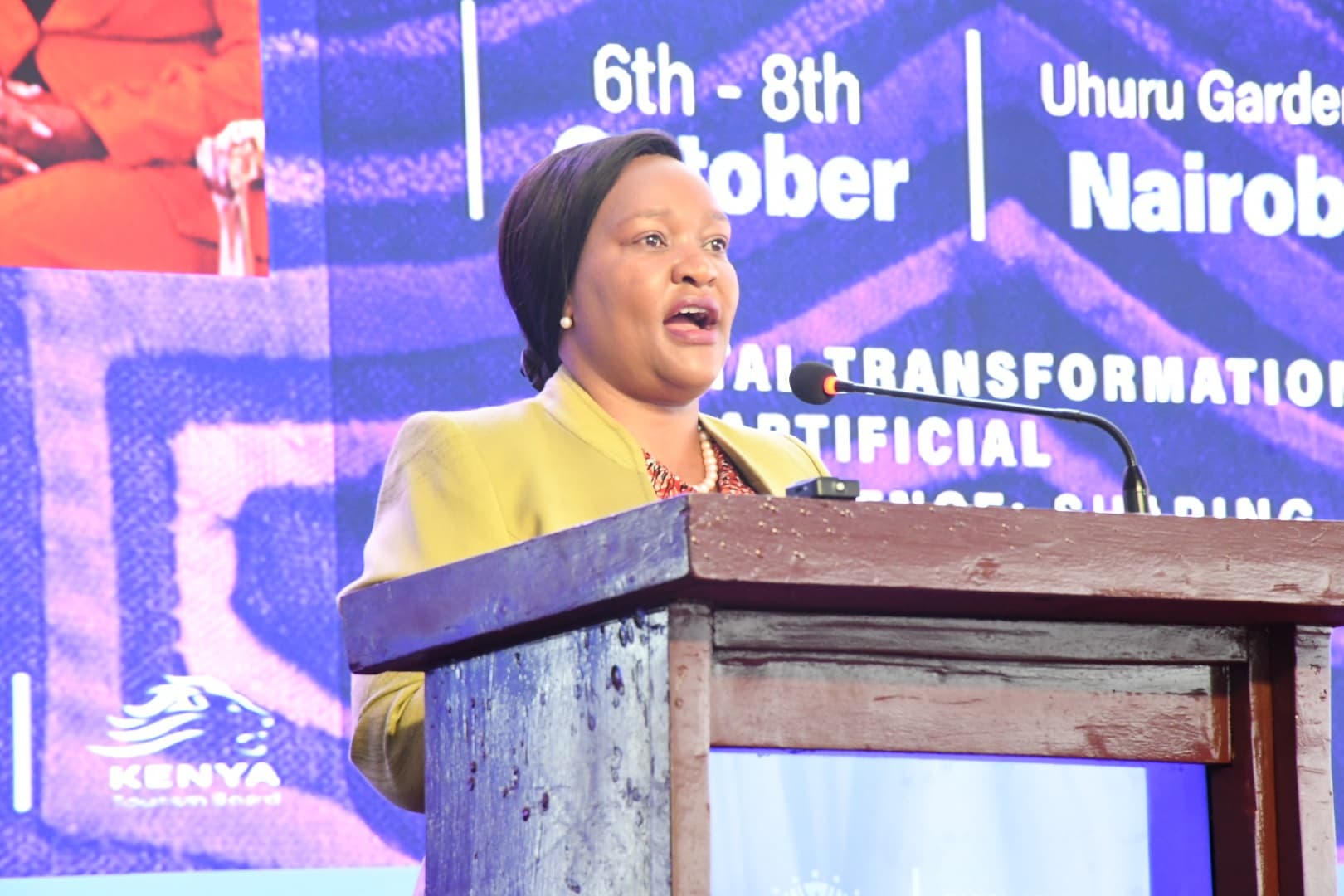
Kenya has officially launched the 16th edition of the Magical Kenya Travel Expo (MKTE 2026) at the Uhuru Gardens National Monument and Museum in Nairobi, setting an ambitious target to scale international tourists’ arrivals to 5.5 million annually by 2028.
Presiding over the official opening ceremony on Wednesday, Cabinet Secretary for Tourism and Wildlife Rebecca Miano stated that the country’s tourism sector has crossed a critical threshold into a new epoch defined by technological innovation, changing traveler behaviors, and evolving destination dynamics.
The three-day premier trade show, running under the theme “Digital Transformation and Artificial Intelligence: Shaping the Future of Tourism,” stands as the largest edition in the event’s history. The platform has convened over 10,000 delegates, 450 exhibitors, and upwards of 250 vetted international travel buyers representing more than 40 countries across the globe.
Highlighting the sector’s robust trajectory, Miano reported that global international arrivals surpassed 1.5 billion in 2025, with Africa recording 81 million arrivals. Locally, Kenya welcomed 2.7 million international visitors, generating approximately Sh500 billion in revenue, while domestic travel achieved a record 5.2 million bed nights.
She emphasized that future market leadership will belong to destinations that deploy artificial intelligence and data analytics to optimize operations, personalize marketing strategies, and manage natural resources sustainably.
“The traveler of today bears little resemblance to the traveler of yesteryears. Technology has transformed how people discover destinations, how they make decisions, how they book experiences, and how they engage with the places they visit. The next competitive advantage belongs to destinations that harness technology to understand travelers better, reach markets faster, create smarter experiences, and manage destinations more sustainably,” Miano noted.
The Cabinet Secretary stressed that digital transformation must be inclusive, enabling grassroots operators, county-based small tour businesses, and community conservancies to access digital platforms on equal footing with multinational corporations.
She further acknowledged President William Ruto’s role as Kenya’s primary tourism ambassador in driving policy reforms, including the Electronic Travel Authorization (eTA) system that has simplified visitor entry into the country.
Addressing health and safety measures following recent public health queries regarding an isolated health case, CS Miano reassured international attendees and potential travelers that Kenya remains a safe and secure destination.
She confirmed that the Ministry of Tourism and Wildlife is collaborating with the Ministry of Health and leveraging the Tourism Resilience and Crisis Management Centre located at Kenyatta University to maintain high-level vigilance.
Principal Secretary for the State Department for Tourism Amb. (Prof.) Julius Bitok underscored the strategic convergence of technology, sports, and infrastructure investments as major drivers for sector growth.
Bitok highlighted upcoming high-profile regional and global events—including the 2027 Africa Cup of Nations (AFCON) co-hosted with Uganda and Tanzania, and the 2029 World Athletics Championships—as pivotal catalysts for expanding tourism capacity.
“When we reflect about AFCON, it is clear it is going to come with a huge opportunity. We are expecting about one million people in Nairobi during that period. That raises fundamental questions about our capacity, accommodation, and infrastructure. We have started working with private sector stakeholders to ensure we provide the best possible experience for our visitors,” Bitok said.
Principal Secretary for the State Department for Wildlife Ms. Silvia Museiya Kihoro, re-affirmed the government’s commitment to conserving wildlife as the primary engine of Kenya’s tourism economy, while prioritizing community empowerment.
“The most important position we have as a ministry is to ensure that benefits flow down to communities and ensure that communities are integrated into our tourism agenda. They must actually feel the growing numbers and revenues on the ground,” Museiya observed.
Uganda’s State Minister for Tourism, Wildlife, and Antiquities Susan Nakawuki, called for accelerated integration within the East African Community (EAC) to unlock the continent’s full travel potential.
She urged regional policymakers to eliminate non-tariff barriers, address high intra-African air transport costs, and jointly market East Africa as a single, unified destination.
“It is time for us to have a borderless East Africa and a borderless Africa. We are better off marketing our region as a single tourist destination than going as individuals. We are one people with one destiny, and we should push that as much as we can,” Nakawuki advocated, emphasizing that Uganda views Kenya as an ally rather than a competitor.
The Magical Kenya Travel Expo continues through Thursday, October 8, featuring pre-scheduled B2B matchmaking sessions, speed networking, investment seminars, and county-led cultural exhibitions.


Comments
No comments yet. Be the first to share your thoughts.