
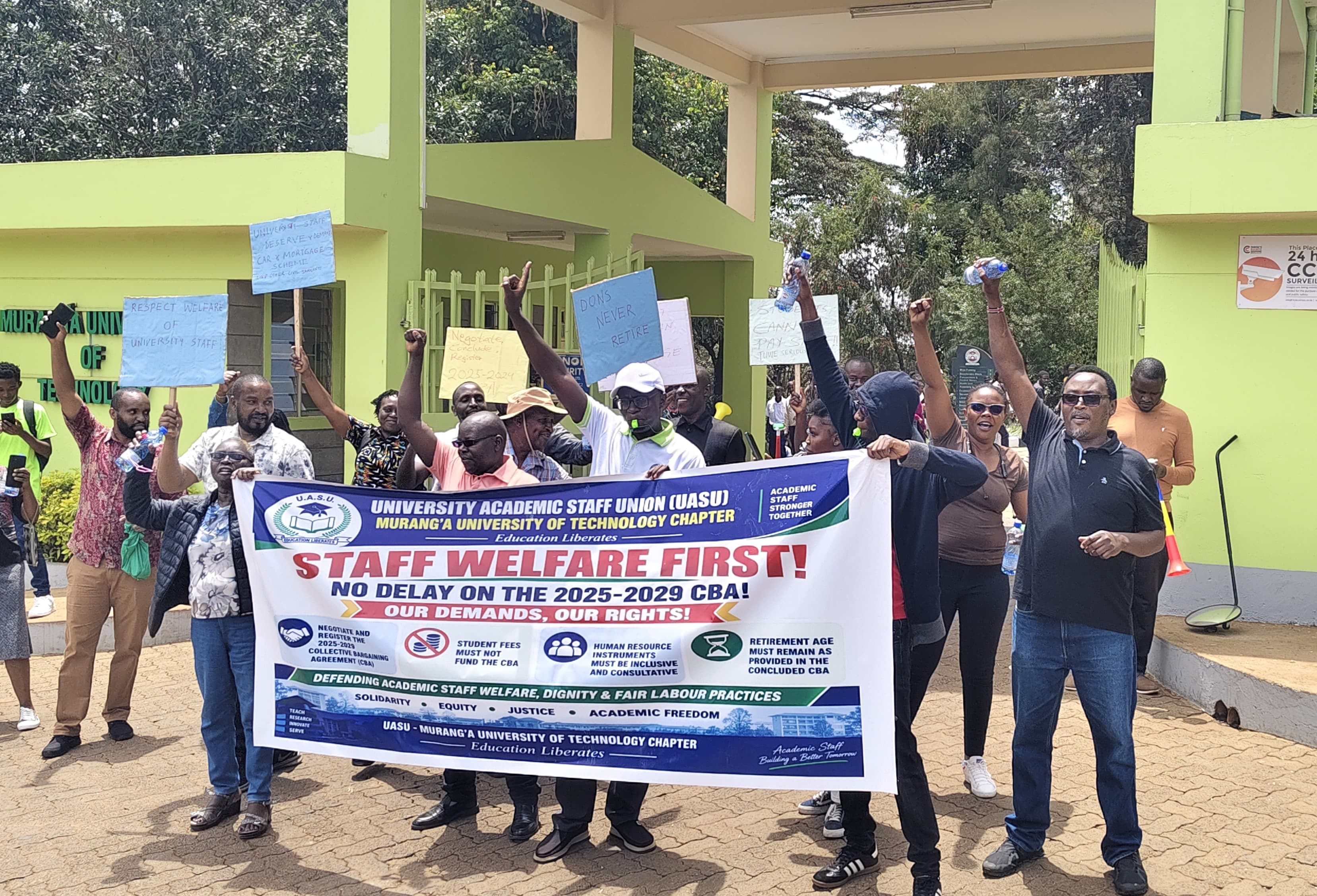
Learning and other operations at Murang’a University of Technology were paralyzed Friday after workers downed their tools, demanding the conclusion and implementation of the 2025–2029 Collective Bargaining Agreement (CBA).
The workers, drawn from the Universities Academic Staff Union (UASU), Kenya Universities Staff Union (KUSU) and Kenya Union of Domestic, Hotels, Educational Institutions, Hospitals and Allied Workers (KUDHEIHA), staged demonstrations within the university compound, calling on the government to urgently resolve the outstanding issues.
The strike is part of a nationwide industrial action by workers in public universities after negotiations between the unions and the Inter-Public Universities Councils Consultative Forum (IPUCCF) failed to resolve the dispute.
The unions had issued a strike notice for October 2, citing delays in concluding, registering and implementing the 2025–2029 CBA and failure by the government to provide funding for its implementation.
Speaking during the demonstrations, UASU Murang’a Chapter Secretary Dr. Stephen Njenga said the workers would not return to their duties until their grievances were addressed.
Njenga said the 2025–2029 CBA, which was expected to have been concluded after the unions signed a return-to-work formula with the IPUCCF in November last year, remained unresolved.
“We have a number of issues which need to be addressed before we resume work. One is the CBA 2025–2029, which was supposed to be concluded last year, but is still pending,” he remarked.
He accused the Salaries and Remuneration Commission (SRC) of delaying the process and called for the agreement to be registered and implemented.
The union official further opposed proposals that would require universities to finance workers’ salaries from student fees, arguing that public universities should continue receiving government funding to meet their wage obligations.
Njenga said relying heavily on student fees would disadvantage universities with relatively low enrolment and could affect their ability to meet salary obligations.
“Some students are already facing challenges paying their fees because of financial constraints. Universities cannot therefore depend entirely on fees to pay their workers,” he added.
The demand comes amid wider concerns over the financial sustainability of public universities, with the unions arguing that inadequate government funding has contributed to financial difficulties and affected operations in some institutions.
Njenga also criticized the Public Service Commission (PSC) over the development of generic human resource instruments for public universities saying university workers had not been adequately involved in the process.
He said the unions would continue pushing for the views of university employees to be incorporated before the instruments are adopted.
“We want to ensure that the generic human resource instruments being developed take into account the views of university workers,” he noted.
The issue of retirement age has also emerged as a contentious matter in the dispute. PSC issued a circular in March 2026 on the mandatory retirement age for lecturers and researchers in public universities and research institutions prompting legal challenges and objections from university staff unions.
Njenga said the unions would resist any move they believe could adversely affect the terms and conditions of service for academic staff.
His sentiments were echoed by Dr. Tirus Maina, who accused the government of failing to honour commitments made during the return-to-work negotiations.
Maina questioned why the workers were still raising the same grievances months after the signing of the return-to-work formula.
“When we ask about our issues, they usually come up with new things. Let the government be gentle enough to honour the promises that have been agreed,” he said.
He argued that public universities serve the wider public by providing higher education and training and should therefore receive adequate government support.
“Universities are of public good. We train children from the public and our payment should come from the exchequer, not students’ fees which cannot cater for the expenses of universities,” he observed.
KUSU chapter Treasurer Kirigo Wangari said workers were concerned that shifting the responsibility of paying salaries to student fees could threaten their job security.
Wangari warned that universities struggling with low enrolment and financial difficulties could find it increasingly difficult to sustain their workforce if government funding was reduced.
She urged the government to urgently intervene and resolve the dispute to allow learning and other university operations to resume.
“No work is going on in our public universities. Students are idling around. Let the government address our issues so that operations at the institutions can resume,” she said.
The latest strike follows failed efforts to resolve the dispute through negotiations. The unions rejected a counter-offer presented by the IPUCCF on September 30, 2026, saying it did not adequately address their concerns on salaries, allowances, medical benefits and staffing.
Among the issues raised by the unions is a proposed four per cent annual salary increment, which they have rejected as insufficient. They have also raised concerns over medical benefits and understaffing in public universities.
The strike has consequently affected teaching, administration and other support services, with the institution employing more than 500 workers across various cadres.
The workers maintained that they would remain on strike until the outstanding issues were resolved and called on the government and universities management to return to the negotiating table.
by Bernard Munyao

Comments
No comments yet. Be the first to share your thoughts.