
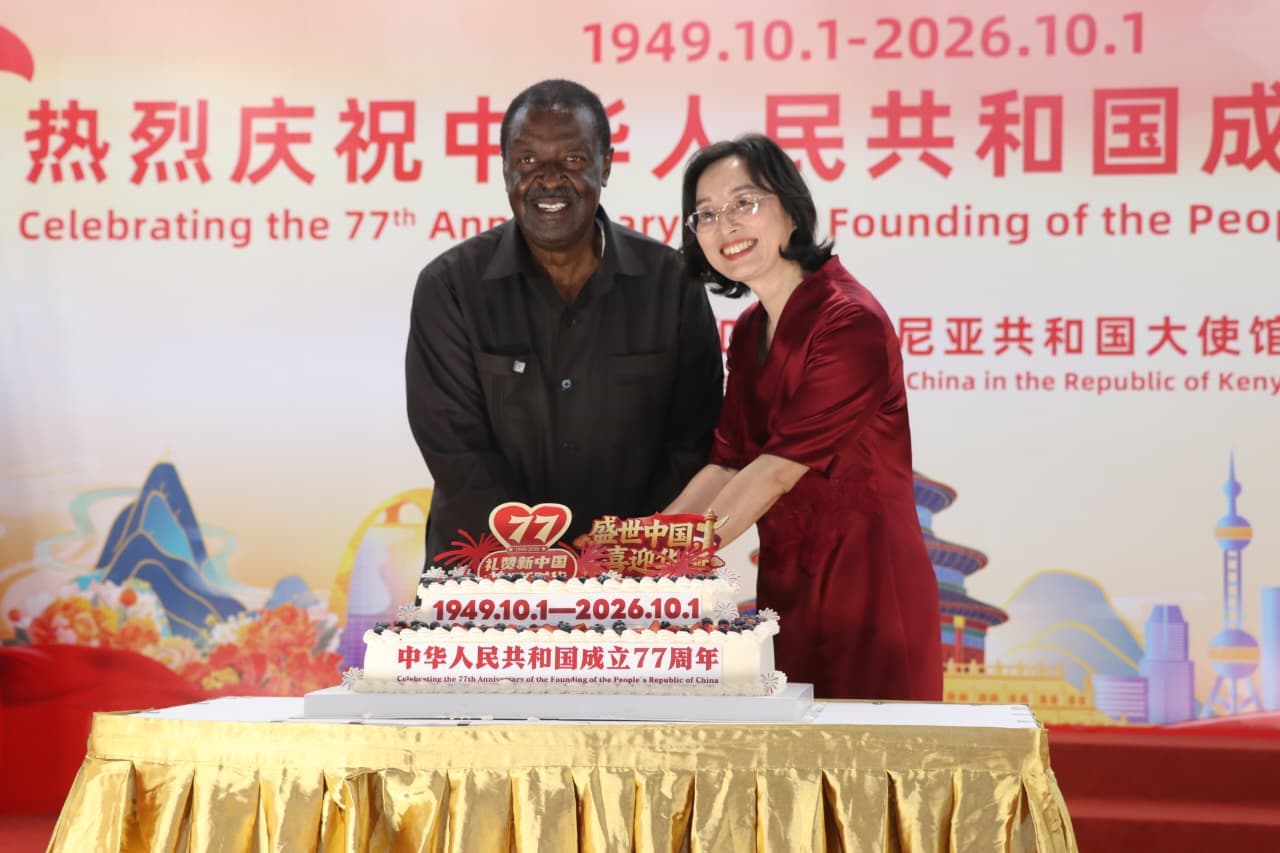
Kenya and China are set to strengthen their strategic partnership, building on decades of robust political, economic, and people-to-people cooperation. The commitment was made by Prime Cabinet Secretary Musalia Mudavadi and Chinese Ambassador to Kenya, Guo Haiyan, in Nairobi on Wednesday, during celebrations marking the 77th anniversary of the founding of the People’s Republic of China.
Conveying the Kenyan government’s goodwill messages to President Xi Jinping and the Chinese people, Mudavadi highlighted China’s post-1949 transformation as a valuable blueprint for Kenya as it formulates its post-Vision 2030 development agenda.
“The Chinese people have continued to create history and shape their future. Today, China has made remarkable strides in its development, emerging as one of the world’s leading economies. I congratulate the leadership and people of China on the remarkable transformation of their nation,” he said
“As Vision 2030 approaches its conclusion, we are already looking ahead to craft our development agenda beyond 2030. In this regard, Kenya and China have much to share in national transformation into the future,” he stated.
Mudavadi specifically referenced China’s experience in institution-building and poverty reduction as crucial for Kenya. He noted that frequent high-level engagements have strengthened Kenya-China relations, citing President William Ruto’s State Visit to China in April 2025, which elevated bilateral relations to an All-Weather Comprehensive Strategic Partnership.
“Kenya and China signed the Early Harvest Agreement, also known as the Zero Tariff Agreement, in March 2026. This agreement facilitates Chinese market access for Kenyan exports at no tariff, with effect from May 2026,” he explained.
“As a result, Kenya’s exports to China are growing, particularly coffee, avocados, and tea, contributing to job creation across the agricultural sector. This supports the Government’s agenda of creating jobs for women and youth.”
Ambassador Guo Haiyan underscored the remarkable early success of the zero-tariff arrangement. Since its full implementation in May, Kenya’s avocado oil exports to China have surged by 700 per cent, aquatic products like sea cucumber have grown by 350 per cent, and coffee exports nearly doubled by the end of August.
Guo expressed Beijing’s hope that these preferential measures, coupled with an upgraded “green channel” for Kenyan products, would facilitate faster and greater volumes of Kenyan goods entering the Chinese market. She contextualised this within a broader policy, stating that China has unilaterally extended comprehensive zero-tariff treatment to Africa without conditions.
“We not only oppose unilateral sanctions, but also have proactively expanded unilateral opening up, granting comprehensive zero-tariff treatment to all 53 African countries with which China maintains diplomatic relations without attaching any conditions. We cherish our traditional friendship,” she declared.
The envoy pointed to infrastructure as a cornerstone of the ongoing cooperation, with Mudavadi reiterating that Kenya values the strong partnership with China in the development of key infrastructure projects, including roads, railways, and renewable energy.
“We appreciate China’s support for the dualling of the Nairobi-Nakuru-Mau Summit highway towards Kisumu and Malaba, and the extension of the Standard Gauge Railway (SGR) from Naivasha through Kisumu to Malaba,” he said, noting that these projects would enhance regional connectivity and provide improved access to the Indian Ocean for trade for landlocked countries. He affirmed Kenya’s commitment to implementing the outcomes of the 2024 FOCAC Summit in Beijing.
Guo, in the meantime, reiterated that China’s engagement with Africa is founded on respect for sovereignty and non-interference.
“China always regards Africa as a continent full of hope. We have never interfered in the internal affairs of African countries. Instead, we have firmly supported Africa in safeguarding its sovereignty, security and national dignity,” she stated.
She advocated for increased international investment in Africa and for the continent’s voice to be amplified in global affairs, portraying China’s outreach as part of a broader drive for cooperation among Global South nations and reform of international governance structures. Both sides committed to closer coordination in multilateral affairs to protect their legitimate interests.
“Facts have shown that the development of China-Kenya relations serves the respective and common interests of both sides and helps improve the well-being of our two peoples,” Guo affirmed.


Comments
No comments yet. Be the first to share your thoughts.