
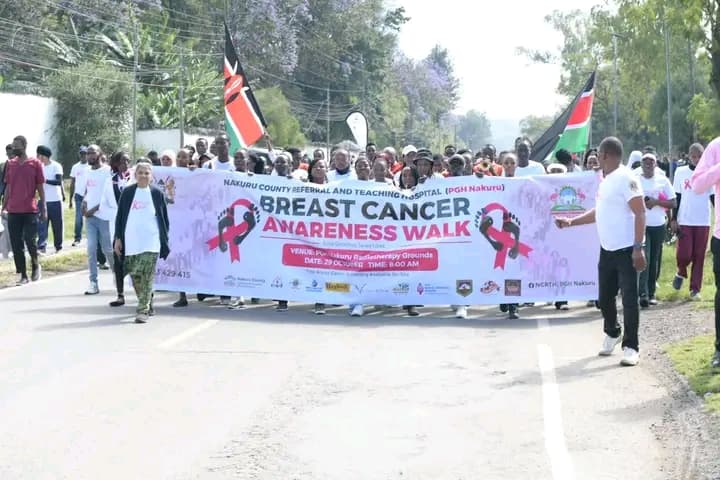
Nakuru County is stepping up breast cancer awareness and early detection efforts as national cancer data highlights the scale of the disease and the consequences of delayed diagnosis.
Clinical Radiation Oncologist Dr Dulcie Wanda of Nakuru County Referral and Teaching Hospital (NCRTH) said early medical assessment improves the chances of successful treatment, urging residents to seek clinical examinations rather than wait until they notice physical changes.
Wanda spoke during a breast cancer awareness walk and free clinical screening drive in Nakuru, where hundreds of residents joined health workers and survivors to promote early detection.
Wanda noted that data published by the National Cancer Institute of Kenya (NCI-K), drawn from the National Cancer Registry, recorded 398 breast cancer cases among Nakuru residents between 2020 and 2023.
“This was the second-highest county total after Nairobi, which recorded 550 cases,” Wanda said.
He also said that the registry recorded 460 cases diagnosed in Nakuru facilities, including patients whose usual residence was elsewhere.
Wanda further clarified that the national figures revealed a further challenge: late diagnosis. The registry recorded 2,258 breast cancer cases with staging information between 2020 and 2023.
“Of these, 840 cases representing 37.2 per cent, were diagnosed at Stage IV, while another 31.4 per cent were at Stage III. Only 7.7 per cent were diagnosed at Stage I or in situ, he added.
The campaign also challenged the misconception that breast cancer affects women only.
Breast cancer survivor Ndung’u Chege urged men to seek medical assessment, saying they should not assume they are immune to the disease.
“Men have breast tissue and can develop breast cancer, although cases are uncommon,” said Ndung’u.
According to World Health Organization (WHO) estimates, men account for approximately 0.5 to one per cent of breast cancer cases globally.
The campaign comes against a significant local disease burden. The programme offered free breast clinic consultations every Wednesday, discounted ultrasound services and reduced mammography charges for eligible patients without Social Health Authority (SHA) cover.
Kenya’s National Cancer Control Strategy identifies delays in diagnosis, limited diagnostic infrastructure and shortages of specialised personnel as barriers to effective cancer care.
It notes that about 70 per cent of cancer cases nationally are diagnosed at advanced stages.
Across Africa, the WHO Regional Office for Africa says more than 70 per cent of breast cancer cases in most countries are detected late.
In September 2026, WHO Regional Director-level official Dr Benido Impouma called for stronger primary healthcare capacity to recognise suspicious symptoms, conduct initial assessments and refer patients promptly for diagnosis and treatment.
Impouma said delays of six months or more between the appearance of symptoms and access to appropriate care remain common in many African settings.
He emphasised that frontline health workers play a crucial role in preventing patients from being lost between initial assessment and specialised treatment.
The global survival gap also demonstrates why early diagnosis must accompany access to treatment.
Early diagnosis involves recognising symptoms, obtaining prompt clinical assessment and accessing treatment.
Screening involves testing people without symptoms, with mammography recommended for appropriate age and risk groups according to national guidelines. WHO stresses that early detection must connect patients to timely diagnosis and complete treatment to reduce deaths.
NCRTH Director Dr Santosh Devaraj has said effective cancer management requires coordinated services covering screening, diagnosis, treatment and follow-up.
He has also urged residents to use the hospital’s breast health services rather than delay assessment until symptoms become advanced.
Nakuru’s Regional Cancer Centre provides screening, chemotherapy, radiotherapy and palliative care, while cancer surgery is available at Nakuru Level 5 Hospital.
The county has also conducted screening outreaches across its 11 sub-counties. The National Government has outlined plans to upgrade the regional centre to serve patients from 24 counties.
The awareness campaign, backed by Governor Susan Kihika’s administration, therefore highlights the need to connect public education with accessible diagnostic services and sustained treatment.
Its impact will depend on whether residents who attend outreach clinics can obtain timely referrals, diagnostic tests and follow-up care.
For survivors who shared their experiences during the walk, the message was also about reducing stigma and encouraging people to seek help.
The broader public health challenge is ensuring that early detection leads to treatment before the disease advances.
By Jefther Simeon and Jane Ngugi

Comments
No comments yet. Be the first to share your thoughts.