
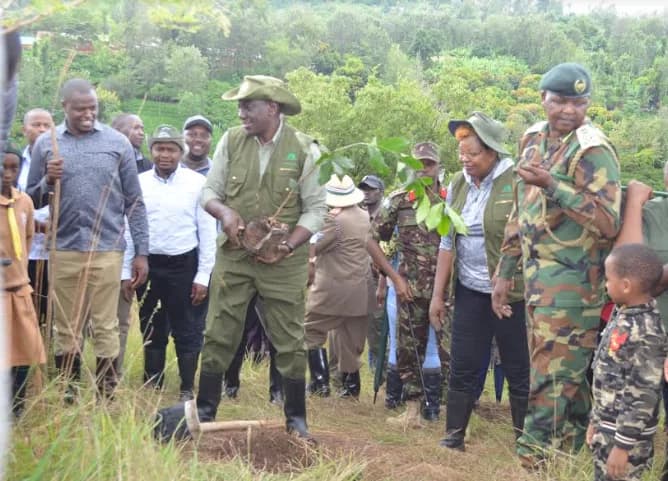
Ruto's 15 billion tree initiative

The government is targeting more than one billion trees annually through a village elder-led initiative that seeks to mobilise communities to grow at least 1,000 trees every month in each village.
The initiative is under the 15 Billion Tree Growing Programme that is being spearheaded by the Ministry of Environment, Climate Change and Forestry.
Felix Kisalu, the director of the 15 Billion Tree Growing Programme the village elders are key to the ambition, as they are central to mobilising local communities.
“The initiative is intended to take tree growing beyond national and county government campaigns and make it a community responsibility,” Kisalu said.
The government will rely on the existing village administration structure to mobilise households, coordinate seedling distribution and encourage communities to take responsibility for restoring degraded land.
The ministry plans to work with the Kenya Forest Service (KFS) and community nurseries to ensure seedlings are available. The programme will also involve public awareness campaigns and the use of local knowledge to identify suitable tree species and planting sites.
The initiative is part of the government's 15 Billion Tree Growing Campaign, also known as Mission 15B, which runs from 2023 to 2032. The programme aims to restore 10.6 million hectares of degraded landscapes and increase the country's tree cover to 30 per cent by 2032.
Kisalu said the government hopes to mobilise communities to contribute more than one billion trees annually, which could help the country meet its target.
“We might even be able to achieve the 15 billion trees in a shorter time than anticipated as a country,” he said.
The village-led approach comes as Kenya seeks to restore degraded landscapes, protect water resources and strengthen the resilience of agricultural systems.
According to the Kenya Forest Service's 2021 National Forest Resources Assessment, the country had 7.18 million hectares of tree cover, equivalent to 12.13 per cent of its land area. Forest cover stood at 5.23 million hectares, or 8.83 per cent.
The assessment showed tree cover was unevenly distributed, with 37 of the 47 counties having at least 10 per cent tree cover, pointing to the need for restoration efforts that consider local environmental conditions.
For farmers, trees can help protect soils from erosion, provide shade, improve soil organic matter and support water retention. Agroforestry, when properly planned, can also provide households with fruits, fodder, fuelwood and other products while diversifying farm incomes.
Kisalu said trees play an important role in supporting agriculture, which depends on healthy soils, adequate moisture, reliable water supplies and favourable climatic conditions.
“Agriculture in this country is reliant on multiple factors, including quality soils, availability of water, moisture retention, quality seeds, an available workforce and appropriate climatic conditions. All these factors are supported by trees and appropriate ecological patterns,” he said.
Kenya has about 10 million hectares of degraded ecosystems requiring restoration, making it important to involve communities in protecting and rehabilitating the land on which their livelihoods depend.
The government's broader restoration programme identifies forests, water towers, rangelands, farmlands, wetlands, marine ecosystems and urban areas as priority landscapes.
Beyond mobilising villagers to plant trees, the ministry is encouraging local leaders and professionals to adopt degraded ecosystems and take responsibility for their restoration.
Kisalu said senior government officials, including Cabinet Secretaries and Principal Secretaries, had been mapped to adopt specific ecosystems across the country. The programme is now extending the approach to middle-level and community leadership.
Teachers, bank managers, practitioners and other local professionals are being encouraged to adopt even small sections of degraded land and contribute to their restoration.
“However small, every tree counts. Even five trees count. The adoption system is another innovation we are implementing,” he said.
The ministry is also making it easier for Kenyans to record trees planted through a digital platform available on mobile phones.
Kisalu said the application allows users to document and georeference trees, making it possible to identify the villages where trees have been planted and the species grown.
“This is a user-friendly platform that ensures every tree planted in this country is recorded and georeferenced. We can know which village has what species of trees,” he said.
He added that the system would also help the government monitor tree survival rates and strengthen accountability by tracking whether planted trees survive.
Kisalu said the programme had so far recorded about two billion trees planted across the country. The government was putting more emphasis on community mobilisation, seedling availability and monitoring to accelerate.
Trees are not just an environmental asset; they are also critical to Kenya's food security. By protecting soils, improving moisture retention and supporting water catchments, they help sustain the conditions farmers need to produce food. The village elder-led initiative therefore presents an opportunity to link tree growing directly to agricultural productivity, particularly as farmers grapple with increasingly unpredictable weather patterns. However, its success will depend not only on the number of trees planted but also on choosing suitable species and ensuring they survive to maturity.


Comments
No comments yet. Be the first to share your thoughts.