
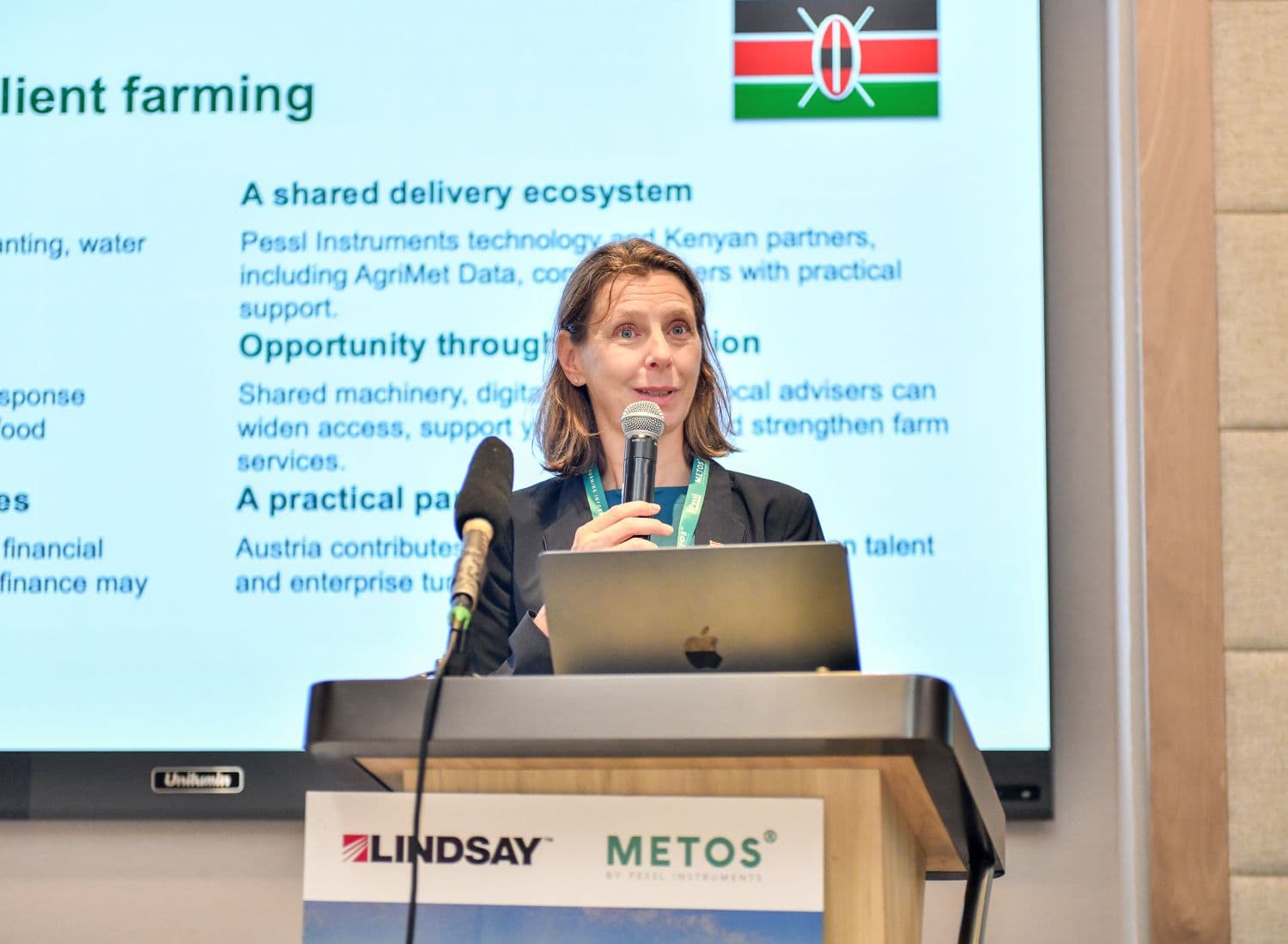
A new commercial farming model leveraging weather intelligence and digital technology has been launched in Nairobi to transform smallholder agriculture across East Africa into a climate-resilient, productive, and bankable sector.
The initiative, dubbed UpYield 4 Africa, brings together Austrian agricultural technology firm Pessl Instruments, AgriMet Data Kenya, Sidian Bank, and local telecommunications giant Safaricom to deploy 15,000 METOS weather-monitoring stations across the region.
Speaking during the official launch at a Nairobi Hotel, the Ambassador of Austria to Kenya, H.E. Dr. Simone Knapp, highlighted the necessity of real-time, precision data in modernizing farming practices and strengthening food security.
“Agriculture depends on soil, water, knowledge, and investment. But there is one essential factor that links those areas: timely and accurate information,” Ambassador Knapp established.
“UpYield 4 Africa aims to make precise local agricultural data accessible and useful for the immediate farmers and community. It is not simply about installing equipment; it is about turning data and facts into better agricultural practice,” she added.
The Ambassador noted that the project leverages Austrian export finance instruments, including ÖKB-supported structures, to facilitate the rollout over the next two years.
Under the framework, smallholder farmers will receive real-time weather and soil observations through community-level Digital Farm Advisors (DFAs) and mobile applications. The system assists farmers in making informed choices regarding planting, irrigation schedules, pest management, and fertilizer application, replacing conventional guesswork with data-driven decision-making.
Representing UpYield 4 Africa, Josef Winklmayr, Assistant to the CEO METOS by Pessl Instruments, explained how precision data directly reduces operational costs for farmers, particularly in managing irrigation schedules amid fluctuating power and fuel prices.
“Pessl Instruments is more than a technology provider; we are a digital farm advisory system. Through our FieldClimate application and weather stations, data generated shows exactly when irrigation is needed,” Winklmayr elaborated, saying that this enables farmers to optimize water use, save on expensive diesel backup generators, and increase crop yield.
Addressing the long-standing challenge of credit and insurance access for rural farmers, Sidian Bank outlined a closed-loop financing and risk-mitigation framework. Instead of requiring individual farmers to pledge land or personal assets as collateral, borrowing is structured through cluster companies or off-takers, using equipment, weather data, and guaranteed harvests to secure facilities.
Sidian Bank Chief Digital Transformation Officer, Bernard Oyoga, emphasized the institution’s commitment to empowering small and medium enterprises (SMEs) and farmer ecosystems through tailored digital onboarding and end-to-end financing.
“We are known as a business bank, and what we have done with SMEs and farmers is look at how we empower them through financing,” Oyoga stated.
“Through a closed-loop financing model, when a farmer needs financing for inputs or assets, the funds go directly to providers. Once produce is ready, it is delivered to verified off-takers, ensuring reduced risk for all partners in the ecosystem,” he added.
Sidian Bank representatives further detailed the role of the bank’s bancassurance subsidiary in offering bundled crop and livestock insurance products. By using weather index data to mitigate climate risks and securing coverage for unforeseen farmer contingencies, the bank creates a sustainable, bankable environment for smallholders.
Highlighting the critical role of connectivity and digital reach, Safaricom PLC’s Acting Chief Financial Services Officer, Boniface Mungania, affirmed the integration of mobile infrastructure and farmer registries to seamlessly deliver agricultural services and government e-subsidies.
“Safaricom brings the connectivity backbone to this ecosystem. By integrating farmer registries, we ensure smallholders gain direct access to digital agricultural services, credit facilities, and essential subsidies,” Mungania said.
On his part, Advisory Board Member Dr. Hans Jöhr urged sector stakeholders to embrace regenerative agricultural practices and leverage digital tools to make farming commercially attractive to the younger generation.
“Regenerative agriculture and precision tools represent the way forward. By measuring soil conditions, weather patterns, and biological inputs, we reduce unit costs and improve profit margins for farmers,” Dr. Jöhr remarked.
“Technology can only be successful if we train young people to manage it, creating sustainable jobs and securing the entire value chain from the field to urban markets,” he emphasized.
Meanwhile, the UpYield 4 Africa initiative is set to roll out across various counties in Kenya before expanding across the broader East African region, creating an interconnected digital ecosystem for smallholders, input suppliers, financial institutions, and insurance providers.
By Lilian Gichohi and John Brighton


Comments
No comments yet. Be the first to share your thoughts.