
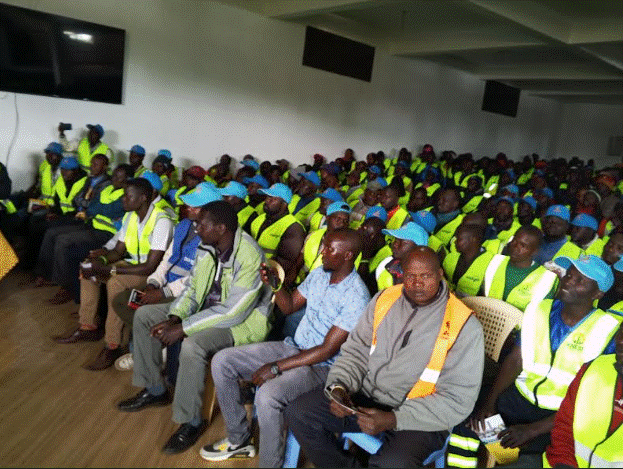
More than 500 boda boda riders in West Pokot County have undergone financial literacy training, aimed at helping them manage their earnings, meet loan obligations and safeguard their livelihoods.
The training, organised by Mogo Kenya in partnership with the Boda Boda Association of Kenya (BAK) at Bendera in Kapenguria Town, focused on budgeting, cash-flow management, understanding loan agreements and planning for regular repayments.
The riders were also advised to maintain early communication with financiers whenever they experience financial difficulties that could affect their ability to repay loans, instead of allowing missed payments to accumulate.
For many boda boda operators, motorcycles are not only a means of transport, but also their workplaces and a major source of income for supporting families, paying school fees and meeting other household expenses.
Industry estimates indicate that about 2.4 million motorcycles are in use in Kenya, with 68.4 percent financed through digital and asset-based credit, highlighting the importance of responsible borrowing for sustainable motorcycle ownership.
The training comes against the backdrop of concerns over loan repayment, with the Central Bank of Kenya’s Financial Sector Stability Report indicating that the gross non-performing loan ratio in the banking sector stood at 15.6 per cent in March 2026.
The boda boda sector is estimated to generate about Sh660 billion annually, while supporting more than 2.5 million jobs and contributing approximately 4.4 per cent of Kenya’s Gross Domestic Product, according to industry estimates.
Mogo Kenya Head of Public Relations Becky Ngigi said financial literacy was essential because motorcycles financed through credit were the main source of livelihood for many riders.
“Behind every motorcycle we finance is a person who depends on that motorcycle to earn a living. It is their workplace, their business and, in many cases, the income that supports an entire family,” said Ngigi.
She said riders needed to understand the cost of credit, manage their daily income and plan for loan repayments to keep their motorcycles productive and maintain financial stability.
Ngigi also urged riders facing difficulties to engage their financiers early rather than remaining silent.
“When a rider experiences a difficult month, the most important thing is not to remain silent. Speaking to the financier early creates an opportunity to understand the available options before a temporary setback becomes a bigger problem,” she said.
BAK President Kevin Mubadi said financial literacy was important because boda boda operators depended on their motorcycles to earn a living and support their families.
“Our members depend on their motorcycles every day to earn a decent livelihood and support their families. It is therefore imperative that they understand the financial commitments that come with motorcycle ownership and know what steps to take when they encounter difficulties,” he said.
Mubadi said collaboration between riders, financiers and industry associations could strengthen financial management among operators and enable them to make informed borrowing decisions.
Mubadi also urged security agencies to work closely with boda boda operators, whom he described as important partners in providing security information because of their daily interaction with people from different parts of society.
He also called on the riders to support government development initiatives, noting the growing importance of the sector in transport and other economic activities.
West Pokot County Commissioner (CC) David Saruni urged boda boda operators to join organised groups, so that they could benefit from government programmes targeting the sector.
He commended county boda boda leaders for helping to organize and regulate operators, saying this had contributed to reducing cases of motorcycle theft.
The CC also urged riders to observe traffic laws and regulations and avoid compromising law enforcement officers.
“Almost everyone uses boda bodas here and there because they are the most convenient last-mile transport connectors. What is afflicting the industry is lack of riding licenses among some of operators,” said Saruni.
West Pokot County Boda Boda Chairman Moses Loitasiwa welcomed the financial education programme, saying it would help operators make better decisions regarding their earnings and borrowing.
“A boda boda rider earns and spends money every day, so without proper planning it is easy to use money meant for a loan repayment on other immediate needs. Training like this helps our members understand the importance of setting aside money for their obligations while still providing for their families,” he said.
Loitasiwa urged riders to understand loan terms before taking financing and maintain communication with financiers whenever their income was affected.
He also commended the West Pokot County Government for policies he said had supported the growth of the boda boda industry, including tax incentives that had made operations less costly compared with some other counties.
Deputy County Police Commander Joseph Yakan said the boda boda sector was an important contributor to the country’s economic development agenda and urged operators to take advantage of available training opportunities.
He encouraged riders to undertake driving courses and acquire customer-care skills to improve service delivery.
“This is a very important industry and let us serve our clients with courtesy for sustainability. We need to practice high standards of grooming and hygiene even if it also means wearing some perfumes,” said Yakan.
The Kapenguria training is part of a wider financial literacy programme by Mogo Kenya and BAK that has reached boda boda operators in counties across the Nyanza, Mt Kenya, Western, Eastern and Rift Valley regions.
The initiative seeks to equip operators with financial management skills to enable them to manage credit responsibly and sustain their businesses.
Mogo Kenya is part of Eleving Group, a global FinTech company operating in 17 countries across three continents. The company says it has more than 90 branches, over 1,700 employees and partnerships with more than 2,200 dealers in Kenya.
by Richard Muhambe


Comments
No comments yet. Be the first to share your thoughts.