
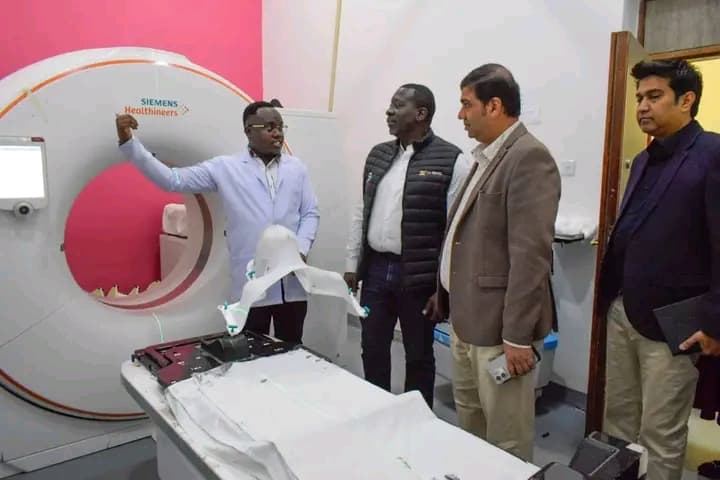
The County Government of Nakuru has partnered with the National Cancer Institute of Kenya (NCI-K) to strengthen cancer care and improve access to treatment for patients in the region.
The Nakuru County Teaching and Referral Hospital (NCTRH) hosted representatives from the NCI-K for a joint monitoring exercise of the cancer care project.
The visiting NCI-K delegation, led by its Chairman Dr. Timothy Olweny, met NCTRH Director Dr. Santosh Devaraj, senior county health officials, medical specialists, and community health stakeholders to plan for the project’s long-term sustainability.
Dr. Devaraj said the county is committed to expanding access to equitable cancer care for all residents.
“Cancer has become a major burden in our communities, and we truly value this partnership, which allows us to extend vital support to patients,” he said.
He also praised the strong political goodwill from the county’s leadership, noting that it has been instrumental in advancing cancer care initiatives.
Dr. Devaraj said the partnership bridges local and international expertise to ensure all residents, regardless of background, can access life-saving cancer services.
“This partnership is expected to improve access to diagnosis, treatment, and follow-up care for patients from Nakuru and neighbouring counties. The initiative focuses on strengthening the capacity of health workers, improving the use of specialized cancer equipment, and integrating Social Health Authority (SHA) and laboratory services to support a more coordinated cancer-care pathway,” the director indicated.
The NCTRH and NCI-K teams inspected cancer treatment and palliative care facilities at the Regional Cancer Centre and Nakuru Hospice.
Both teams assessed existing services and interacted with healthcare workers to identify areas requiring additional support.
One of the key issues identified was the need for specialized training to strengthen the capacity of healthcare workers, particularly in operating and managing cancer diagnostic and treatment equipment.
Dr. Devaraj appealed for support from NCI-K to enhance the capacity of staff working in specialized oncology services.
Dr. Olweny committed to forwarding the request for consideration, providing an avenue for further engagement between the national cancer institution and the county referral facility.
He also called for integration of the Social Health Insurance Fund (SHIF) and laboratory services to facilitate seamless delivery of cancer care.
“Such integration is important because cancer management requires coordinated services ranging from screening and laboratory investigations to diagnosis, staging, treatment, and follow-up,” Dr. Olweny said.
The engagement comes as Kenya continues to confront a substantial cancer burden, with the International Agency for Research on Cancer (IARC) estimating 44,726 new cancer cases and 29,317 cancer deaths in Kenya in 2024.
Breast, cervical, prostate, oesophageal, and colorectal cancers were among the leading cancers recorded nationally.
The National Cancer Control Strategy 2023–2027 identifies early detection, diagnostic services, treatment, palliative care, survivorship, cancer surveillance, and sustainable financing as key components of the national response to the disease.
The Ministry of Health says the strategy is intended to strengthen collaboration between national and county governments in cancer prevention and control.
The strategy notes that diagnosis is the entry point to cancer care and that delays in diagnosis can affect treatment outcomes.
Dr. Olweny indicated that about 70 per cent of cancer cases in Kenya are diagnosed at late stages, underscoring the need to strengthen diagnostic capacity and early detection.
He singled out inadequate and unevenly distributed pathology services as a national challenge, noting that only about 10 counties had pathology services at the time of its preparation.
Dr. Olweny called for stronger cancer diagnostic networks, infrastructure, equipment, and capacity building for healthcare providers.
Nakuru has already positioned itself as an important regional center for oncology services.
The county’s 2024 health sector report states that the Regional Cancer Centre at the Nakuru County Teaching and Referral Hospital, commissioned in June 2022, had served more than 5,000 clients from within and beyond the county.
The center provides screening, chemotherapy, radiotherapy, and palliative care, while cancer surgery is also available at Nakuru Level 5 Hospital.
The county has additionally conducted cancer screening outreaches across all 11 sub-counties.
Dr. Olweny pointed out that continued strengthening of the center is consistent with the national government’s plan to expand regional cancer care.
In February 2026, the Ministry of Health announced intergovernmental and service-level agreements covering regional cancer centers in Nakuru, Mombasa, and Garissa.
The agreements provide frameworks for preventive maintenance, quality assurance, and technical support for radiotherapy equipment, including linear accelerators, with the aim of improving reliability and continuity of specialized cancer treatment.
The Ministry of Health has previously announced plans to upgrade the Nakuru Regional Cancer Centre into a major referral facility serving patients from 24 counties.
According to the ministry, the upgrade forms part of the national government’s efforts to expand access to specialized cancer treatment under its Universal Health Coverage agenda.
“NCI-K’s engagement with NCRTH therefore comes as national and county health authorities seek to ensure that investments in cancer infrastructure are matched by skilled personnel and reliable diagnostic and treatment systems,” Dr. Olweny said.
The National Cancer Institute, established under the Cancer Prevention and Control Act, 2012, is mandated to coordinate cancer prevention and control, promote access to quality diagnostic and treatment services, and support capacity building in cancer care.
The institute identifies capacity building as a critical component of cancer control and says it works with healthcare providers to improve knowledge and skills in cancer prevention, diagnosis, and treatment.
The national institution has also recently emphasized stronger referral linkages between national and regional cancer centers, specialized oncology training, and the use of technology to improve cancer diagnosis and treatment.
According to Dr. Olweny, improving specialist capacity at NCRTH could strengthen the facility’s ability to provide more comprehensive services to patients within the county while supporting its wider regional referral role.
The integration of laboratory, financing, and clinical services could also reduce fragmentation in the patient journey and support timely access to appropriate care.
The engagement between NCI-K and NCRTH consequently places human resource development alongside infrastructure and equipment as a critical component of expanding specialized cancer services.
As Kenya continues to decentralize oncology care, strengthening regional facilities such as NCRTH remains important in bringing specialized services closer to communities and reducing the need for patients to travel long distances for cancer diagnosis and treatment.
By Jane Ngugi and Jefther Afuyo

Comments
No comments yet. Be the first to share your thoughts.