
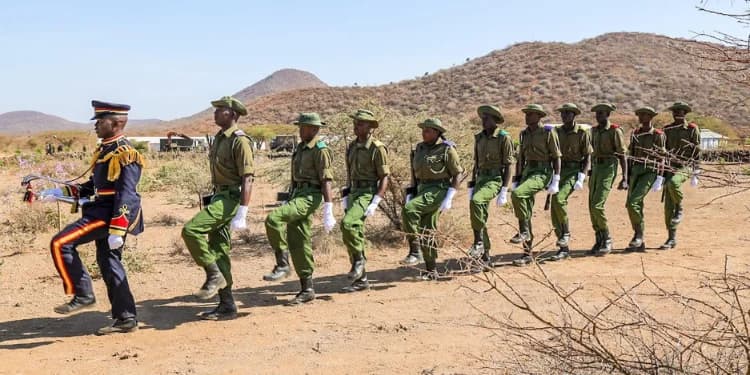
Interior Cabinet Secretary Kipchumba Murkomen arrived at Magado in Igembe North, Meru County, to preside over the passing-out parade of National Police Reservists on Wednesday, September 23, 2026.
Murkomen is expected to preside over the ceremony as the reservists formally complete their training and prepare to take up their duties under the National Police Service.
The National Police Service operates the National Police Reserve (NPR), formerly the Kenya Police Reserve, as an auxiliary security force that assists regular law enforcement in remote, rural, and pastoralist regions
The National Police Reserve (NPR) offers eligible Kenyans the opportunity to serve voluntarily alongside the National Police Service in areas where reserve officers are needed.
Unlike regular police recruitment, joining the Reserve is based on an identified need by the Inspector-General of Police and requires approval by the National Police Service Commission (NPSC). The current recruitment regulations also set specific requirements for age, integrity, and criminal records.
Requirements to Join the National Police Reserve
Under the National Police Service Commission (Recruitment and Appointment) Regulations, 2025, applicants for the National Police Reserve must meet several requirements, which include:
- Be a Kenyan citizen and resident in Kenya.
- Be aged 18 to 55 years.
- Meet the integrity requirements under Chapter Six of the Constitution.
- Have no criminal record.
- Be willing to volunteer their services to the Reserve.
The NPSC must also conduct vetting or background checks before appointing a person.
Applicants should therefore be prepared to undergo the necessary vetting as part of the recruitment process.
How Recruitment Works
Recruitment into the National Police Reserve is different from the routine recruitment of police constables.
The Inspector-General first identifies the need for reserve officers and suitable people for recruitment. The IG then submits a report to the NPSC containing the identified need, proposed names, qualifications, and recommendations.
The Commission determines the number of officers to be recruited and must approve the appointments.
This means that meeting the stated requirements does not automatically guarantee appointments to the Reserve.
National Police Reserve Training
The National Police Service Act provides that the Inspector-General enlists and trains Reserve police officers.
However, the law does not set a standard, publicly stated training period for every NPR intake. The duration and nature of training can therefore depend on the requirements the National Police Service sets for a particular intake.
After appointment, Reserve officers are subject to the laws and regulations applicable to police officers, except where the law provides otherwise.
A Reserve police officer serves for five years.
Under the 2025 recruitment regulations, the five-year term is non-renewable. The National Police Service Act also provides a five-year service period, subject to special provisions that may apply during a war or state of emergency.
National Police Reserve Salary
The National Police Reserve does not operate on a regular monthly salary structure like salaried police employment.
The 2025 regulations state that Reserve officers serve voluntarily and are not entitled to remuneration, except for allowances that the Commission may specify or determine.
Duties and Deployment
Reserve officers may be called upon to perform police duties within their areas.
The National Police Service Act provides that the head of the National Police Service in a county may, in writing, require a Reserve officer who is resident in that county to perform the duties of a police officer.
The Inspector-General may also call out Reserve officers during a state of war or state of emergency, in accordance with the law.
Deployment is based on operational requirements rather than being determined solely by the individual officer.
A person appointed to the Reserve receives a certificate of appointment.
The officer then serves under the applicable police laws and regulations and may be deployed when required.
Follow our and X Account for real-time news updates




Comments
No comments yet. Be the first to share your thoughts.