
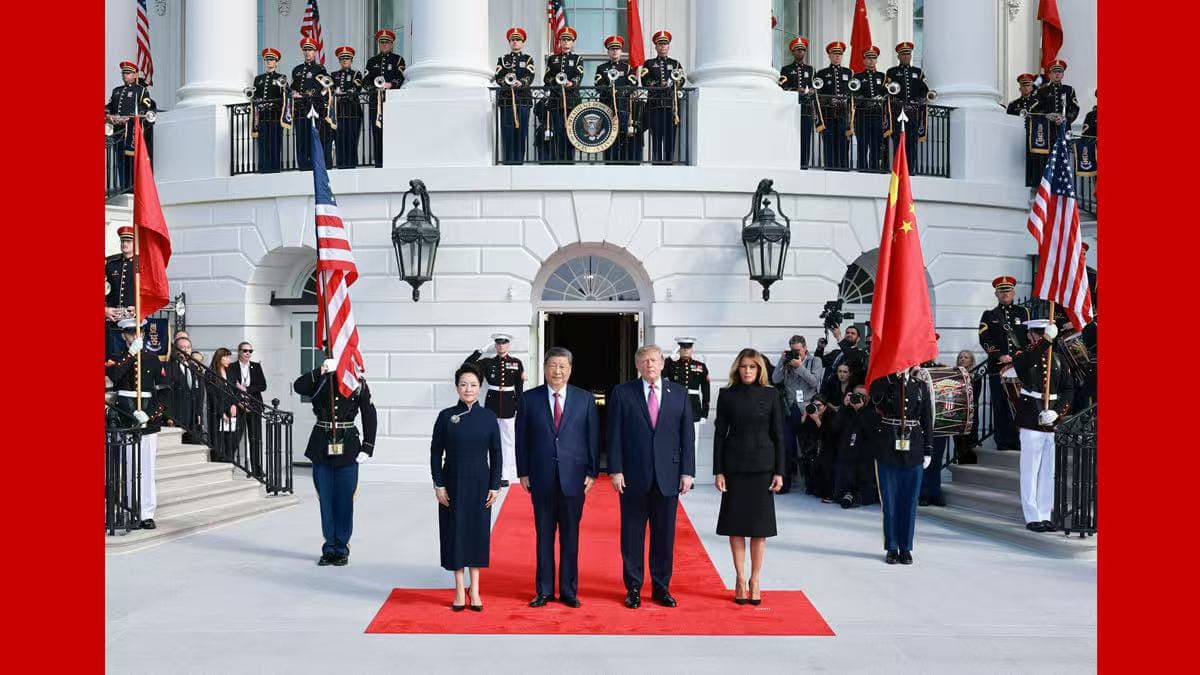
Chinese President Xi Jinping referenced over two centuries of interaction between China and the United States, advocating for the enduring friendship between their peoples across generations as Beijing and Washington aim to place their relationship on a more stable footing.
Speaking at a state dinner hosted by US President Donald Trump and First Lady Melania Trump in Washington this week, Xi detailed the evolution of China-US relations, from early trade and wartime cooperation to Ping-Pong diplomacy and contemporary people-to-people exchanges.
His remarks followed discussions with Trump, during which, according to Xi, the two leaders reached a common understanding on several issues and agreed to forge what he described as a “constructive China-U.S. relationship of strategic stability.”
Xi noted that the two countries had arrived at another historic juncture and should review the trajectory of their relationship as they contemplate its future.
“Reviewing the past gives us new perspectives. We have come to another historic juncture for China-U.S. relations…China and the United States must act as responsible major countries, meet the expectations of our peoples, keep pace with the trend of our times, and explore a new approach for major countries to get along with each other,” Xi stated.
He highlighted the long history of contact between the two societies, which began over 200 years ago when the newly independent United States established commercial links with China.
According to Xi, the early relationship was founded on trade, with both countries exchanging goods to meet their respective needs and leverage their complementary strengths. He also shared a personal historical detail, mentioning that President George Washington had acquired a large collection of Chinese porcelain.
Xi then addressed one of the most challenging periods in modern history, recalling the cooperation between Chinese and American forces during the Second World War in the fight against Japanese militarism.
“Over 80 years ago, the Chinese and American people stood shoulder to shoulder in the fight against Japanese militarist aggressors,” Xi said.
He recounted the establishment of the Hump air route across the Himalayas and noted that Chinese soldiers and civilians had rescued hundreds of American pilots during the War of Resistance Against Japanese Aggression, at immense human cost.
“Such a friendship, forged in blood and fire, will surely live on through the generations,” Xi affirmed.
The Chinese president also underscored Ping-Pong diplomacy in the 1970s, when exchanges between Chinese and American table-tennis players helped re-establish contact between the two countries after years of limited interaction.
He credited the political leadership of Mao Zedong and Richard Nixon with utilising the momentum generated by these exchanges to advance the normalisation of bilateral relations.
Xi further cited an example of people-to-people cooperation involving American environmentalist Ronald Sakolsky and Chinese desert-control worker Yin Yuzhen. He explained that Sakolsky had provided financial support for Yin’s tree-planting efforts over two decades ago and recently returned to China to witness the desert transformed into forest.
According to Xi, such stories demonstrate how exchanges between ordinary people can complement government-to-government relations.
“Exchanges have helped promote heart-to-heart communication between our people and cemented public support for Sino-U.S. friendship and cooperation,” he said.
Against this historical backdrop, Xi connected the future of the relationship to the national development goals of both countries. He referenced Trump’s “Make America Great Again” agenda alongside China’s pursuit of national rejuvenation and Chinese modernisation.
“These two goals are both ambitious and can surely be mutually reinforcing,” Xi stated.
He argued that cooperation between the two countries should always take into account their responsibilities as major powers and the broader implications of their relationship for the international community.
Xi also pointed to recent high-level engagement as evidence of a renewed effort to manage bilateral relations.
“In May this year, President Trump paid a successful visit to China at my invitation. We agreed to build a constructive China-U.S. relationship of strategic stability. During the visit, President Trump warmly invited me to visit the United States, and I have come as promised,” he said, adding that “in less than half a year, the Chinese and American presidents have exchanged state visits, making history in our bilateral engagement.”
At the dinner, Xi stated that his latest discussions with Trump had added “new substance” to the goal of strategic stability and provided “new strategic guidance” for China-US relations.
He emphasised that the two countries should build on the historical ties between their peoples rather than allowing differences to define the entire relationship.
“Like a river that never stops flowing, history never stands still,” Xi observed.
“The friendship between the two peoples is a worthy cause that holds great promise. Let us join hands and move forward side by side. Together, let us nurture the beautiful flowers of Sino-U.S. friendship. Together, let us write a new chapter in our friendly relations.”
Xi ended his toast by raising his glass to Trump and his wife, to the prosperity and progress of China and the United States, and “to the friendship between our two peoples.”


Comments
No comments yet. Be the first to share your thoughts.