
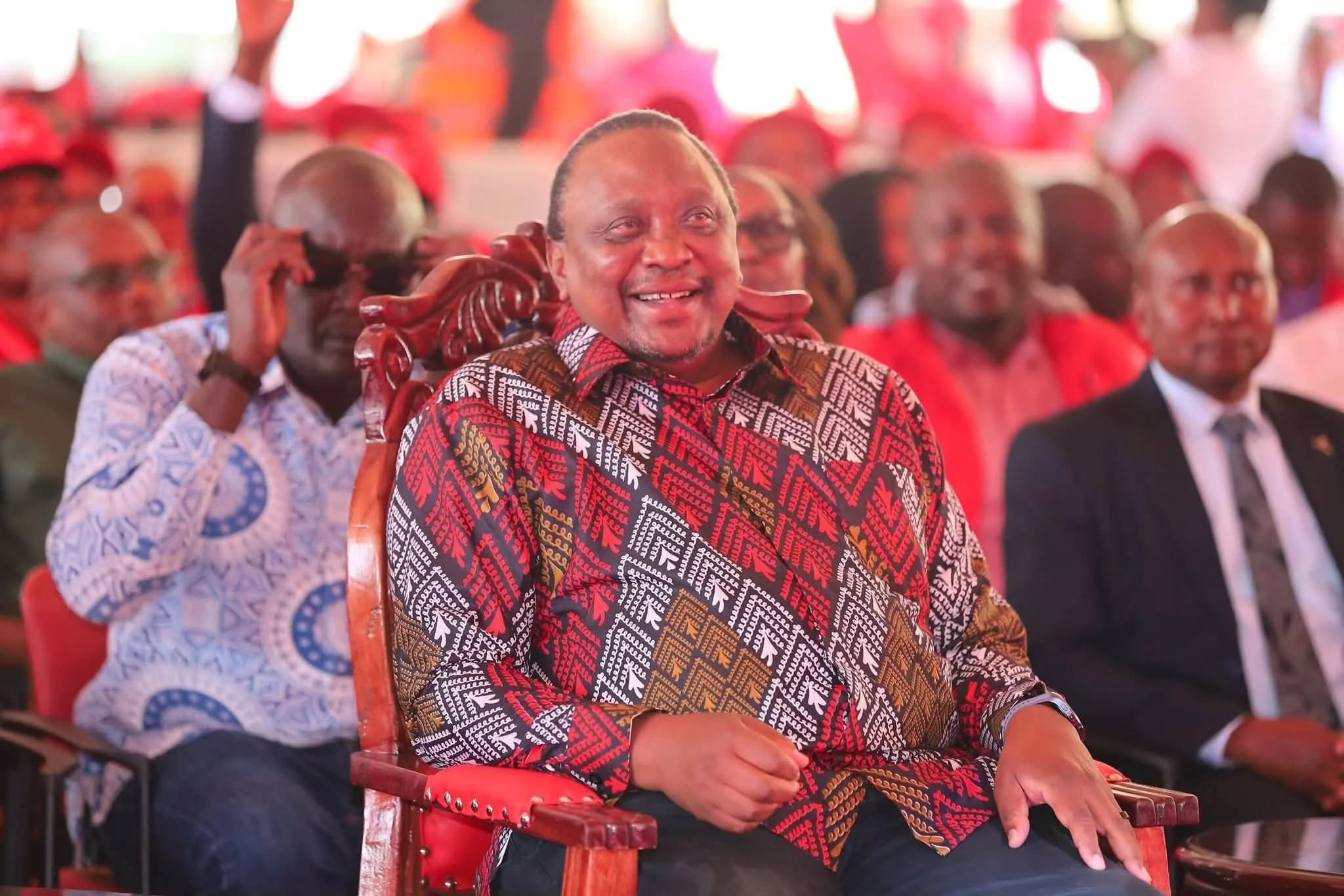
Four years late and barely a year before the next vote, former President Uhuru Kenyatta has dropped a political bombshell about the 2022 elections.
“We did everything to help Baba become President. He got the votes, and to this day I know he is the one who won those votes. We know how things happened, and we do not want it to happen that way again.”
He was speaking at Jubilee Party headquarters in Nairobi on September 22, 2026, as he handed the party to former Interior Cabinet Secretary Fred Matiang’i ahead of the 2027 elections. The man he was referring to, Raila Odinga, died in October 2025.
Read simply as news, President Kenyatta’s assertion is another reopening of the 2022 election. The Independent Electoral and Boundaries Commission declared William Ruto the winner with 7,176,141 votes, or 50.49 per cent, against Odinga’s 6,942,930, or 48.85 per cent. The Supreme Court upheld the result and power was transferred on September 13, 2022.
But this is not a statement that should be understood merely as news. It should be read and unpacked as strategy because it is not really about 2022. It is a decision brief for 2027.
Whether by design or default, Kenyatta’s statement is a strategic communication intervention that exposes the choice, the trade-off and, crucially, who owns the next move.
Strategic political communication, an area many politicians in Kenya struggle with, is ultimately about decisions rather than press conferences or press releases. Good political strategy is anchored in decision-making that allows the communicator to shape the next steps while remaining conscious of the trade-offs involved.
Those trade-offs matter because audiences are never a single mass public. They are fragmented into multiple constituencies, each interpreting the same message through different interests and experiences. The strategist’s task is therefore to control attention and centre the conversation on what advances the political objective.
So what choice is Kenyatta exposing?
Students of literature will tell you that a work of art eventually becomes independent of its artist. Political communication works in much the same way. It is not only what Kenyatta said that matters, but what his statement invites audiences to infer.
The outcome of his communication is not ultimately about Raila. It is about who owns Raila’s political legacy.
Kenyatta is not seeking to reopen the work of the IEBC or the courts. He appears to be seeking ownership of the opposition coalition itself.
When he asks how Azimio could have been defeated when it had a strong parliamentary and gubernatorial presence, he reframes the 2022 election around a different question. If Azimio secured significant numbers of MPs, governors and senators, then perhaps, in this framing, the problem was not the strength of the opposition at the ballot box but the protection of the presidential vote.
That creates a powerful narrative for 2027. It shifts the conversation away from the seemingly insurmountable advantage created by the broad-based government and towards the possibility of an opposition victory if the lessons of 2022 are properly understood.
The trade-off, however, is significant.
Kenyatta appears to be trading closure for continuity. To declare in 2026 that Raila won in 2022, when Raila can no longer contest the next election, creates a martyr narrative. It keeps the Azimio base mobilised around a grievance and gives his political legacy a continuing electoral purpose.
But the cost is that it risks denying the country the opportunity to allow Raila to rest.
There is another trade-off. Kenyatta is trading evidence for assertion. He has not presented new vote-counting evidence. Instead, he points to parliamentary and gubernatorial strength, which is not proof of the presidential tally, while largely bypassing the legal processes that upheld Ruto’s victory.
That is why Oburu Oginga’s question is so consequential: if Kenyatta was convinced that Raila had won, why did his government facilitate the transfer of power to a man he believed had not won?
That question exposes the most uncomfortable trade-off of all. If Kenyatta believed Raila had won in 2022, then he owned the next move in 2022. He was the incumbent president. He transferred power anyway.
This brings the argument back to Kenyatta himself. His statement is not only a defence of Raila. It is also a defence of his own record.
By anchoring 2027 in 2022, Kenyatta is attempting to make the strategic decision visible before political pressure intensifies. He is telling Jubilee and, perhaps, the wider opposition that their task is not necessarily to invent a new political grievance or manifesto. It is to ensure that “how things happened” in 2022 does not happen again.
That makes the statement powerful.
Kenyatta’s rallying call appears simple. The opposition should approach 2027 not as an underdog confronting an apparently dominant incumbent, but as the custodian of a victory it believes was denied to a revered leader who is no longer alive to claim it.
The avalanche of rebuttals suggests that Kenyatta has rattled the political establishment. More importantly, the reactions indicate that he has succeeded in setting the terms of a conversation he appears prepared to own.
He has reopened a question from 2022 that cannot be settled by assertion alone. Yet by doing so, he has made that unresolved question central to the 2027 conversation.
For Raila’s supporters, there is an even more unsettling interpretation. What they are witnessing may be confirmation of something some had suspected all along: that the political long game was always longer than they imagined.
Four years later, and barely a year before the next vote, Kenyatta has not closed the 2022 chapter.
He has turned its unfinished business into the opening argument for 2027.


Comments
No comments yet. Be the first to share your thoughts.