
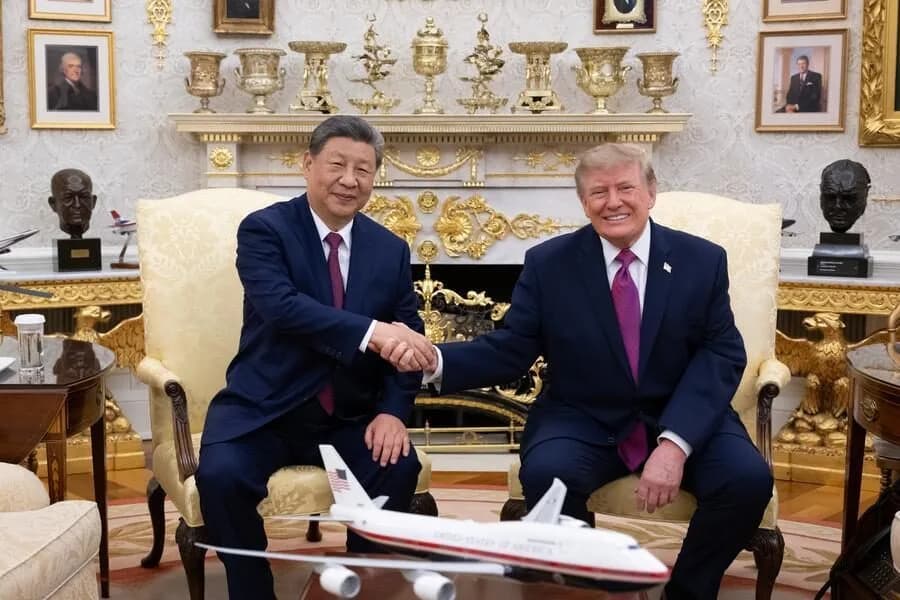
In a world increasingly defined by uncertainty, geopolitical tensions and economic disruption, the most consequential message to emerge from the meeting between Chinese President Xi Jinping and US President Donald Trump is stability.
The meeting comes at a particularly difficult moment for the international community. Military conflicts continue to reshape geopolitical relationships, disruptions to global supply chains are affecting economies and consumers, economic growth remains uneven, and widening development disparities continue to present a significant challenge to the international community.
Against this backdrop, greater stability and predictability in relations between China and the United States matter far beyond Washington and Beijing. The quality of this relationship matters for the wider international system and for countries whose economic and development prospects are closely tied to global trade and investment.
The two countries are the world’s largest economies and among its most influential countries. Their decisions have far-reaching implications for global trade, investment, technology, energy and international security. When relations between them become uncertain, the consequences are rarely confined to the two countries themselves.
The significance of the Xi-Trump meeting last week, therefore, should not be measured solely by the agreements reached or the issues that remain unresolved. Its broader importance lies in whether it can contribute to a more predictable and sustainable framework for managing one of the world’s most consequential bilateral relationships.
With the world watching closely, Xi’s message centred on communication, cooperation and peaceful coexistence. His emphasis was significant because the future of China-US relations will depend not on the absence of differences, but on the ability of the two countries to manage those differences while preserving space for cooperation.
He said the two countries should strengthen communication, cooperate with sincerity and coexist in peace. He also acknowledged that competition between China and the United States is inevitable, but argued that it should remain healthy and within reasonable bounds.
That distinction is important.
Competition does not necessarily have to lead to confrontation. Major countries can compete economically and technologically while maintaining dialogue, managing differences and establishing safeguards against miscalculation.
This is particularly important in an era of rapid technological change. China and the United States are both leading players in artificial intelligence, an area that is already transforming economies and societies. Cooperation in developing and managing AI responsibly could have consequences well beyond their borders.
The same principle applies to trade, law enforcement, counternarcotics, financial cooperation and people-to-people exchanges. None of these areas requires the two countries to agree on everything. What they require is a willingness to keep talking and identify where cooperation is possible.
But a stable relationship ultimately depends on a clear and informed understanding of each other’s interests, perspectives and strategic priorities.
For the China-US relationship to develop in a healthy and sustainable way, Washington and Beijing must recognise the realities of the other side. Differences in political systems, economic structures and strategic priorities are unlikely to disappear. Nor should they necessarily be expected to.
The challenge lies in managing those differences without allowing them to define the broader relationship, given the far-reaching consequences that tensions between the two countries can have across the international system.
This requires moving beyond the assumption that every difference must become a contest in which one side wins and the other loses.
Xi’s description of competition as a race in which countries can encourage one another to improve rather than a struggle in which only one can prevail offers an alternative way of looking at competition.
The United States also faces an important question about its own future.
Arnold Toynbee’s famous observation that civilisations face their greatest challenges from within offers a useful reminder that international influence is ultimately sustained by a country’s capacity for renewal, innovation and effective responses to its domestic challenges.
For the United States, maintaining its considerable global influence will depend not only on how it approaches other major countries, but also on how effectively it addresses its own economic, technological and social challenges and continues to generate new ideas and opportunities.
That is not a question of decline or defeat. It is a question of adaptation.
China, too, faces its own challenges and responsibilities as its global influence grows. The relationship between the two countries will therefore require adjustment from both sides.
What matters is finding a framework in which differences can be managed while areas of common interest continue to expand.
Xi’s call to “steer the giant ship” of China-US relations towards the future captures the scale of the task.
A ship of that size cannot change direction suddenly without consequences. It requires communication, coordination and a clear understanding of where it is going.
The same is true of the global economy.
China and the United States do not have to agree on every international issue. They do, however, have a shared interest in preventing their differences from becoming a source of wider global instability.
The potential benefits of greater cooperation extend well beyond the two countries.
Developing economies depend on predictable trade and investment flows. Businesses need certainty. Consumers are affected by supply chains and commodity prices. Countries in Africa, Asia and elsewhere have a strong interest in an international environment that provides space for development rather than one dominated by prolonged strategic rivalry.
This is why the Xi-Trump meeting deserves attention beyond the immediate headlines.
China-US cooperation will not resolve every problem facing the world. But sustained disagreement between the two countries can make many global challenges more difficult to address.
The task now is to build on the opening created by the meeting.
That means maintaining dialogue when disagreements emerge, strengthening mechanisms that can prevent misunderstandings from escalating, expanding practical cooperation where interests overlap and allowing healthy competition to coexist with peaceful relations.
The world does not require China and the United States to share the same political systems, strategic priorities or visions of national development. What it requires is an understanding that profound differences can coexist with dialogue, cooperation and mutual respect. Their ability to manage those differences responsibly will have consequences far beyond their own borders, shaping the stability of the international system and the prospects for global economic development.
In an increasingly uncertain international environment, stability is a fundamental condition for sustained economic and social progress. It provides the predictability necessary for countries to trade, invest, innovate and pursue long-term development.
The Xi-Trump meeting offers an important opportunity to strengthen that foundation and establish a more predictable framework for China-US relations.
Its lasting significance, however, will be determined by what follows the presidential engagement. Sustained dialogue, institutional cooperation and continued people-to-people exchanges will be essential to translating political understanding into a durable relationship. The responsibility will rest not only with the two leaders, but also with the institutions and societies that give the relationship substance.
The “giant ship” of China-US relations has been given an opportunity to find a steadier course. Keeping it on that course will require patience, strategic clarity and a recognition that cooperation between the two countries serves interests that extend well beyond their own borders.
In an unsettled international environment, that may be one of the most consequential responsibilities before Beijing and Washington.
Elijah Mwangi is a scholar based in Nairobi who comments on local and global affairs.


Comments
No comments yet. Be the first to share your thoughts.