
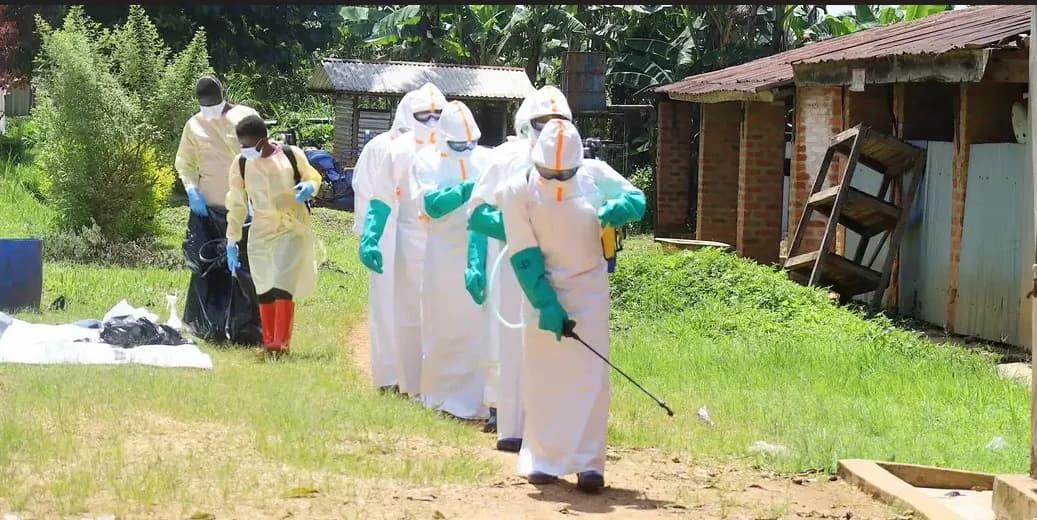
Uganda says it has no active Ebola cases as Africa CDC calls for urgent global support

Africa CDC has begun mobilising support for Nigeria while strengthening its response in the DRC and Kenya and maintaining heightened vigilance in Uganda.
Uganda has clarified that it has no active Ebola cases despite Nigeria confirming Ebola in a woman who travelled to eastern DRC for business and passed through Uganda on her way to Nigeria.
Nigeria’s Federal Ministry of Health and Social Welfare says the woman arrived on an international flight from Uganda and was admitted to a private hospital in Abuja, where she received treatment for several days before lab tests confirmed the infection.
The patient is currently in isolation and receiving medical care.
Nigerian health authorities have now launched emergency public health measures and contact tracing involving 44 people to prevent further transmission.
Uganda’s Ministry of Health has, however, cautioned against linking the infection to Uganda, noting that investigations were still ongoing to establish where the woman contracted the virus.
According to the Ministry, the woman passed through the country in early October without showing symptoms but developed them after arriving in Nigeria.
Latest Stories
- Japan’s MMX mission aims to swipe soil samples from Mars’ moon Phobos
- Earth’s oldest evidence of life is written in stone – but it’s at risk of disappearing
- Poorer, less-educated people face greater barriers to chronic disease care, WHO report finds
- Palestinian citizens face a painful choice in Israel’s election: To vote or not
“Travel through Uganda does not establish that infection occurred here,” the ministry said.
Uganda’s Director General of Health Services, Professor Charles Olaro, said the government was waiting for detailed information from Nigerian authorities about the woman’s travel itinerary and clinical history to guide further investigations and any necessary contact tracing.
“The Government of Nigeria is yet to provide detailed information on her travel itinerary and clinical history which will guide further investigations and any necessary contact tracing,” reads the statement.
The ministry also said Uganda had maintained limited arrangements for humanitarian and diplomatic movement. It added that, working with relevant agencies, it would strengthen screening and public health controls at points of entry.
It urged the public to remain calm and vigilant, practise regular handwashing and sanitising, and follow verified updates shared through official channels.
“We wish to clarify that, as at the time of this statement, Uganda has no confirmed active Ebola cases,” it said.
The case has prompted renewed concern over the spread of Ebola Bundibugyo across Africa, with the Africa Centres for Disease Control and Prevention (Africa CDC) calling for urgent international assistance to contain the outbreak.
Africa CDC Director General Dr Jean Kaseya said he had spoken with Nigeria’s Coordinating Minister of Health and Social Welfare, Professor Muhammad Ali Pate, who informed him of the confirmed case.
Kaseya praised the Nigerian minister for his transparency and leadership, stressing that early reporting was essential in saving lives.
“When Africa CDC declared this Ebola outbreak on May 15, 2026, we warned of its regional dimension and implications,” Kaseya said.
He described the outbreak as the most geographically widespread in history, affecting several countries across three African regions. He also warned that the fatality rate in the Democratic Republic of Congo was approaching 50 per cent.
Africa CDC has begun mobilising support for Nigeria while strengthening its response in the DRC and Kenya and maintaining heightened vigilance in Uganda.
Kaseya called for immediate and flexible funding, medical supplies, diagnostic equipment, trained emergency responders and stronger community-based surveillance to help affected countries contain the disease.
“My appeal to the international community is urgent: Act Now,” he said.
He warned that delays in providing assistance could allow the outbreak to spread to more countries or continue into another year.
“Every day of delay costs lives. Africa’s health security is global health security,” Kaseya said.
He reaffirmed Africa CDC’s support for Nigeria, saying the response required joint action by African governments, international partners and health organisations.
“Nigeria can count on our full solidarity and unwavering support. Together, we must defeat this outbreak,” Kaseya said.
The latest developments follow Kenya’s confirmation of its first imported Ebola Bundibugyo case on October 6, 2026, by Health Cabinet Secretary Aden Duale, with the number of cases since rising to nine.
Duale said the Kenyan patient had travelled from the DRC to Kampala by road before boarding Jambojet flight number 8523 to Nairobi, arriving at Jomo Kenyatta International Airport on October 3 at about 1:00 pm.
He said the patient had lived and worked in the DRC for seven years and had fallen ill about a month before travelling, receiving treatment at several hospitals in the country. The patient later died.
The cases have heightened the need for early detection, information-sharing, contact tracing and coordinated public health measures to limit further transmission across borders.


Comments
No comments yet. Be the first to share your thoughts.