
Understanding Ebola: Why Kenya's two cases don't amount to a wider outbreak

Although the Ministry has reported no evidence of wider community transmission, continued contact tracing, testing and monitoring remain critical to containing the virus and preventing further infections.
Kenya has confirmed two cases of Ebola, including one death, but health authorities say there is no evidence of wider community transmission.
The situation has raised questions about what constitutes an outbreak, whether an imported case can trigger one, and what must happen before the disease is considered contained.
The Ministry of Health confirmed the country's first case of Bundibugyo virus disease, a form of Ebola, on October 6, 2026. The patient, a Kenyan man who had been living in the Democratic Republic of Congo (DRC), travelled through Uganda before arriving in Nairobi on October 3. He tested positive for the virus and died on October 5.
On October 14, the Ministry confirmed a second case involving a close family member of the first patient. The 39-year-old had been identified as a contact and placed in quarantine before developing symptoms, including fever, fatigue and joint pain. He was isolated after becoming ill and subsequently tested positive.
According to the Ministry, the infections are linked, and there is no evidence of wider community transmission. An outbreak occurs, the World Health Organisation (WHO) says, when a disease emerges in a particular area and requires a coordinated public health response.
For Ebola, authorities do not need to wait for several people to become infected before taking action. A single confirmed case can be enough to trigger an outbreak declaration, depending on the circumstances and the assessment of public health authorities.
Latest Stories
- African countries could save billions by cutting air pollution and greenhouse gases at the same time
- Nominated Senator Crystal Asige joins Winnie Odinga and Jalang’o in Nairobi Senate race
- Tusker FC suffer home defeat as Singida strike puts CAF Confederation Cup hopes at risk
- Ecuadorian priest dies after giant wooden crucifix crashes down on him during live-streamed Mass
An imported case occurs when a person acquires an infection in another country and is diagnosed after arriving in a new country. Local transmission occurs when that person infects someone within the country. Wider community transmission refers to further spread beyond the initial case and directly identified contacts.
Kenya's first case was classified as imported because the patient had been infected before arriving from the DRC, where the virus was already circulating.
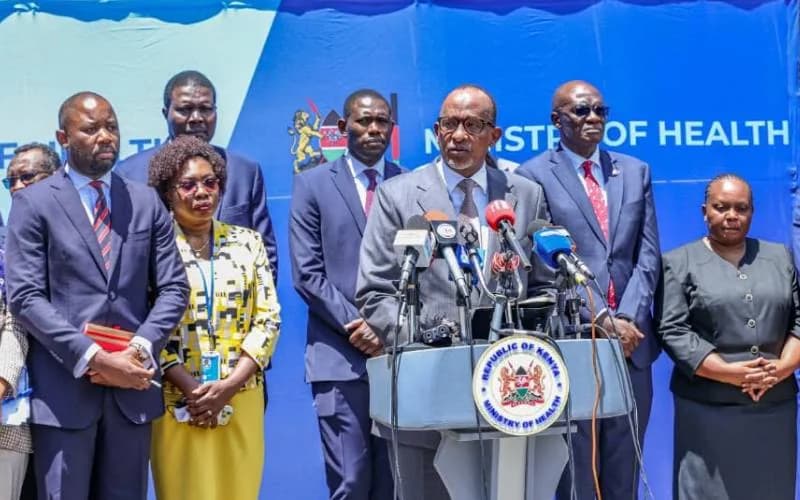
On October 7, Health Cabinet Secretary Aden Duale said Kenya was not experiencing an Ebola outbreak following confirmation of the imported case. He said the government was strengthening surveillance, contact tracing and isolation measures to prevent further spread.
However, the second case changed the picture because it confirmed that another person in Kenya had become infected. Since the patient was already in quarantine, the infection was detected through contact monitoring.
This does not indicate widespread community transmission, but it means the situation can no longer be described simply as an imported case with no secondary infection. An imported case can trigger an outbreak declaration. The absence of wider community transmission describes how far the virus has spread; it does not, by itself, determine whether an outbreak exists.
The Ministry is leading Kenya's response through laboratory testing, isolation, contact tracing and surveillance. Confirmed cases are investigated to establish how infection occurred, identify people who may have been exposed and determine whether further transmission has taken place.
Director-General for Health Dr Patrick Amoth has emphasised the importance of early detection, quarantine and monitoring in containing the disease. These measures help health workers identify infected people before they expose others.
Kenya has also declared Ebola a formidable epidemic disease under the Public Health Act, strengthening the legal basis for measures such as screening, isolation, quarantine and contact tracing. This legal designation is distinct from the assessment of whether the virus is spreading widely in the community.
The WHO recommends that an Ebola outbreak be declared over after 42 consecutive days without a new confirmed or probable case. The countdown begins the day after the last patient either tests negative twice following recovery or, in the event of death, is safely buried under appropriate infection-control procedures.
The 42 days represent twice Ebola's maximum 21-day incubation period, allowing time to detect infections that may have gone unnoticed. During this period, health authorities must continue surveillance, investigate suspected cases and monitor contacts. If another linked case is confirmed, the countdown may need to restart.
Uganda provides a recent example. The WHO and Africa CDC declared the end of its Bundibugyo Ebola outbreak on August 27, 2026, after 42 consecutive days without a new confirmed case following the discharge of the last patient.
Kenya has reported 334 suspected Ebola cases, alongside two confirmed infections and one death. Of the 128 contacts identified in connection with the first patient, 108 are in quarantine, while 15 remain untraced and five are being followed up by health authorities outside the country.
The untraced contacts remain a concern because anyone exposed to the virus could develop symptoms and potentially infect others before being identified and isolated.
Although the Ministry has reported no evidence of wider community transmission, continued contact tracing, testing and monitoring remain critical to containing the virus and preventing further infections.


Comments
No comments yet. Be the first to share your thoughts.