
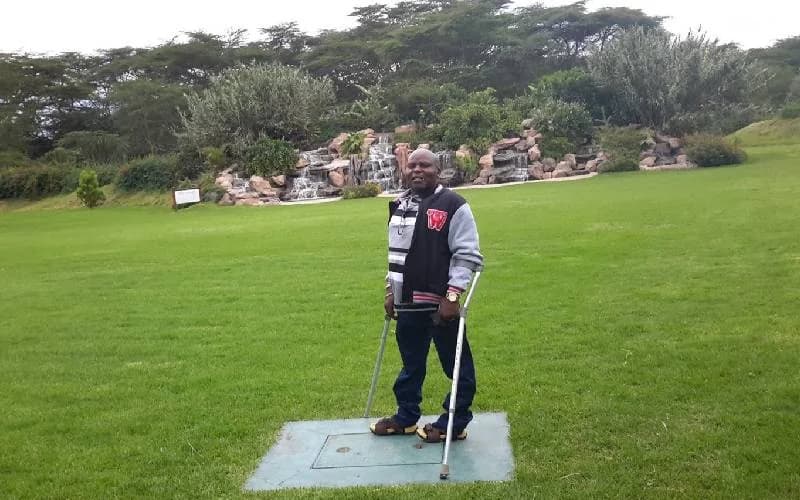
Polio survivor Samuel Chira's push for inclusion after a childhood in hiding

In their search for answers, his family often took him to prayer crusades, while others recommended alternative interventions.
For much of his childhood, Samuel Chira was hidden from visitors to his family home after contracting polio at the age of one.
His parents and relatives did not understand why he could not walk like other children. As a result, he grew up facing stigma, isolation and widespread misconceptions about disability.
Some members of the community attributed his condition to a curse or believed he had been bewitched. In their search for answers, his family often took him to prayer crusades, while others recommended alternative interventions.
“I was brought up in an enclosure. Even outsiders could not see me. When visitors came, I would be hidden in a certain room until they left,” says Chira, now 58.
Looking back, he does not blame his parents. He understands they were products of their time, when knowledge about disability was limited, and families often struggled to understand conditions they had never encountered.
But his childhood could have taken a different course had a Catholic priest not taken an interest in him. The Italian, who was on a visit to his grandmother's home nearby, saw him crawling on the ground with no crutches or other assistive devices to help him move.
Latest Stories
- Ballon d'Or: How countries compare in all-time wins
- Kenya scores poorly on pension adequacy in global index, raising questions over retirees’ financial security
- Uganda Law Society demands probe into beheading of ex-Rwanda military officer
- Hassan Omar appears before IEBC committee, defends 'dead voters' remarks
He took an interest in his welfare and helped arrange for him to attend a special school for children with disabilities, which he joined at the age of 10, much later than most children start primary school.
At the special school, he received callipers and crutches that enabled him to stand and begin walking with support. It also gave Chira an opportunity to learn alongside other children with disabilities and develop skills that would later help him become independent.
He studied there for eight years, completing his primary education before moving to a mainstream secondary school.
Samuel Chira, 58, a polio champion who works at Kenyatta National Hospital. (Photo: Handout)After primary school, Chira joined Jabilo Boys Secondary School, where he studied alongside hundreds of students without disabilities. He was the only student with a disability in a school of approximately 300 to 400 learners.
The transition was not easy. Participating in games and other school activities was difficult, and he had to find ways to adapt to an environment that was not necessarily designed with his needs in mind.
He later joined Machakos Technical College, where he studied electronics and electrical installation. In 1989, he completed his training, paving the way for his entry into the workforce.
The experience transformed not only his life but also his family's understanding of disability. His parents, who had initially struggled to accept his condition, were happy to see him get an education. Chira says they eventually came to understand his disability and were proud of what he achieved before they died in the 1990s.
Today, Chira has worked in the ICT department at Kenyatta National Hospital for 33 years, where he serves as a telephone operator.
His journey from a child hidden from visitors to an employee at one of the country's largest referral hospitals is one he hopes other people living with disabilities can draw inspiration from.
The 58-year-old encourages people with disabilities to interact with others and participate in community life rather than withdraw because of how society might treat them.
“The more you get exposed, the more people understand and accept you,” he says.
However, Chira says inclusion requires more than courage. In secondary school and college, inaccessible facilities, transport challenges and inadequate accommodations often left him feeling excluded from his peers. He believes people with disabilities should participate alongside others with the support they need to live independently.
He also faced challenges finding a partner, as some women questioned whether he could provide for a family. Eventually, he found someone who accepted him, and they have been married for 35 years and raised three sons.
For Chira, raising a family and maintaining a career are reminders that disability does not take away a person's ability to love, work, parent or contribute to society. Through conversations, support and encouragement, he has seen people become more confident in confronting challenges and engaging with their communities.
A past polio vaccination drive in Garissa County. (Photo: KNA)Chira urges parents to seek medical care for their children, complete routine polio immunisation and participate in vaccination campaigns. He says early acceptance and care help children reach their potential.
“Any child you are blessed with has a right to live just the way you do. Try to provide the necessary care and give that child a chance,” he says.
He believes people with disabilities should be supported to develop skills, access employment, and earn a living rather than be treated only as recipients of charity.
“Show me how to fish so that I can also fish, rather than just giving me fish,” he says.
It is a philosophy shaped by his own journey. The child who once depended on others to help him access education grew into a man who has worked for more than three decades, raised a family and encouraged others to overcome the stigma surrounding disability.
No child, he believes, should have to be hidden away because the people around them do not understand their condition.
Polio is a highly infectious viral disease that mainly affects children under five and can cause irreversible paralysis within hours, according to the World Health Organisation (WHO). About one in 200 infections leads to permanent paralysis, and there is no cure, although vaccination can prevent the disease.
Vaccine hesitancy, misinformation and difficulties reaching vulnerable communities are complicating efforts to eradicate polio, with health experts warning that gaps in immunisation leave children exposed to a disease that can cause permanent paralysis.
Speaking during a webinar hosted by Rotary Kenya, Boston Zimba and representatives from the WHO and Kenya’s National Vaccines and Immunisation Programme highlighted the need to rebuild public confidence in vaccines, strengthen surveillance and improve community engagement to prevent outbreaks.
Zimba raised concerns about the growing challenge of vaccine hesitancy, noting that immunisation campaigns are costly to organise and can be difficult to sustain when communities do not understand why they are necessary.
He emphasised the importance of providing accurate information about vaccines and helping communities understand the benefits of immunisation, rather than relying solely on campaigns to persuade people to vaccinate their children.
The goal, he said, should be to reach a point where communities understand the value of vaccination and actively seek it for their children.
A child being vaccinated against polio after an outbreak in the Horn of Africa. (Photo: UNICEF Ethiopia/2013/Sewunet)According to Dr Christine Miano of the National Vaccines and Immunisation Programme, vaccine hesitancy must be addressed through consistent public education and clear communication.
Miano said social media misinformation, vaccination fatigue and concerns about children receiving multiple vaccines in one visit can fuel hesitancy. She stressed the need for health workers to address parents’ concerns, explain possible side effects and provide clear, reliable information on vaccine safety.
Both experts noted that active case searches and integrated surveillance require adequate resources and coordination between national and county health teams to ensure suspected cases are promptly investigated and tested.
They called for stronger community engagement, accessible vaccination services and sustained surveillance, noting that polio eradication depends on vaccines, public trust, effective communication and reaching every child.
And as long as pockets of children remain unvaccinated, the virus can continue to circulate and threaten communities that have made progress in controlling the disease.
The concern comes as polio remains a global public health threat despite decades of eradication efforts. According to WHO, 52 cases of wild poliovirus type 1 were reported globally in 2025, including 31 in Pakistan and 21 in Afghanistan. A further four cases had been reported in the two countries by April 2026.
The burden extends beyond wild poliovirus. WHO reported 238 cases of circulating vaccine-derived poliovirus across 30 countries in 2025, alongside 247 confirmed detections in environmental samples.
By April 30, 2026, another 32 cases and 27 environmental detections had been reported across 12 countries. These figures demonstrate why maintaining high vaccination coverage remains essential even as eradication efforts advance.
Wild poliovirus is the naturally circulating form of the virus. Vaccine-derived poliovirus, meanwhile, can emerge when the weakened virus used in the oral polio vaccine circulates for a prolonged period among under-immunised populations and undergoes genetic changes that allow it to cause disease.
The risk of vaccine-derived outbreaks is not a reason to abandon vaccination. Rather, it highlights the importance of ensuring that enough children receive their recommended doses to prevent the virus from circulating. WHO says polio vaccines remain central to preventing the disease, which has no cure.
Comments
No comments yet. Be the first to share your thoughts.