
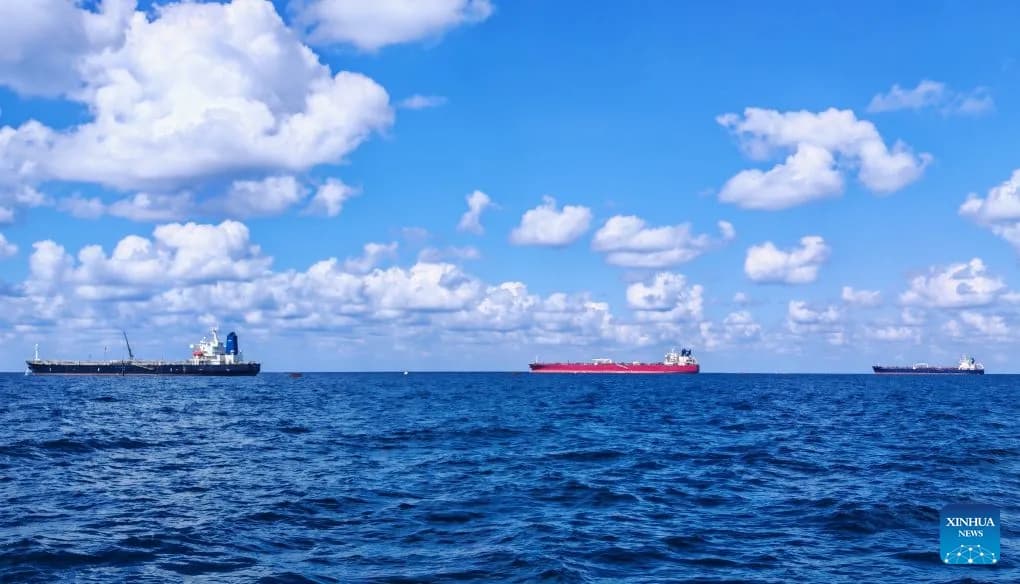
DAMASCUS, Sept. 28 (Xinhua) — The Syrian Petroleum Company (SPC) has begun transporting gasoline supplied for Iraq through the Banias oil terminal under a three-month renewable agreement, as regional energy flows face disruption from instability around the Strait of Hormuz, Syria’s state news agency SANA reported Sunday.
Ahmed Qabbaji, deputy executive president for transportation and storage at the company, said the operation began Thursday with an initial batch of 57 tanker trucks, with plans to increase capacity to around 200 trucks per day traveling to Iraq through the al-Tanf border crossing between Syria and Iraq.
According to media reports, Iraq’s State Organization for Marketing of Oil signed a contract with Qatar’s UCC to supply Iraq with improved gasoline via road tankers from Banias. The operation is carried out under a transit contract between the SPC and the Qatari company.
Qabbaji said UCC is purchasing the gasoline from several international sources, while the Syrian side handles its transportation in return for transit fees.
Ten fuel tankers are currently at sea as part of the operation, two of which have already unloaded into the SPC’s storage facilities in Banias, he said.
The company has prepared loading areas and eight loading bays capable of filling eight tanker trucks simultaneously, with unloading and loading operations continuing around the clock.
Qabbaji said the transit operation would generate revenue for both the company and the Syrian state while strengthening Syria’s role as a regional corridor for imports, exports and energy transportation.
He added that gasoline and fuel oil are currently being transported through the al-Tanf crossing, while other border crossings could be used for different products. Plans are also under consideration to expand transit operations to other commodities.
Separately, between 1,000 and 1,200 tanker trucks carrying Iraqi oil are currently moving through Syrian territory each day, according to Qabbaji, with volumes varying depending on weather and transportation conditions.
Qabbaji also said work is underway to prepare the Arab Gas Pipeline up to the Syrian-Jordanian border and a branch toward Lebanon, which is expected to be ready within about 15 days to transport gas to Lebanon once the necessary preparations are completed.
The developments come as Syria seeks to revive its energy and transit infrastructure and capitalize on its geographical position linking Iraq and the Gulf region with Mediterranean ports.
The country’s economy has shown signs of recovery after years of conflict and isolation. The International Monetary Fund said in August that Syria’s economy began recovering in 2025 and projected growth of more than 10 percent in 2026, supported partly by the country’s gradual reintegration into regional and global economies.



Comments
No comments yet. Be the first to share your thoughts.