
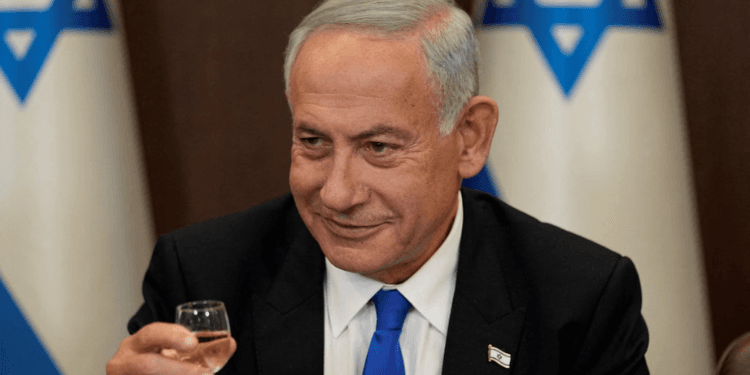
Israeli Prime Minister Benjamin Netanyahu has ordered an expansion of Israel’s military campaign in southern Lebanon, rejecting European calls for restraint as fighting along the northern border escalates.
In a statement delivered by Israel’s Northern Command on April 13, Netanyahu said he had instructed the Israel Defense Forces to expand what Israel describes as a security buffer zone in southern Lebanon.
The decision comes amid ongoing hostilities with Hezbollah and growing international concern about the scale and duration of Israel’s operations inside Lebanon.
Netanyahu Defies European Nations
Netanyahu said the move was intended to protect Israeli communities near the border and to prevent rocket and missile fire from Hezbollah.
The Israeli Prime Minister added that Israel’s actions were not limited to a small number of locations but were aimed at changing the security situation along the entire frontier.
Israeli military officials confirmed that ground forces have advanced beyond earlier positions and established new points of control in southern Lebanon.
The army said the expanded campaign includes ground maneuvers, air strikes, and artillery fire directed at what it described as Hezbollah launch sites, command centers, and supply routes.
The military did not release precise troop numbers but acknowledged that additional units had been deployed to support the widened operations.
Netanyahu’s order followed renewed diplomatic pressure from European governments and institutions.
Leaders from France, Ireland, Spain, and other European Union (EU) member states have publicly urged Israel to scale back its military action, warning that continued escalation risks further destabilizing the region.
The EU has also called for respect for Lebanese sovereignty and for full compliance with United Nations Security Council resolutions governing the border region.
In response, Netanyahu said Israel would not allow foreign pressure to dictate its security policy.
He stated that ceasefire discussions elsewhere in the region do not apply to Lebanon and that Israel would continue its military actions for as long as it deems necessary to prevent attacks from the north.
Israeli officials later reiterated that European objections would not prompt changes to the operational plans.
The expansion in Lebanon comes as Israel continues military operations in the Gaza Strip against Hamas.
Netanyahu has repeatedly stated that Israel is conducting a multi-front campaign and that Hamas and Hezbollah have both been weakened by sustained military pressure.
Hezbollah Steps Up Cross‑Border Attacks
Hezbollah has intensified its attacks along the Israeli-Lebanese border, increasing pressure on Israel’s northern front and contributing to a sustained escalation in fighting.
The group has expanded the scope and frequency of its operations, launching rockets, missiles, armed drones, and anti-tank fire toward Israeli military positions and nearby communities.
Israeli authorities say the attacks have targeted border areas, surveillance systems, and troop positions, forcing evacuations in several northern towns and prompting heightened military readiness.
Hezbollah has stated that its actions are directed at Israeli military assets and are part of what it describes as a broader confrontation tied to ongoing regional hostilities.
The intensified attacks have coincided with heavier Israeli air strikes and expanded ground operations inside southern Lebanon.
Israeli forces say they are responding to persistent fire and attempting to destroy Hezbollah’s launch sites, weapons stockpiles, and command infrastructure.
Lebanese officials, meanwhile, report casualties and widespread displacement in areas affected by the fighting.
The exchanges have resulted in near‑daily cross‑border fire, disrupting civilian life on both sides and prompting warnings from international organizations about the risk of further escalation.
United Nations officials have reported damage near peacekeeping positions and have urged restraint to reduce civilian harm.




Comments
No comments yet. Be the first to share your thoughts.