
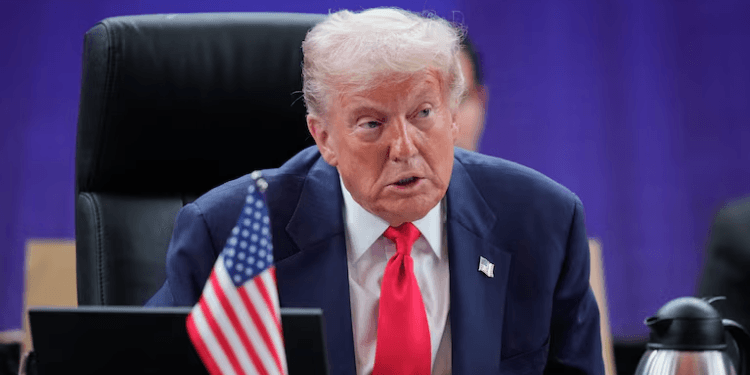
U.S President Donald Trump has openly blamed a senior member of his own cabinet for blocking efforts to end the war with Iran.
Speaking at events in Tennessee and later at the White House this week, Trump said his defence secretary, Pete Hegseth, was opposed to any settlement with Tehran and was unhappy when talks about ending the war were raised.
This marks the clearest signs yet of deep divisions inside Trump’s administration as the conflict enters its fourth week.
Trump said Hegseth and another top military official were “disappointed” when he told them the conflict could soon be brought to a close.
Trump Blames Pete Hegseth
According to Trump, some officials were focused solely on a total victory and were not interested in an agreement that could stop the fighting.
He added that he now believes the war’s key goals have been achieved and that negotiations should follow.
The comments came as the White House claimed it was engaged in negotiations with Iran, including a reported 15-point proposal sent through intermediaries.
Iran has publicly denied engaging in direct talks with Trump’s administration, which adds to the confusion about the true state of diplomacy.
Hegseth, who was standing beside Trump during an Oval Office event, made remarks that sharply contrasted with the president’s claims of peace efforts.
“We negotiate with bombs,” he said, describing the ongoing air campaign as part of the negotiating process.
He praised the scale of US and Israeli strikes and said force was the reason Iran would eventually comply.
In earlier statements, Hegseth also warned that the United States would continue attacking Iran on its own timeline and assured that the most intense days of bombing are still to come.
He has repeatedly said the war is being fought to permanently deny Iran the ability to develop nuclear weapons.
Trump’s Indecision
Trump’s public criticism of his defence secretary appears to be part of a wider effort to distance himself from the increasingly unpopular war.
After returning to the office, Trump had promised to avoid long foreign conflicts.
However, the war with Iran, launched on February 28 alongside Israel, has already become the largest US military operation in more than two decades.
At least 13 US service members have been killed, with hundreds wounded. Iran has responded with missile and drone attacks across the Middle East, including strikes affecting Gulf states and shipping lanes.
The Strait of Hormuz, an essential route for global oil exports, has been heavily disrupted, causing a rise in energy prices worldwide.
Despite this, Trump has repeatedly declared victory, claiming Iran’s military power has been destroyed, and regime change has already occurred.
He insists the war could end very soon, but he also contradicts himself by saying it might continue as long as he feels necessary.
Inside Washington, lawmakers from both parties have expressed concern about the absence of a clear end plan.
Iran’s Stance on the War
Iran has taken a firm position against ending the war on terms set by the United States or Israel.
Iranian military leaders and government officials state that fighting will persist until what they call complete victory and the end of external military pressure.
Tehran has rejected claims by the U.S that peace talks are underway, insisting no direct negotiations are taking place.
Iran says any ceasefire must include an end to US‑Israeli strikes, protection of its sovereignty, and guarantees against future attacks.
Officials have warned that ongoing pressure could lead to broader retaliation, including attacks on regional bases, shipping routes, and energy infrastructure.




Comments
No comments yet. Be the first to share your thoughts.