
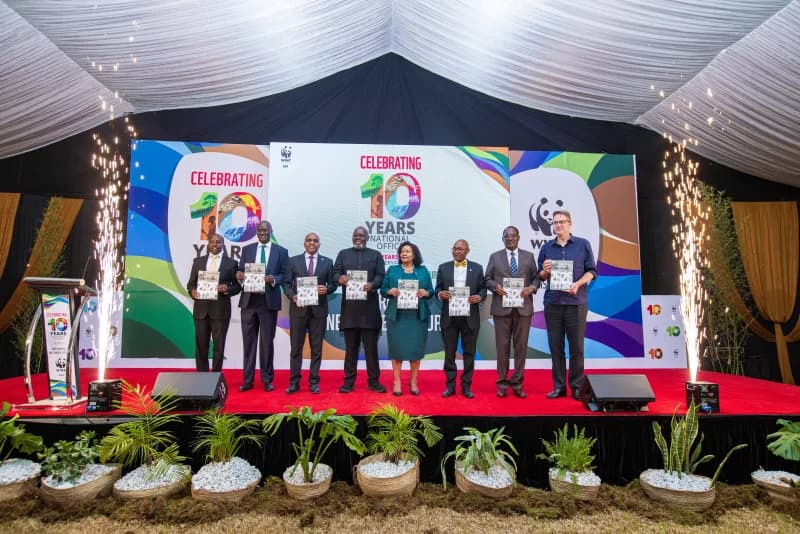
The push for private-sector financing gained momentum with a strategic partnership between WWF-Kenya and KCB Group to mobilise climate finance
The organisation reported that initiatives supporting nature-based enterprises, conservation employment, ecotourism and land leases generated Sh80.8 million for beneficiaries in the 2026 financial year. /HANDOUT

Conservation organisation WWF-Kenya is seeking greater investment from Kenyan businesses as pressure on traditional development funding forces conservation agencies to diversify their financing and find new ways to sustain environmental programmes.
The organisation’s 2026 annual report shows that programme investments grew from Sh629.5 million in the 2017 financial year to more than Sh1.6 billion in the 2026 financial year, reflecting an expansion of its conservation activities since becoming an autonomous national office in 2016.
WWF-Kenya says it has mobilised more than $132 million (approximately Sh16.88 billion) in sustainable investments since 2020 through partnerships directing public and private finance towards nature-related initiatives.
However, the report does not disclose how much of this funding originated from Kenyan businesses, foreign investors or public institutions, leaving the extent to which domestic capital can replace traditional donor support unclear.
The partnership, announced in Nairobi during WWF-Kenya’s 10th anniversary celebrations as a national office, will support nature-based enterprises, develop bankable conservation projects and mobilise public and private resources for climate resilience.
It will also cover landscape restoration, tree growing, institutional clean cooking, solarisation and the integration of environmental, social and governance (ESG) considerations into business and lending decisions.
“Since 2020, we have supported the restoration of more than 278,000 hectares of diverse ecosystems, including forests, wetlands, riparian areas and rangelands. We have also helped mobilise more than $132 million (Sh16.88 billion) in sustainable investments over the past seven years,” said WWF-Kenya chief executive Jackson Kiplagat.
“This is the scale of impact that must now be accelerated through stronger partnerships with Kenya’s corporate sector,” he added.
The partnership builds on earlier collaboration between WWF-Kenya and KCB Group, including a case study on integrating nature-related risks into financial institutions’ governance structures and lending decisions.
Cumulative benefits reached approximately Sh606.6 million between the 2020 and 2026 financial years, supporting activities including honey production, farm produce, seedling sales, fishing-related enterprises, ranger employment and ecotourism.
“Over the past seven years, WWF-Kenya has directly benefited more than 369,000 people, helping generate over KES 600 million in income for communities. These outcomes demonstrate that conservation and economic development can go hand in hand when communities are at the centre of the solution,” Kiplagat said.
The organisation also reported disbursing more than Sh400 million to partners over the past year and working with more than 50 partners. The 2026 report further records that 96,000 acres were placed under restoration across five ecosystems.
National Treasury Principal Secretary Chris Kiptoo lauded the initiative noting that partnerships between government, communities, conservation organisations and businesses would be essential to sustaining environmental programmes beyond individual funding cycles.
He cited the Kaptagat Integrated Conservation Programme as an example of how ecosystem restoration can be combined with community development, enterprise creation, water security and sustainable land management.
Kiptoo said conservation and development should reinforce each other, with locally led initiatives delivering lasting environmental, social and economic benefits.
The financing drive follows another partnership announced earlier this year between WWF-Kenya and Old Mutual Holdings to restore 100 hectares of degraded Chepalungu Forest over three years.
Comments
No comments yet. Be the first to share your thoughts.