
Intergovernmental Authority on Development (IGAD) member states have been urged to strengthen governance, improve coordination and translate national policy frameworks into practical implementation plans to address emerging regional challenges.
The states have also been encouraged to integrate anticipatory action into national and county development plans, sectoral programmes and budgets to enhance preparedness and build resilience against disasters.
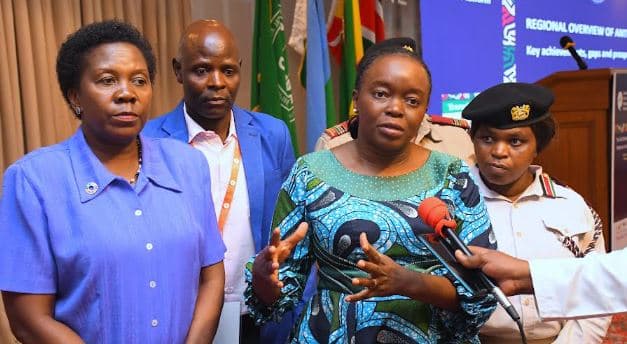
Cabinet Secretary (CS) for Environment, Climate Change and Forestry Dr Deborah Barasa underscored the need to strengthen coordination among national institutions, county governments and implementing partners during a ministerial forum held on the final day of the second Eastern Africa Dialogue Platform on Anticipatory Action in Mombasa.
Dr Barasa urged member states to develop operational triggers linked to pre-arranged financing and agreed early actions while strengthening monitoring, reporting, accountability and learning mechanisms.
“Our policies and strategies must result in funded plans. We are really looking into ensuring that the finances are able to support us in implementing the plans with clear mandates and measurable outcomes, and ensuring accountability and transparency through our monitoring and evaluation strategies,” said Dr Barasa.
She affirmed that anticipatory action must become an integral part of government systems rather than remain an isolated project or be implemented in silos.
The CS noted that the government was also promoting meaningful community participation to ensure local priorities and indigenous knowledge complement scientific approaches.
“We are strengthening cross-border information sharing, joint preparedness and coordinated responses to transboundary hazards, while encouraging development partners to align their support with national priorities and strengthen existing institutions and local capacity,” she said.
Dr Barasa emphasised that regional cooperation was critical in ensuring that risks that cross national borders were matched by equally coordinated responses.
“Financing must be arranged before a hazard strikes and released when agreed triggers are reached,” she said.
Member states were also encouraged to identify realistic and measurable financing commitments or establish time-bound pathways towards achieving them, taking into account their fiscal capacities, exposure to hazards and national priorities.
“We should turn political will into measurable commitments and implementations,” urged Dr Barasa, emphasising the need for clear plans on early warning systems, financing mechanisms and public awareness.
On the anticipated El Niño phenomenon, the CS said Kenya was prepared to respond through a well-coordinated mechanism spearheaded by the Deputy President.
IGAD Executive Secretary Dr Workneh Gebeyehu said the three-day deliberations had reinforced the need for countries to shift from merely predicting disasters to taking proactive measures to prevent or minimise their impacts.
“Early warning is essential, but it is not enough. We must ensure that forecasts trigger timely action and that financing is available before disasters strike. The importance of connecting short-term anticipatory actions with long-term resilience and development was a very central point of the discussion,” said Dr Gebeyehu.
On El Niño, he called for enhanced regional coordination, experience-sharing and joint anticipatory action through IGAD.
The Executive Secretary assured member states of the organisation’s continued support in addressing the challenges facing the region.
On the ongoing conflict in Sudan, Dr Gebeyehu said millions of people had been displaced, noting that although other member states were also grappling with their own challenges, the conflict remained one of the region’s most pressing crises.
“This is one of the biggest crises which we are facing in our region,” he said.
He stressed that resolving the Sudan conflict required more than anticipatory action, calling for a political solution through dialogue between the warring parties.
“The Sudanese issue needs not only anticipatory action, it needs a political solution for the problem, the warring parties should come to the table of the discussion, which IGAD and other international organisations, which we are doing,” he said.
By Sadik Hassan



Comments
No comments yet. Be the first to share your thoughts.