
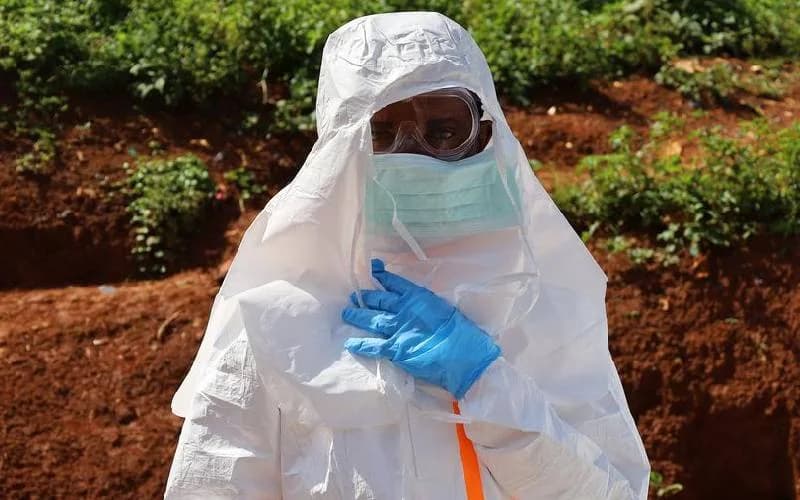
Medics demand urgent action to protect frontline workers from Ebola

KMPDU has urged healthcare workers to check whether their facilities have isolation and quarantine units, adequate protective equipment and the necessary medicines for supportive care, and to report any gaps.
Medics are now demanding stronger safety measures to protect healthcare workers exposed to Ebola, as cases in Kenya rise to eight, amid concerns over inadequate protective equipment, staff shortages and preparedness in health facilities.
Of the eight cases recorded, one involves a healthcare worker, prompting renewed calls for better protection, adequate staffing and proper isolation facilities for those handling suspected and confirmed infections.
In a statement, the Kenya Medical Association (KMA) said every healthcare worker deserves a safe working environment and timely access to the highest standard of care.
KMA called for prompt assessment, referral and treatment of affected workers, adequate personal protective equipment (PPE), continued infection prevention and control training, and confidential mental and emotional support for workers and their families.
“As the umbrella professional association for doctors in Kenya, KMA reaffirms that every healthcare worker deserves a safe working environment and timely access to the highest standard of care,” KMA President Dr Ibrahim Matende said.
Matende also urged health facility managers to address safety gaps, improve systems for reporting exposure and create an environment where workers can report suspected infections without fear of punishment.
Latest Stories
- US raises Kenya travel warning to Level 3 over Ebola, security risks
- NPS clears long-pending promotions for 1,948 officers after court ruling
- Blood sugar levels rise 14 times faster after starting antipsychotics, raising concerns over diabetes risk
- Mashujaa Day 2026: Kipchoge Keino Stadium filled to capacity as thousands arrive before dawn
KMA further advised healthcare workers to follow Ministry of Health infection prevention guidelines and report any suspected exposure immediately.
“Anyone developing symptoms should stop work, avoid contact with others, and seek urgent assessment through established public health response channels,” Matende said.
The concerns come after healthcare workers at a Nairobi hospital examined and treated a Kenyan who had fallen ill in the Democratic Republic of Congo (DRC) and travelled to Nairobi for treatment, without knowing that he was infected with Ebola.
The medical staff were among the first people in Kenya exposed to the virus, alongside the patient’s immediate family and others who received him at the airport.
The Kenya Medical Practitioners, Pharmacists and Dentists Union (KMPDU) has questioned its exclusion from the national Ebola task force, saying this limits its ability to raise concerns over workers’ safety and working conditions.
KMPDU Secretary General Dr Davji Atellah said professional associations were represented on the task force, but unions were not, despite their role in negotiating and protecting workers’ rights.
He said the Union was also excluded from inspections of isolation facilities conducted after the first case was reported at Nairobi Hospital, leaving it unable to assess the conditions in which its members were working or being quarantined.
“When you sit on the task force as a union representative, your role is to speak as a worker in the hospitals. You check whether there are plans to ensure that the quality and quantity of Personal Protective Equipment (PPE) are adequate. When staff shortages or other measures come up, you ask whether there are budget plans to employ more health workers in the facilities. You look into all of that. Take medical insurance: during Covid-19, a doctor who had the virus did not have the money or insurance to access care. Is that part of the discussion on the task force?
It cannot be,” Atellah said.
Atellah said Ebola care required several healthcare workers to manage one patient safely, placing additional pressure on a workforce already facing shortages.
“A single patient in isolation can therefore need four or five health workers at once. Across a day, as many as 10 may be needed on rotation. In a well-staffed setting, this could mean two specialists, three to four nurses working in the same room, and up to three support staff handling matters such as food,” he said.
He said some regions had one doctor for every 16,000 or 17,000 people, compared with the World Health Organisation (WHO) benchmark of one doctor for every 10,000 people. In some sub-counties, a single doctor or nurse serves an entire health facility.
Atellah said the last mass recruitment of healthcare workers took place during the Covid-19 response in 2019, while the government’s agreement to employ 2,000 doctors during the last strike remained unimplemented.
“We are now in 2026, seven years later. When you’re telling us that we need to have soldiers to combat the war, those soldiers must be there. They cannot be virtual soldiers. They must be real ones,” he said.
KMPDU has urged healthcare workers to check whether their facilities have isolation and quarantine units, adequate protective equipment and the necessary medicines for supportive care, and to report any gaps.
The Ministry of Health has said about 4,000 healthcare workers have been trained to handle Ebola. However, Atellah said more training was needed, including for the country’s roughly 107,000 community health promoters, who work in villages and could be among the first to encounter people showing symptoms and refer them to hospitals.
The government has reaffirmed its commitment to containing the outbreak through early detection, isolation and stronger infection prevention and control measures, while urging Kenyans to remain calm and vigilant.
On Monday, the Ministry of Health announced that it had received Ebola response supplies worth Sh83.3 million from the Government of India.

Comments
No comments yet. Be the first to share your thoughts.