
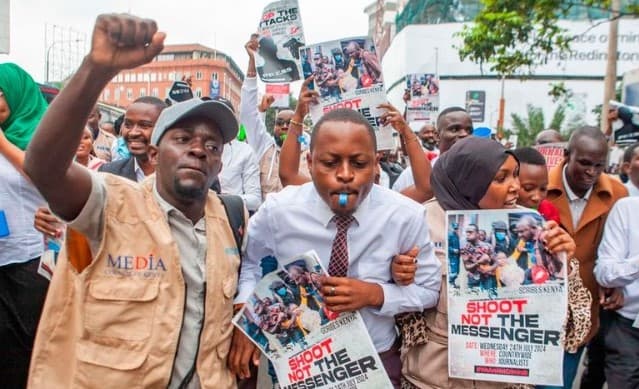
The Media Council of Kenya has raised the alarm over a sharp rise in press freedom violations, warning that attacks on journalists are increasing as the country approaches the 2027 General Election.
According to data from the Media Council of Kenya (MCK), 47 cases of press freedom violations were documented between July and September 2026, a significant increase from 17 cases recorded during the same period in 2025 and 24 cases in 2024.
The cases involved physical assaults, arrests, threats, intimidation, harassment and surveillance, the Council said in its Press Freedom Violations Situation Report released during the commemoration of the International Day to End Impunity for Crimes against Journalists (IDEI) 2026.
What the numbers show:
Of the 47 cases documented:
– 34 were assaults
– 5 were threats
– 2 were arrests
– 2 were intimidation
– Abduction, harassment and surveillance accounted for one case each
Nairobi recorded the highest number of violations with 13 cases, followed by Homa Bay with eight, Meru with seven, Bungoma with six and Nyandarua with four.
In terms of gender, 36 cases involved male journalists, nine involved female journalists, while two involved journalists whose individual gender identities were not specified.
Challenge of documentation
Despite the rise, inadequate documentation and reluctance by victims to pursue legal action continue to hamper accountability, the Council said.
MCK Manager for Press Freedom and Advocacy Rebecca Mutiso said journalists often fail to obtain police Occurrence Book (OB) numbers or P3 forms from hospitals after being attacked, leaving investigators without evidence needed to pursue cases.
“When we do not have evidence to pick up a case, then it becomes a big challenge to us,” Ms. Mutiso said.
She added that some journalists fear employer interference and loss of advertising revenue, which discourages them from seeking justice.
Police protection questioned
The Kenya National Commission on Human Rights (KNCHR) stressed the importance of documenting and preserving evidence to strengthen accountability.
KNCHR Assistant Director for Reforms and Accountability Lucas Kimanthi questioned the effectiveness of police deployment during incidents of violence, citing the attack on journalists in Ol Kalou.
“In Ol Kalou, when the first attack happened in that school, there were around 30 police officers and none of them responded,” Mr. Kimanthi said, noting that the presence of security officers does not necessarily guarantee protection.
On July 16, 2026, journalists covering the parliamentary by-election in Ol Kalou Constituency, Nyandarua County, were violently attacked, beaten and robbed by armed, masked men in SUVs and civilian clothing.
Regional warning
Committee to Protect Journalists (CPJ) Africa Programme Coordinator Muthoki Mumo warned that the security environment for journalists in East Africa is becoming increasingly dangerous, particularly during election periods.
Citing developments in Tanzania and Uganda, Ms. Mumo said journalists in the region were increasingly exposed to assaults, beatings and internet shutdowns.
“We like to think Kenya is a beacon, a haven of press freedom, but the forces and factions that have made East Africa increasingly dangerous for journalists are also operating here,” she said, urging stakeholders to anticipate potential threats ahead of the 2027 polls.
Beyond legal redress, stakeholders said journalists facing threats also need immediate protection.
Obino Nyambane, representing the Defenders Coalition, said the organisation provides bail and bond assistance to journalists and other human rights defenders facing criminal charges related to their work.
It also arranges emergency relocation for journalists working in hostile environments, helping them move to safer locations within Kenya.
The interventions, he said, are intended to protect journalists from immediate threats while allowing them to continue their work.


Comments
No comments yet. Be the first to share your thoughts.