
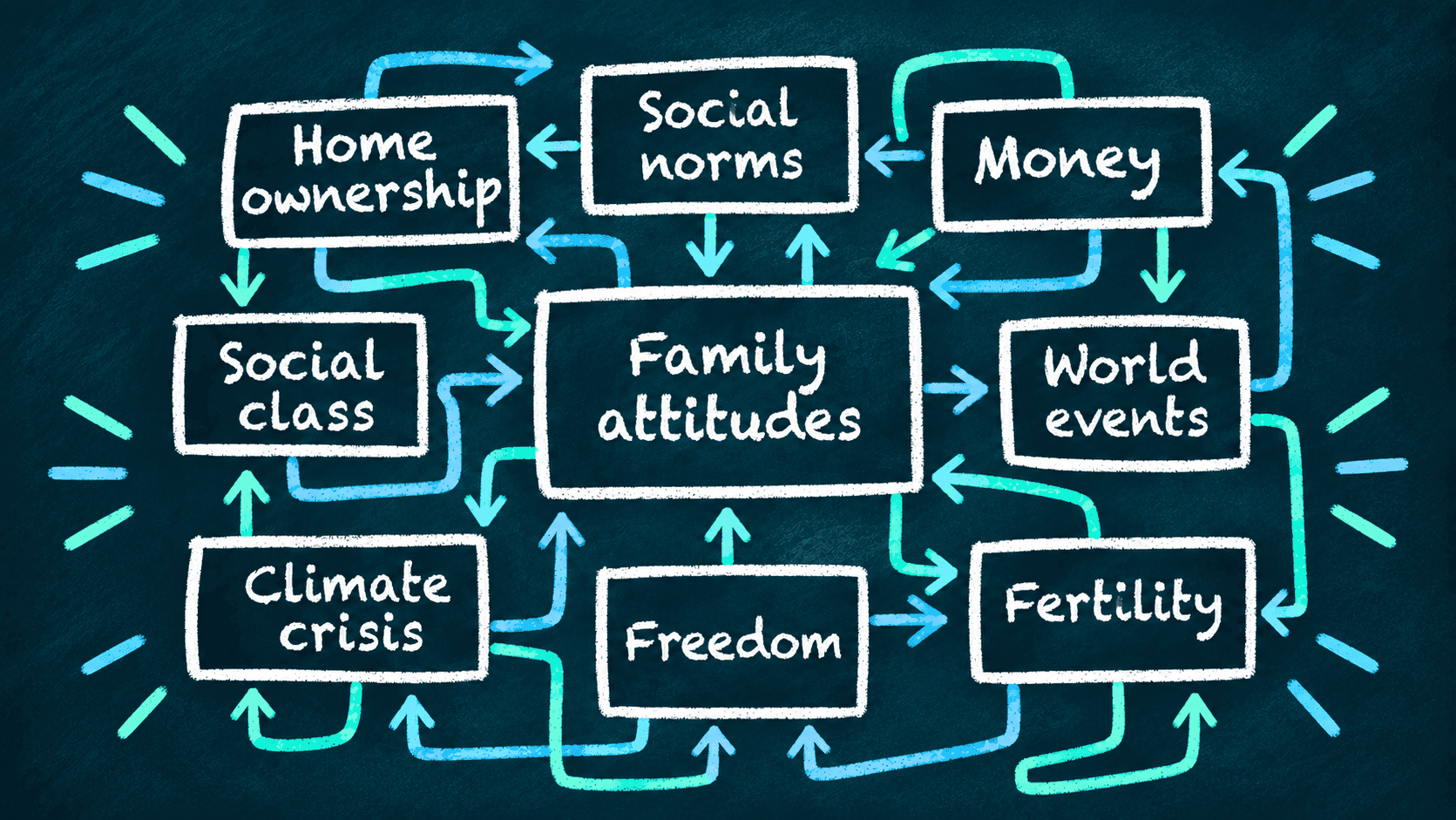
The fertility rates are dropping, sparking concern all around the world. In the 1700s and 1800s, women were having on average, anywhere between 5 and 10 live births in their lifetime. Between the 1950s and 1970s, it was 5 live births on average per woman. In 2023, it was down to 2.2 live births per woman. This has many concerned because the minimum replacement rate to ensure a stable population is 2.1, putting many countries at risk of not reaching that. About half of the world’s population lives in countries that are below replacement levels, the most well-known among them being Japan, China, and South Korea, where the 4B Movement was born. The main low fertility clusters are in East Asia, the Americas, and Europe.
What’s going on? Why are people everywhere having fewer children or none at all? Here are the most common reasons.
Economic insecurity
There are people who want children but can’t afford them. Job insecurity, housing insecurity, the high cost of living; these things deter even those who would like to have children. Children are expensive, and it is widely understood that one of the fastest ways to get yourself into economic trouble is to have children, and the fastest way out of poverty is to have none.
Climate change
It’s been said that climate change will manifest as a series of disasters you’re watching on your phone, until you’re the one making the video. Every week, there’s a new catastrophe somewhere. For many, this is not a safe place to bring a child into.
Declining child mortality
Medical advances, including vaccines, have decreased the number of children dying in infancy, which has decreased the pressure on women to have many children to increase the odds of those who survive past infancy.
Rising infertility rates
Infertility is defined as being unable to get pregnant. An average of 1 in 6 couples trying to have a child are diagnosed as infertile. One study found that approximately 1.8% of men and 3.7% of women are living with infertility and the rates are rising. For men in particular, sperm count has halved, and sperm quality has alarmingly declined over the past 40 years, with an estimated 1 in 20 men now affected.
Social progress
Fewer teenagers are having children. There is increased access to birth control, including abortion. Women are educated, socially and financially empowered, enabling them to make choices about their lives, including whether they will have children and how many. They are no longer at the mercy of men, unlike the generations of women who came before them. Stigma around not having children has also significantly decreased.
Personal freedom
There’s an increasing awareness about the cost of having children, particularly for women. It is a cost many women no longer wish to pay, choosing instead to prioritize their own freedom, happiness, and well-being.
Just don’t like ’em
Some people just do not like children and, given the option to opt out, choose to do so.
Social media
A lot is blamed on social media, granted. However, there is no underestimating the role of social media in normalizing the child-free style. Social media has created a forum for people to speak honestly and deconstruct social norms in a way that makes them feel less alone. Women are sharing previously taboo stories about the physical, psychological, and even social effects of childbirth. They’re showing what their lives are like, how much they have to carry, and how little their male partners contribute. These previously hidden stories help women make informed choices, which leads to fewer children, if any.
Decreasing heterosexual relationships
There’s an increasing chasm between men and women. The rise of the manosphere and red pill misogynistic content has significantly decreased women’s desire to partner with men.
The 4B Movement is one of the most extreme examples of women rejecting all relationships with men. The tenets of the Korean 4B movement are: Do not date men, marry men, have sex with men, or have children with men.
Marriage and relationships with men no longer hold the place of honour that they used to. In fact, the pendulum has swung so far that being in romantic relationships with men is embarrassing. Not having to interact with men is viewed as a new privilege and a highly desirable one at that.
Antinatalism
Antinatalism is the philosophical argument that procreation is unethical. It argues that people should abstain from having children because coming into existence is always a harm. The one guarantee in life is suffering. Happiness is not assured, but suffering is. It doesn’t matter how rich you are, how insulated your life is; you will suffer.
Once you have a child, you introduce them to suffering, and depending on where you have them, their suffering could be compounded. Dreary capitalism, climate change, wars and genocides, the certainty of illness and death. The list is endless. They will either suffer it or watch other people suffer, which is its own suffering.
There’s also the fact that no one consents to being born, and there is no non-selfish reason for reproduction. It’s always about the parents’ selfish desires, never about the child. Their position is encapsulated in the statement: “Because I love you, you shall not be born.”
Conclusion
They say if this trend continues, global fertility rates will drop below replacement levels by the mid-2050s and start falling by the 2080s.
What can I say? We had a good run. Well, a semi-good run. A run. We had a run. 😊
Check out
Parenting: Are Child-Free People Misunderstood Or Missing Out?
Is It Okay For A Woman To Want A Child-Free Life?
Research Shows That Parents Are More Likely To Regret Having Children Than Childfree Adults
Opinion: Why Don’t We Believe Women Who Say That They Want To Be Child-Free?
Opinion: Children Don’t Owe Their Parents Anything (Do You Agree?)
[/vc_column_text][/vc_column][/vc_row]



Comments
No comments yet. Be the first to share your thoughts.