
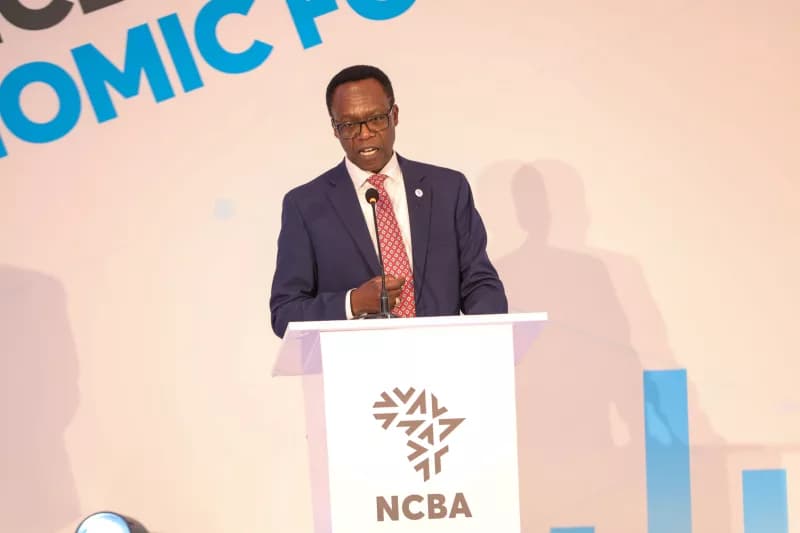
NCBA group managing director John Gachora. /HANDOUT

Kenya’s economy is expected to grow by 4.8 per cent this year, supported by a recovery in industrial activity, expansion in the services sector and improving agricultural output, according to NCBA economic outlook.
The latest projection is slightly lower than what Central Bank of Kenya and National treasury had predicted.
Despite the slightly positive outlook, geopolitical tensions, expensive energy and election-related uncertainty and changing global monetary conditions threaten the outlook for not only for this year but until 2027.
NCBA group managing director John Gachora said the economy had demonstrated resilience despite external shocks, prompting the bank to revise its 2026 growth forecast upwards from 4.6 per cent to 4.8 per cent.
The revised projection, however, remains below the bank’s earlier forecast of 5.1 per cent, reflecting the economic disruptions caused by geopolitical tensions and rising commodity prices.
“According to our in-house projections, we now expect output to close around 4.8 per cent in 2026. Given the uncertain external environment, we see economic growth for 2027 to be in the range of four to five per cent,” said Gachora.
NCBA Group Director for Global Markets and Chief Economist Raphael Agung said growth would be primarily driven by industry and services, with agriculture expected to record a relatively stable performance and improve from previous levels.
He projected the economy would expand by 4.5 per cent in 2027, slightly slower than this year's expected growth of 4.8 per cent, as businesses and households adopt a more cautious approach to spending ahead of the elections.
The projections point to a continued recovery in productive sectors, although the economy is yet to return to the growth levels needed to generate sufficient employment and significantly improve household incomes.
Agriculture remains an important source of growth, particularly through value chains such as coffee, tea, beef, rice and nuts, which are expected to benefit from efforts to increase production and improve farmer earnings.
Gachora said safeguarding gains in agricultural production would be critical in supporting exports, protecting foreign exchange earnings and maintaining stability in the local currency.
Kenya's external sector has already recorded encouraging performance, with exports growing by 12 per cent year-on-year, according to the NCBA chief executive.
Tourism is another important source of foreign exchange, with tourism receipts growing by eight per cent and tourist arrivals increasing by four per cent, providing additional support to the balance of payments.
Gachora said the implementation of the Kenya-European Union Economic Partnership Agreement and the Comprehensive Economic Partnership Agreement with the United Arab Emirates would provide opportunities to diversify export markets and expand the country's earnings from international trade.
Agung warned that escalating tensions in the Middle East and the Russia-Ukraine conflict could disrupt global trade, push up energy prices and complicate investment decisions.
The global economy is projected to grow by 3.1 per cent, with geopolitical developments, changing trade policies and energy market disruptions weighing on the outlook.
For Kenya, the possibility of El Niño conditions presents another threat, particularly to agricultural production and food prices, with the effects potentially becoming more pronounced in the first quarter of 2027.
Domestically, businesses are also expected to adopt a cautious investment approach ahead of the August 2027 General Election as uncertainty weighs on spending and capital commitments.
NCBA Group CEO John Gachora warned that increased government expenditure during the election period could derail fiscal consolidation and further strain public finances.
However, Treasury Cabinet Secretary John Mbadi blamed the failure by banks to effect rate cuts as some of the reasons why Kenyans are not enjoying economic benefits.
“The Central Bank Rate has come down by more than four percentage points since mid-2024, yet the average lending rate is still 14.4 per cent. Borrowers should feel more of that cut and the also lend to the real economy,” said Mbadi.
“Government is now borrowing less from the banks, and that frees room on your balance sheets. We expect that room to go to the businesses in this room, and to farmers, manufacturers and MSMEs.”
The forecast shows that public debt servicing had consumed about 78 per cent of tax revenue in the first three months of the current financial year and could rise to 81 per cent by year-end, compared with 38 per cent a decade ago.
The rising debt burden leaves the government with less money for development spending and essential public services.
Agung also cautioned that higher international interest rates could increase the cost of external borrowing, while continued government borrowing locally risks limiting credit available to businesses, particularly small and medium-sized enterprises.
Despite these pressures, NCBA expects the shilling to remain relatively stable, supported by export earnings, tourism receipts and foreign exchange inflows.
However, he warned that the current growth trajectory remains insufficient to significantly improve living standards.
“We need well above five per cent growth to meaningfully pull our people to prosperity, perhaps close to six per cent,” said Agung.


Comments
No comments yet. Be the first to share your thoughts.