
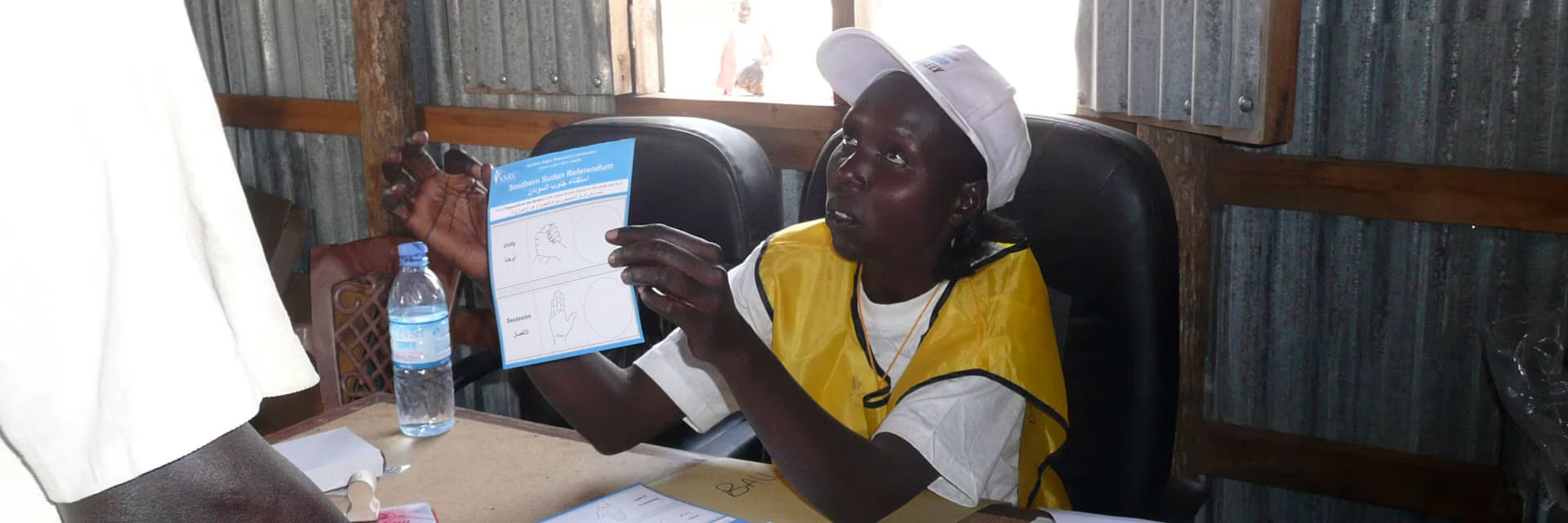
South Sudan wants to hold elections in December: Three major obstacles and some ways around them

The ruling party (SPLM) is already conducting its internal primaries to select aspirants. However, the electoral preparations face a serious problem.
South Sudan is scheduled to hold general elections on December 22, 2026 – its first since independence. President Salva Kiir and his inner circle have repeatedly insisted that the elections will take place on that date.
The elections are meant to bring South Sudan’s post-conflict transition to an end. Since 2018, a power-sharing government led by the South Sudan People’s Liberation Movement (SPLM) and including the major opposition party SPLM-in-Opposition (SPLM-IO) has been ruling the country. The election would allow for this arrangement to be replaced by a government people have voted for.
However, the electoral preparations face a serious problem.
The National Elections Commission announced that voter registration would begin in early November 2026. This leaves less than two months before polling day.
Even with accelerated preparations, the remaining tasks will be extremely difficult to complete. Three major obstacles stand in the way.
Latest Stories
- Bomb threats disrupt flights across Europe as airlines divert planes and airports halt operations
- Kenya’s Phoebe Okowa triumphs after tense UN voting deadlock to secure full nine-year ICJ term
- Sabastian Sawe’s sub-two-hour marathon shortlisted for 2026 World Athletics’ Moment of the Year
- Indian navy rescues 20 Iranian sailors from hijacked vessel off Somalia
Firstly, South Sudan has no existing national electoral register. The electoral authorities must still register voters, verify the register, confirm candidates, prepare ballot papers and organise polling across the country. Secondly, millions of people are internally displaced, and infrastructure is poor. Lastly, uncertainty remains over a recently amended electoral law intended to regulate the electoral process.
I have studied South Sudan’s post-war transition, and in my view the country’s challenges in the coming months extend beyond the electoral calendar. The transitional institutions established under the 2018 peace agreement to end a five-year civil war were dissolved in September 2026. They were replaced by caretaker arrangements. This makes another postponement of the elections more difficult.
Yet any delay would also prolong a caretaker government operating without parliamentary checks and balances. This takes any official scrutiny away from the executive.
The challenges
South Sudan has an estimated population of 12.5 million, 80 per cent of whom live in rural areas. The country is divided into 10 states and three administrative areas.
Voter registration: The National Elections Commission plans to register voters manually. It will use paper registration books before entering the information into its computer systems. This process faces several challenges.
Candidate nominations: those who want elective seats must get written endorsements from registered voters for their nominations to be accepted. There is a potential appeal process if signatures are contested.
Only once candidates are confirmed can the final ballot papers be prepared. These must be printed and distributed across a country where even ordinary transport remains difficult.
The legal framework: Kiir signed an amendment to the National Elections Act on 21 September 2026. This finalised the polling procedures, the political constituencies and the size of parliament. Yet the final signed text has not been made available either publicly or to stakeholders involved in the election process.
This leaves uncertainty about the precise requirements governing several stages of the process, including their sequencing.
The ruling party’s electoral process
The ongoing SPLM primaries have generated remarkable political activity. Hundreds of aspirants have submitted applications for nominations, from parliamentary to governorship seats. Party members are voting to select SPLM nominees.
These primaries are a serious exercise. Candidates are investing substantial resources, and local party structures are politically active. In several places, competition is intense.
The process has also generated allegations of manipulation and disputes over candidate selection. Some contests have become confrontational.
The SPLM is dominant in many parts of the country. Winning its nomination may effectively determine eventual winners in several constituencies.
But the primaries create another timetable problem. Candidates cannot complete formal nomination applications before the party has decided who will represent it. The ruling party’s own electoral mobilisation is, therefore, adding pressure to an already overly compressed electoral calendar.
Another extension?
Elections first scheduled for December 2022 were pushed to 2024. This was then moved to 2026 because of delays in implementing parts of the peace agreement, like constitutional reforms and security arrangements. These tasks remain unfulfilled.
Another extension, however, would take place under very different circumstances. The September 2026 constitutional amendment removed the requirement to complete the permanent constitution and population census before holding elections. Kiir then dissolved the transitional government and legislative institutions, replacing these with caretaker arrangements.
This changed the political landscape. Previous extensions preserved the transitional power-sharing institutions established under the peace agreement.
The presidency has also invested considerable political authority in the December deadline. The SPLM leadership has insisted that general elections will be held at all levels. Retreating from this commitment would carry political costs.
With parliament dissolved, the institutional route towards another political extension is more complicated. Elections, therefore, appear to be the only available pathway towards restoring a functioning, legitimate government and legislature.
The difficulty, then, is how to give electoral authorities more time without reopening the political transition or abandoning the commitment to elections.
Next steps
One possibility is a technical postponement. This could provide additional time for registration and candidate nomination. It would maintain the political commitment to conducting general elections.
Another possibility is technical staging. Different electoral contests – such as for the presidency or parliamentary seats – could be held several months apart while remaining within one general election process. This might ease the administrative burden without abandoning the commitment to elections.
But the legal basis for such arrangements remains uncertain.
The country’s caretaker arrangements were intended to administer a short electoral period. Their continuation becomes more difficult to justify if elections are postponed for several months.
The Conversation
Comments
No comments yet. Be the first to share your thoughts.