
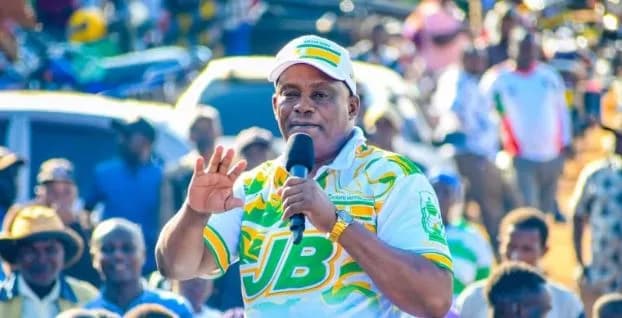
Democratic Party leader Justin Muturi./HANDOUT

Democratic Party leader Justin Muturi has criticised former Deputy President Rigathi Gachagua over what he described as political bullying, double-speak and attempts to undermine unity within the United Opposition.
In a statement, Muturi questioned Gachagua’s commitment to the opposition’s collective presidential ambition under the Wantam movement, warning that his political approach could weaken efforts to build a united coalition ahead of the 2027 General Election.
Muturi said no Kenyan president had ever been elected through the support of one community alone, arguing that winning State House required national consensus, strategic alliances and the ability to unite people across ethnic and regional boundaries.
“Mr Gachagua must understand one fundamental truth: No Kenyan President has ever been made by one community alone,” Muturi said.
He took issue with Gachagua’s alleged insistence on tripartite political arrangements, saying the approach risked creating divisions within an opposition seeking to challenge President William Ruto.
Muturi questioned whether the opposition was focused on winning the presidency or securing control of parliamentary and county positions at the expense of its wider national ambition.
“Is the objective to win the presidency or to control MPs, legislators and devolved units while sacrificing the bigger national ambition?” he posed.
The DP leader argued that building a winning national coalition required compromise, maturity and strategic thinking. He maintained that splitting the opposition into separate political formations would not automatically improve its chances of winning the presidency.
“A tripartite arrangement is not a magic formula for State House,” he said.
Muturi further warned against political ultimatums and supremacy contests, insisting that no individual or community owned the United Opposition.
He said political partnerships should be founded on mutual respect rather than intimidation or attempts by individual leaders to dominate the coalition.
To reinforce his argument, Muturi referred to the political history of Gachagua’s family, citing the late Nderitu Gachagua’s victory in the gubernatorial contest against TNA, the political vehicle that produced former President Uhuru Kenyatta.
He said the outcome, despite GNU supporting Uhuru, demonstrated the complexity of political alliances and the fact that no political formation belonged to one individual.
Muturi also questioned the assumption that three separate political formations could automatically deliver the Wantam presidency.
He warned that reducing presidential politics to ethnic arithmetic, regional strongholds and individual bargaining power could undermine the aspirations of Kenyans seeking political change.
The DP leader challenged the United Opposition to decide whether it wanted to build one national movement with a shared presidential ambition or create separate political kingdoms whose leaders would negotiate individual interests after the elections.
Describing the push for political change as a national undertaking, Muturi said it required sacrifice, discipline, strategic thinking and commitment to a common objective.
“Komboa Kenya is not child's play,” he said.
He maintained that the Democratic Party remained open to dialogue with leaders committed to constructive solutions but would not give in to intimidation or attempts to undermine its principles.
“Kenya is bigger than any one politician. State House is the national prize. Unity must not be sacrificed at the altar of individual political survival,” Muturi said.
Comments
No comments yet. Be the first to share your thoughts.