
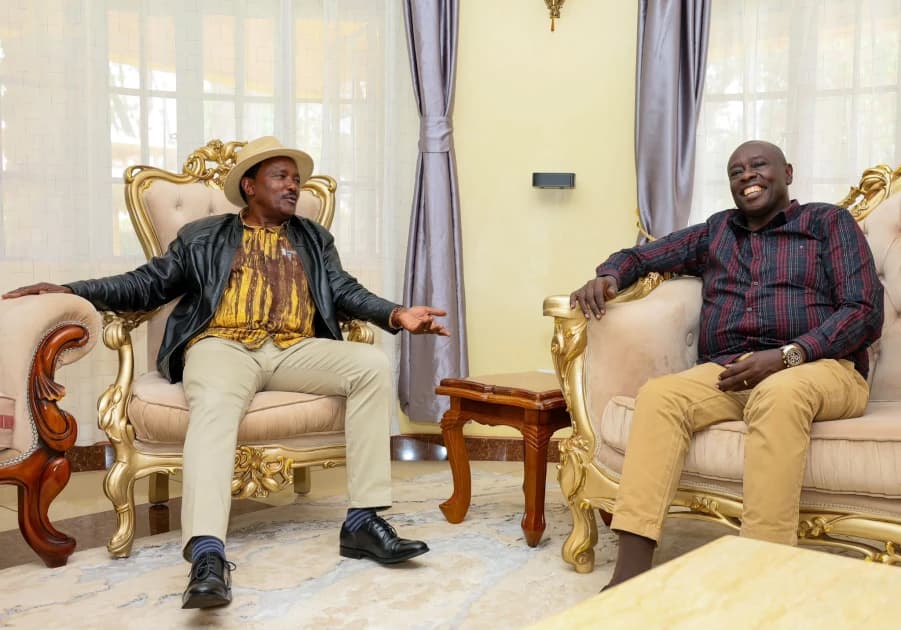
Wiper Leader Kalonzo Musyoka meets Rigathi Gachagua at his Wamunyoro residence in Nyeri, October 26 /HANDOUT

In Kenyan politics, seasons change, alliances collapse and new players emerge, but one variable has remained stubbornly constant: Kalonzo Musyoka.
For nearly two decades, Kalonzo has played a pivotal role in a deeply fractured political landscape, proving time and again that being a political kingmaker can be just as powerful as holding the crown.
In January 2008, with the country reeling from post-election violence, President Mwai Kibaki reached out to Kalonzo to help steady a shaken nation by appointing him Vice President.
Fast-forward to the high-stakes elections of 2013 and 2017, Kalonzo became Raila Odinga's trusted running mate under the now-defunct CORD and NASA coalitions, respectively.
Through successive election cycles, Kalonzo has remained one of the most sought-after figures in Kenyan politics, ever since Kibaki brought him into government and helped cement his identity as a political stabiliser.
As the country inches towards the 2027 General Election, a familiar narrative is unfolding. Both the Kenya Kwanza administration and the United Opposition are actively courting the Wiper Patriotic Front leader.
How a politician frequently accused of indecision has managed to make himself indispensable to rival political camps is remarkable.
While the current scramble for Kalonzo's support may appear to be a new phenomenon, it is essentially a rerun of a political contest that began nearly two decades ago.
In the aftermath of the disputed 2007 General Election, a newly sworn-in President Kibaki reached out to Kalonzo to help legitimise and stabilise his government.
The country had descended into violent chaos after Raila disputed the election results. The Electoral Commission of Kenya (ECK) later acknowledged that it could not establish with certainty who had won the presidential contest.
Kalonzo had contested the presidency that year, securing more than 800,000 votes countrywide. His support in Ukambani accounted for about 80 per cent of his total tally, demonstrating the strength of his regional voting bloc.
That loyalty has since emerged as one of the defining factors behind Kalonzo's solid political power, even as he faces competition from politicians representing regions with larger voting populations.
The IEBC's voter register stands at 24.45 million, with the commission projecting that the number of registered voters will rise to 28.4 million by 2027.
While the Mt Kenya region remains the country's largest electoral bloc, the arithmetic of presidential elections shows that no single region can deliver victory on its own.
Winning the presidency will require parties to build national coalitions that cut across all voting blocs in the country.
In an election that could be decided by the narrowest of margins, securing the support of a region known for voting as a bloc can prove decisive.
Kalonzo's regional following has therefore made him a potentially indispensable coalition partner for rival camps seeking to strengthen their presidential ambitions.
After serving as Kibaki's political shield in 2008, the 2013 and 2017 election cycles recast Kalonzo as a central pillar of Raila's coalition-building efforts, providing the opposition with a reliable regional base.
That decision proved pivotal, as Raila missed the top seat by a narrowly on both occassions.
In the 2013 polls, Raila got 5.3 million votes (43.31 per cent) against Uhuru Kenyatta's 6.1 million (50.07 per cent).
In the 2017 elections, Raila garnered 6.7 million votes (44.74 per cent) against Uhuru's 8.2 million (54.27 per cent), although the results were later nullifed by the Supreme Court.
Having spent two successive election cycles as the perennial number two, Kalonzo has now re-emerged on the 2027 political chessboard as an ally being fiercely pursued by rival camps.
On October 24, while addressing residents in Tseikuru, Kitui county, his rural home turf, President William Ruto directly courted Kalonzo, asking the local community to persuade the Wiper leader to support his re-election bid.
The President praised Kalonzo for acknowledging the government's development record and urged him to abandon what he described as empty rhetoric and work with his administration.
He also directed that the road leading to Kalonzo's home be tarmacked.
Two days later, on October 26, Kalonzo met DCP leader Rigathi Gachagua at his Wamunyoro home in Nyeri county, where consultations centred on building a united political front and agreeing on a single presidential candidate to challenge Ruto.
Speaking at a church service on Sunday, Gachagua dismissed the government's attempts to woo Kalonzo, insisting that the Wiper leader remained firmly committed to the opposition's quest to send Ruto home.
"I saw government officials yesterday crying to Kalonzo... I want to tell them the Kalonzo you're trying to play with is not the Kalonzo you're used to," he said.
"I have stayed with him for two years. This is a leader to be trusted and cannot betray the people of Kenya."
Gachagua described himself as Kalonzo's political cousin and spokesperson, saying anyone seeking to strike a deal with the Wiper leader should go through him by visiting his Wamunyoro home.
"But sitting as a family, I don't think we will allow Kalonzo to go, so please stop disturbing Kalonzo Musyoka. We are working together, don't bother him," he said.
Reports indicate that the two leaders are expected to hold another meeting at Wamunyoro, with the focus on consolidating the opposition ahead of the 2027 election.
Among the key issues discussed during their last meeting was when to announce the opposition's presidential flagbearer, with the two sides agreeing to name their candidate early next year.
But Kalonzo has since made his position on the competing overtures from the ruling coalition clear.
Speaking at a church service on Sunday in Kyumvi, Machakos county, November 1, the Wiper leader rejected the Kenya Kwanza administration's invitation to abandon the opposition and support Ruto's re-election bid.
"I have seen headlines saying they are looking for me. My answer is no... No, thank you very much," he said.
"And I say this seriously, no, thank you very much," he stressed.
Kalonzo pivoted himself as the most suitable opposition candidate to face Ruto in 2027, ruling out the likelihood of dropping his ambition to support his rival.
"He (Ruto) has himself declared that his most formidable challenger he will face at the ballot in a democratic process is Kalonzo Musyoka. So, how is it possible that your biggest opponent should join government? It's not possible...let's meet at the ballot."
As the 2027 General Elections draw closer, only time will tell if Kalonzo will remain one of the most coveted allies in the battle for State House, or if his refusal to cross political camps will diminish his value to either side amid continued coalition politics.
Comments
No comments yet. Be the first to share your thoughts.