
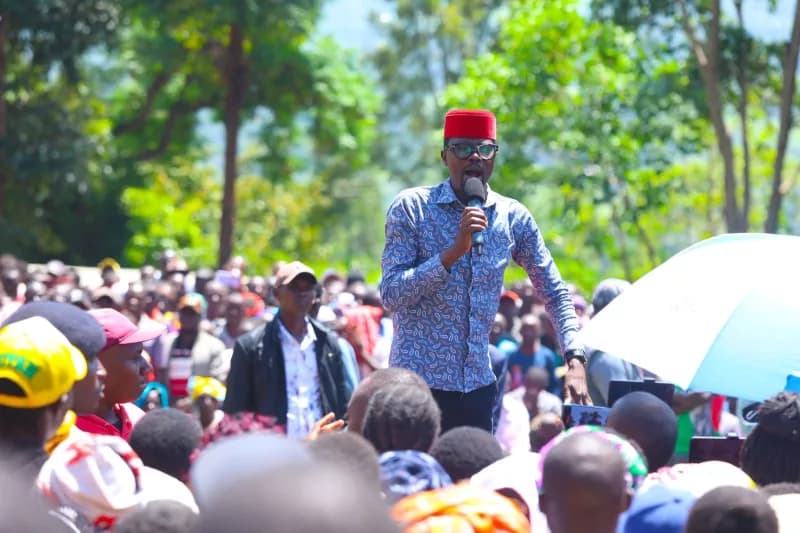
Bungoma governor hopeful Didmus Barasa./HANDOUT

Kimilili MP Didmus Barasa has broken ranks with National Assembly Speaker Moses Wetang’ula and is calling for his retirement after more than three decades in leadership.
Barasa, who is eyeing the Bungoma governorship in 2027, said he had withdrawn his political support for Wetang’ula’s local political direction, citing differences over leadership, succession and the future of the county.
In a statement on Monday, the MP said he was aligning himself with calls for Wetang’ula to exit Bungoma politics, alleging that his long tenure had yielded little for residents.
“After careful reflection and wide consultation, I have decided to withdraw my political support from the current political direction of Rt. Hon. Moses Wetang'ula, EGH in Bungoma County, and to align myself with the popular view that he retires from Bungoma politics after more than three decades at the helm, with little to ride home about apart from his close family associates,” Barasa said.
He insisted that the split was not driven by personal animosity but by what he described as the need to protect Bungoma’s political future.
“This decision is not precipitated by disrespect or personal animosity. It is a principled act of political realignment, undertaken to safeguard the unity, stability, and long-term political trajectory of our people,” he said.
Barasa said he remained committed to President William Ruto and the Broad-Based Government but accused Wetang’ula of being politically conflicted because of his relationship with his brother, (Westlands MP Timothy) Wanyonyi, whom Barasa identified as his political rival.
He alleged that Wetang’ula was supporting his brother.
“The growing perception that Rt. Hon. Wetang'ula is tacitly supporting his brother, Hon. Tim Wanyonyi, and the opposition formation to which he is aligned, constitutes a serious conflict of interest and a case of dual political allegiance,” Barasa said.
He argued that the perceived split in political loyalties made it difficult for him to work with Wetang’ula in Bungoma.
“One cannot simultaneously serve two antagonistic political vectors,” he said, adding that the activities of some FORD-Kenya leaders, including MCAs, suggested divided loyalties.
Barasa also accused Wetang’ula of favouring candidates he personally endorsed instead of allowing open competition, saying Bungoma should not be treated as a political inheritance.
“Bungoma is not a monarchy. It is a democracy premised on merit, competition, and the sovereign will of the people, not hereditary succession,” he said.
“Let it be categorically clear: my engagement with his brother is not in his capacity as his brother, but in his capacity as my political opponent,” Barasa said.
He further criticised the distribution of resources under a memorandum of understanding between UDA and Ford-Kenya. Barasa described the arrangement as poorly managed, without providing further details in his statement.
Despite the fallout over Bungoma politics, he maintained that he and Wetang’ula shared a national political destination under Ruto’s leadership.
“Rt. Hon. Moses Wetang'ula and I share the same horizon in President William Ruto. At the national level, our destination is convergent. But in Bungoma, our political philosophy and local vision are divergent,” he said.
Barasa said he would now focus on consolidating the United Democratic Alliance (UDA), strengthening grassroots structures and building alliances with residents, like-minded local parties and FORD-Kenya members who share his vision.
He said his aim was to secure support for his 2027 bid for governor while opposing what he described as hereditary leadership.
“Henceforth, I will concentrate on consolidating the United Democratic Alliance (UDA), the political vehicle I will deploy in my bid to be elected Governor of Bungoma next year, on constructing robust grassroots systems, and on forging strategic alliances with wananchi and like-minded local political parties that share our vision,” he said.
Barasa declared his bid for the Bungoma gubernatorial seat in April 2026, on a UDA ticket, setting the stage for a high-stakes political contest.
Barasa, an ally of President Ruto, joined a crowded field that includes MP Timothy Wanyonyi, former governor Wycliffe Wangamati and businessman Zachariah Barasa.
Wangamati is seeking to reclaim the seat he lost to current governor Kenneth Lusaka in 2022, while Wanyonyi is banking on his development record in Westlands as he shifts his political base to Bungoma.
Lusaka, who is serving his second and final term, is leading Ruto’s re-election campaigns in the Western region.
The Bungoma governor seat has remained under Ford Kenya since the advent of devolution, raising questions about whether UDA can wrest control from the party.
Analysts say the race will likely be shaped by sugar politics, party loyalties and individual candidates’ track records.
“The election is expected to be closely contested, with candidates navigating complex alliances and rivalries,” said political commentator Isaac Wanjekeche.
Speaking at a rally in Nasianda market, Bumula constituency, on April 13, 2026, Barasa said his decision to run on a UDA ticket followed wide consultations across the county.
“I have made a firm decision to run for governor so that I can transform Bungoma, especially the health sector, which has suffered for too long,” he said.
Comments
No comments yet. Be the first to share your thoughts.