
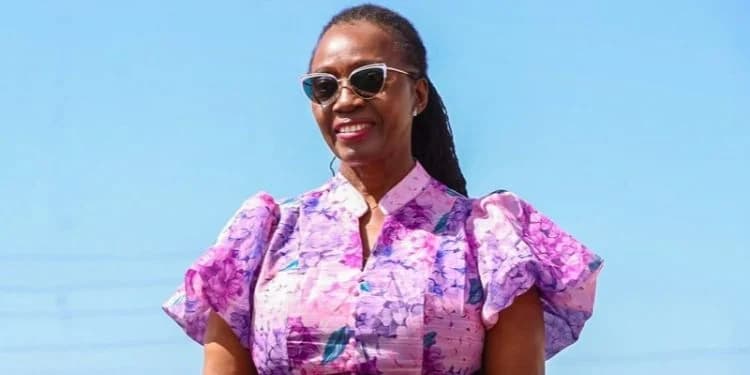
Martha Karua is a Kenyan advocate, Senior Counsel and politician whose career spans the judiciary, private legal practice, parliamentary politics, Cabinet service and opposition leadership.
Martha rose to national prominence through her involvement in Kenya’s multiparty democracy movement, her advocacy for constitutional reform and her years in elective and executive office.
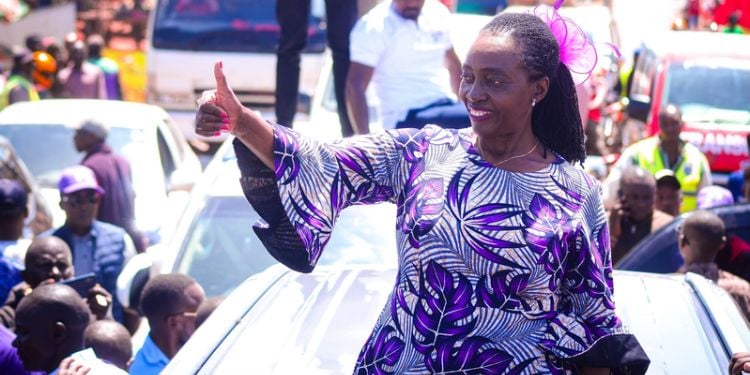
As of October 2026, Karua leads the People’s Liberation Party (PLP), formerly NARC-Kenya, and is pursuing the presidency in the 2027 general election.
In her bid for the presidential seat, she has ruled out serving as another candidate’s running mate, saying she intends to seek the opposition’s presidential nomination but would support another candidate if selected through an agreed process.
“I will not be a running mate. I will do my best to be that united opposition candidate, but should somebody else be chosen, I am willing to support them without being their running mate,” Karua said during an interview on Citizen TV’s Sunday Live show on June 14.
At a glance
- Full name: Martha Wangari Karua
- Date of birth: September 22, 1957
- Age: 69, as of October 2026
- Place of birth: Kimunye, Kirinyaga County, Kenya
- Siblings: Margaret Karua, Isaac, Jeffitha, Simon, Loise, Esther and Peter
- Profession: Advocate, Senior Counsel and politician
- Political party: People’s Liberation Party (PLP), formerly NARC-Kenya
- Education: Bachelor of Laws, University of Nairobi; postgraduate legal training at the Kenya School of Law; Master of Business Administration from the United States International University-Africa
- Legal career: Magistrate from 1981; established Martha Karua & Company Advocates in 1987
- Former parliamentary seat: Gichugu Constituency, 1992–2013
- Former Cabinet positions: Minister for Water Resources Management and Development; Minister for Justice and Constitutional Affairs
- Presidential campaign: Contested the presidency in 2013 under NARC-Kenya
- Deputy presidential candidate: Raila Odinga’s running mate in the 2022 Azimio la Umoja campaign
- Current political position: Leader of the PLP and declared presidential aspirant for the 2027 general election
Legal Foundation And Early Career
Born on September 22, 1957, to her parents Josephine and Jackson Karua, Martha, the second-born in a family of seven, began her education at St Michael’s Primary School before she proceeded to Kabare Girls Boarding School, Kiburia Girls Secondary School and later to Karoti Girls High School, where she completed her basic education.
Karua studied law at the University of Nairobi, graduating in 1980, before completing her professional legal training at the Kenya School of Law in 1981.
She joined the judiciary in 1981, beginning a legal career that later extended into human rights advocacy, parliamentary representation and executive government.
As a magistrate, she served in several courts, including Nakuru, Makadara and Kibera, before leaving the judiciary in 1987 to establish Martha Karua & Company Advocates.
Her transition into private practice allowed her to represent clients in civil and criminal matters while becoming increasingly involved in public-interest litigation and the defense of civil liberties.
During the one-party rule under President Daniel arap Moi, Karua represented individuals facing politically sensitive charges.
Her legal work included the treason trial of opposition activist Koigi wa Wamwere, a case tied to the wider struggle for political pluralism in Kenya.
She also participated in professional and civil society organizations, including the Law Society of Kenya (LSK), the International Federation of Women Lawyers in Kenya (FIDA Kenya) and the International Commission of Jurists (ICJ).
Through the networks, she became involved in campaigns for judicial independence, women’s rights and the expansion of democratic space.
In 2020, Karua was conferred with the rank of Senior Counsel.
The Struggle For Multiparty Democracy
Karua’s political ascent coincided with the campaign the restore multiparty democracy in Kenya in the late 1980s and early 1990s.
Opposition politicians, lawyers, religious leaders and civil society organizations challenged the political dominance of KANU and demanded reforms to the electoral and constitutional systems.
Ahead of the 1992 general election, she initially sought a FORD-Asili nomination but lost the party primary.
She later secured a Democratic Party ticket and won the Gichugu parliamentary seat, marking the beginning of a parliamentary career lasting approximately two decades.
Additionally, Martha Karua was among the women who entered Parliament during Kenya’s return to multiparty electoral competition, and her victory established a political base in Kirinyaga County.
In 1998, Karua joined the Inter-Parties Parliamentary Group (IPPG) initiative, which brought together government and opposition representatives to discuss reforms.
The initiative aimed to reduce political tensions and build common ground on electoral and constitutional reforms.
Parliamentary Career And Gichugu Constituency
Karua represented Gichugu Constituency in Kirinyaga from 1992 to 2013, winning four consecutive elections.
In 2002, Martha emerged the winner with 28,262 votes, and in 2007 with 30,736 votes.
Her parliamentary tenure provided the foundation for her subsequent ministerial appointments and national political profile.
During her tenure, Martha focused on access to education, healthcare, water, and infrastructure in her constituency.
She also promoted community participation in development projects and mobilized residents and partners to contribute to local initiatives.
Her approach emphasized public participation, community priorities, and shared responsibility for development.
In Parliament, Karua participated in debates on constitutional reform, governance, and the organization of public institutions.
Her parliamentary career also provided a route into national executive leadership. Following the 2002 general election, the formation of the National Rainbow Coalition (NARC) government brought several opposition figures into Cabinet, including Karua.
Martha Karua’s Cabinet Service Under Mwai Kibaki
Following the 2002 general election, Karua joined the government of President Mwai Kibaki as Minister for Water Resources Management and Development.
She held the position from 2003 to 2005 before moving to the Justice and Constitutional Affairs docket.
Her work in the water sector supported reforms under the Water Act 2002, which reorganized aspects of water-resource management, regulation, and service delivery. The reforms sought to establish clearer institutional responsibilities and improve the management of water services.
Karua also participated in regional discussions on Nile Basin water resources and access to and management of shared water resources.
In 2005, she became Minister for Justice and Constitutional Affairs, a position that placed her at the center of debates about constitutional review, judicial independence, human rights and institutional reform.
The 2007–2008 Post-Election Crisis And National Accord
After the disputed December 2007 general election, Martha, as a representative of the Party of National Unity (PNU), defended Kibaki’s victory at the Kenyatta International Convention Center tallying center and rejected allegations of election rigging.
Further, Martha Karua accused Raila Odinga’s Orange Democratic Movement (ODM) of planning “mayhem” and alleged “ethnic cleansing.” Odinga rejected the accusation as outrageous.
Karua also served on the government negotiating team during the mediation led by former United Nations Secretary-General Kofi Annan.
The negotiations brought representatives of President Kibaki’s Party of National Unity and Raila Odinga’s Orange Democratic Movement to the table to end the crisis.
They also resulted in the National Accord and the establishment of the Grand Coalition Government in 2008.
Under the agreement, they established a framework for power-sharing and a broader reform program to address the causes and consequences of the crisis.
In 2020, Karua rejected attempts to link her to the post-election violence, insisting that acting as Kibaki’s election agent did not mean she had participated in rigging or violence.
Cabinet Resignation
In April 2009, Martha Karua resigned as Minister for Justice and Constitutional Affairs.
Her resignation followed President Kibaki appointment of judges without her knowledge, after criticism of Chief Justice Evan Gicheru over judicial reforms.
Martha Karua said the circumstances made it difficult for her to perform her ministerial responsibilities.
In contrast, other political observers placed the resignation within the broader tensions that had affected the coalition government following the disputed 2007 election and the formation of the Grand Coalition.
After several years in government, she returned to a more independent political role, with greater emphasis on constitutional principles and public accountability.
NARC-Kenya And The 2013 Presidential Campaign
Karua helped establish NARC-Kenya as an independent political platform following political realignments within the NARC coalition.
In the 2013 general election, she contested the presidency under the NARC-Kenya banner, emphasizing governance, integrity, constitutionalism, and public accountability.
The election was held under the new constitutional framework adopted in 2010 and included several prominent candidates competing for the presidency.
Karua finished sixth among the eight candidates in the presidential race with 43,881 votes (0.36% of valid votes), while Uhuru Kenyatta won.
Kirinyaga Gubernatorial Race
Karua contested the governorship of Kirinyaga County during the 2017 general election. However, she lost the contest to Anne Waiguru.
According to the 2017 gubernatorial results, Karua received 122,091 votes (40.98%), while Anne Waiguru received 161,343 votes (54.16%).
Martha Karua challenged the result in court, alleging irregularities in the election.
The High Court struck out her initial petition in November 2017 on procedural grounds, but she successfully appealed the decision.
In March 2018, the Court of Appeal ordered the High Court to hear the petition on its merits.
However, in June 2018, the High Court dismissed the petition.
The High Court dismissed her petition, and the Court of Appeal dismissed her subsequent appeal in December 2018.
She then took the matter to the East African Court of Justice, arguing that problems with the handling of video evidence and the subsequent proceedings had denied her a fair hearing.
In November 2020, the EACJ ruled that Kenya had infringed her right to access justice under the East African Community Treaty.
In February 2022, the EACJ Appellate Division upheld that decision and the award of US$25,000 in damages.
2022 Azimio presidential campaign
Despite the setback, Martha Karua continued to lead NARC-Kenya and participated in opposition politics.
Eventually, Martha Karua returned to the national presidential contest in 2022 as part of the Azimio la Umoja coalition.
In May 2022, Raila Odinga selected her as his running mate in the Azimio la Umoja presidential campaign.
Karua became the first woman to serve as running mate on a major Kenyan presidential ticket, placing her in contention for the deputy presidency.
Raila and Martha Karua contested the August 2022 general election against William Ruto and Rigathi Gachagua of the Kenya Kwanza alliance.
After the Supreme Court upheld the result following a legal challenge, Ruto emerged as the winner.
Deportation from Tanzania
Tanzanian authorities detained and deported Karua after she traveled to Dar es Salaam in May 2025.
Karua explained she went to support the opposition leader’s legal defense in the treason case against Tundu Lissu.
In response, Tanzania’s Minister for Constitution and Legal Affairs said the Kenyan lawyers did not hold licenses to practice law in Tanzania.
In June 2025, Karua, former Chief Justice Willy Mutunga and other activists filed a case at the East African Court of Justice (EACJ), alleging unlawful detention, denial of entry and deportation.
The petition sought remedies under East African Community law.
Denial of Entry to Uganda
Karua was again denied entry and returned to Kenya after traveling to Kampala to participate in the defense of Ugandan opposition politician Kizza Besigye and his co-accused, Hajj Obeid Lutale, in 2026.
The case followed their 2024 arrest in Nairobi and subsequent treason-related proceedings in Uganda.
Martha Karua emphasized that she had obtained a special practicing certificate authorizing her to appear before Ugandan courts.
Ugandan authorities declared her persona non grata.
In September 2026, Karua and the Uganda Law Society challenged the deportation in Uganda’s High Court.
During the petition, they sought to overturn the decision and prevent immigration authorities from obstructing her entry to represent her clients.
High-Profile Legal Cases Martha Karua Has Handled
During her private legal practice, Karua represented political activist and former Subukia MP Koigi wa Wamwere in a treason case during the one-party rule period.
Karua also represented the late Mirugi Kariuki, a lawyer, politician, and former assistant minister, in a politically sensitive treason case during the 1990s.
In her more recent regional legal work, Karua joined the defense team for veteran Ugandan opposition politician Kizza Besigye and his co-accused, Hajj Obeid Lutale.
Leadership of the People’s Liberation Party
NARC-Kenya was rebranded as the People’s Liberation Party (PLP) in 2025, marking a new phase in Karua’s political organization.
The party uses the slogan “Unite, Liberate” and has a purple rose as its party symbol. Its official colors are lilac, white, and purple.
The party’s leadership structure includes Karua as party leader, Jacob Gitau as acting Secretary General, Kabala Kile as Vice Chair, and Fatuma Abbas as Treasurer.
Gitau assumed the acting Secretary General role in October 2026 following the resignation of Asha Bashir.
2027 Race to State House
Martha Karua has positioned her candidature around the rule of law, accountability, protection of public resources, and reforms in the security sector.
In January 2026, she emphasized that she had the experience to steer the country back to constitutional governance.
“I will be going for the presidency in 2027, and I have already declared. I believe I have what it takes to return this country to the path of being governed under the rule of law,” Karua stated.
Karua has also pledged to ensure public resources benefit citizens rather than being treated as the personal property of those in public office.
Her proposed agenda includes strengthening the justice system, protecting civil liberties and ensuring security agencies operate within the law.
Position on Ruto’s Administration
Karua has emerged as a vocal critic of President William Ruto’s administration, particularly over public spending, governance, security and the protection of civil liberties.
In an interview with K24, Karua accused the President of failing to differentiate between public and personal resources.
Martha Karua cited cash distributions at State House and financial pledges during public engagements in supporting her claims.
“When we ignore the law, we behave and utilize public resources as our own. I think that is what William Ruto is doing,” she said on April 8, 2026.
She has also criticized the government’s handling of security matters, including allegations of abductions and the killing of young people during protests.
Follow our and X Account for real-time news updates and subscribe to our YouTube Channel for in-depth interviews.

Comments
No comments yet. Be the first to share your thoughts.