
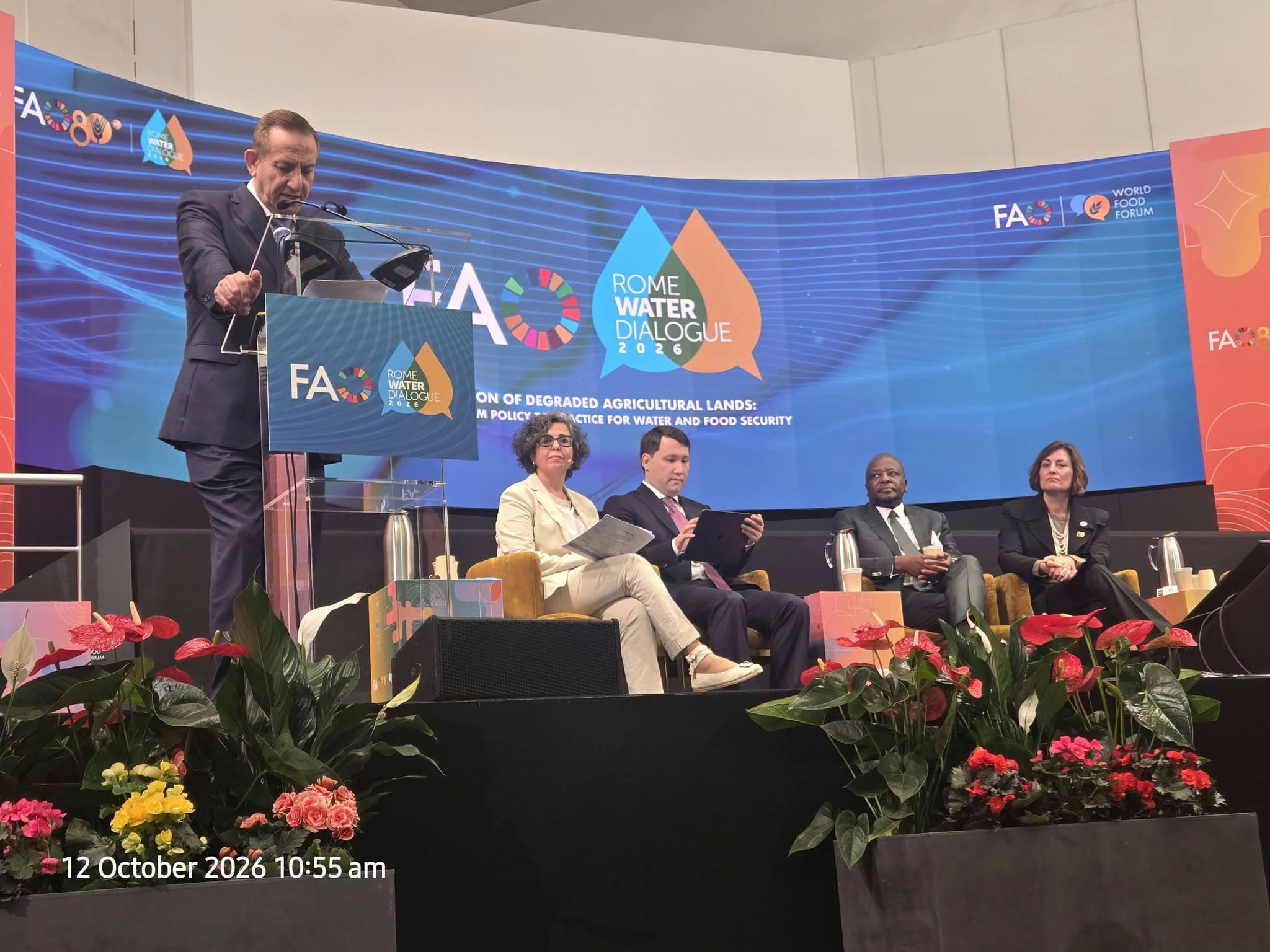
Kenya has unveiled an ambitious water infrastructure and agricultural transformation plan aimed at boosting food security, expanding irrigation and unlocking the economic potential of Arid and Semi-Arid Lands (ASALs).
Cabinet Secretary for Agriculture and Livestock Development Mutahi Kagwe announced the strategy while representing Kenya at the Rome Water Dialogue in Italy, where global stakeholders are discussing sustainable water management and the restoration of degraded agricultural ecosystems.
Speaking during a technical session on the Restoration of Degraded Agricultural Lands: Innovation from Policy to Practice for Water and Food, Kagwe said Kenya was positioning its ASAL regions as opportunities for sustainable agricultural investment rather than development challenges.
He noted that approximately 70 per cent of the country’s landmass is classified as arid and semi-arid, making investments in water harvesting, storage and irrigation critical to reducing dependence on rainfall.
To support the transformation, Kagwe said the government planned to use funding from the newly launched National Infrastructure Fund to develop 50 mega dams, 200 medium-sized dams and 1,000 small reservoirs and water pans.
The proposed infrastructure is intended to strengthen water security and support reliable, high-yield irrigation, reducing the vulnerability of farmers to increasingly unpredictable weather patterns.
Kagwe said the government would adopt a public-private partnership model in which the state develops dams and core irrigation infrastructure while supporting the branding and marketing of Kenyan agricultural produce.
Under the arrangement, private investors, local communities, farmer producer organisations and savings and credit cooperative societies would lead agricultural production, local value addition and exports.
The approach is expected to create employment, retain more wealth within the country and strengthen the competitiveness of Kenyan agricultural products in domestic and international markets.
The CS also highlighted the Land Commercialisation Initiative, which provides a framework for private investors to lease idle government and community trust land on a long-term basis for large-scale production of food, animal feed and fodder.
He said the government was also promoting technology-driven farming through digital soil-testing laboratories and last-mile soil advisory services to help farmers improve productivity.
Under the initiative, farmers would receive digital soil passports to facilitate access to subsidised agricultural inputs and artificial intelligence-powered advisory services tailored to their farming needs.
Kagwe said collaboration among the Kenya Agricultural and Digital Information Centre (KADIC), the Kenya Agricultural and Livestock Research Organisation (KALRO), county governments, women and young people would be essential to implementing the strategy.
The broader plan aims to quadruple agricultural production per unit, improve food self-sufficiency and reduce Kenya’s annual food import bill, estimated at 3.4 billion US dollars.
Reducing food imports would also help retain national income for domestic investment while expanding opportunities for farmers, agribusinesses and rural communities.
Kagwe linked the agricultural transformation agenda to Kenya’s 10-year initiative to plant 15 billion trees by 2032, saying environmental restoration and sustainable water management were essential to building resilient agricultural systems.
by Michael Omondi


Comments
No comments yet. Be the first to share your thoughts.